Why Poor Drainage Can Destroy Your Property (And Your Wallet)
Landscape drainage solutions are systems designed to redirect excess water away from your property. The right approach prevents standing water, soggy lawns, and basement leaks, saving you thousands in repairs while improving your property’s value and appearance.
Common landscape drainage solutions include:
Quick fixes – Gutter cleaning, downspout extensions, and soil aeration
Grading solutions – Regrading land, building swales, and creating berms
Underground systems – French drains, catch basins, and dry wells
Natural approaches – Rain gardens and dry creek beds
Improper grading is a major issue. A few inches of rain can produce nearly 10,000 gallons of runoff on a typical lot. Without proper drainage, this water cracks foundations, floods basements, kills plants, and creates mosquito breeding grounds.
The good news? Many drainage problems can be solved with DIY methods. More complex solutions like French drains typically range from $10 to $100+ per linear foot when professionally installed, while rain gardens cost about $5 to $20 per square foot for materials. Please note: All prices referenced are average ranges based on internet data and are not actual costs for McLeod Landscaping. High-end pricing is at least 3x the average.
The most critical rule: Your ground should slope away from your home’s foundation at 2 to 3 inches every 10 feet. This simple principle prevents water from pooling near your house.
I’m Scott McLeod of McLeod Landscaping. For over 30 years, I’ve helped clients solve drainage issues, from simple soggy spots to complex grading challenges. Landscape drainage solutions are key to protecting your property investment. Understanding your options is the first step to a drier, healthier landscape.
Why Proper Drainage is Non-Negotiable for Your Property
Imagine your home as a fortress and water as a persistent attacker. Without proper landscape drainage solutions, that attacker can cause costly damage. For us, ensuring your property in the Merrimack Valley is well-drained isn’t just about aesthetics; it’s about protecting your investment.
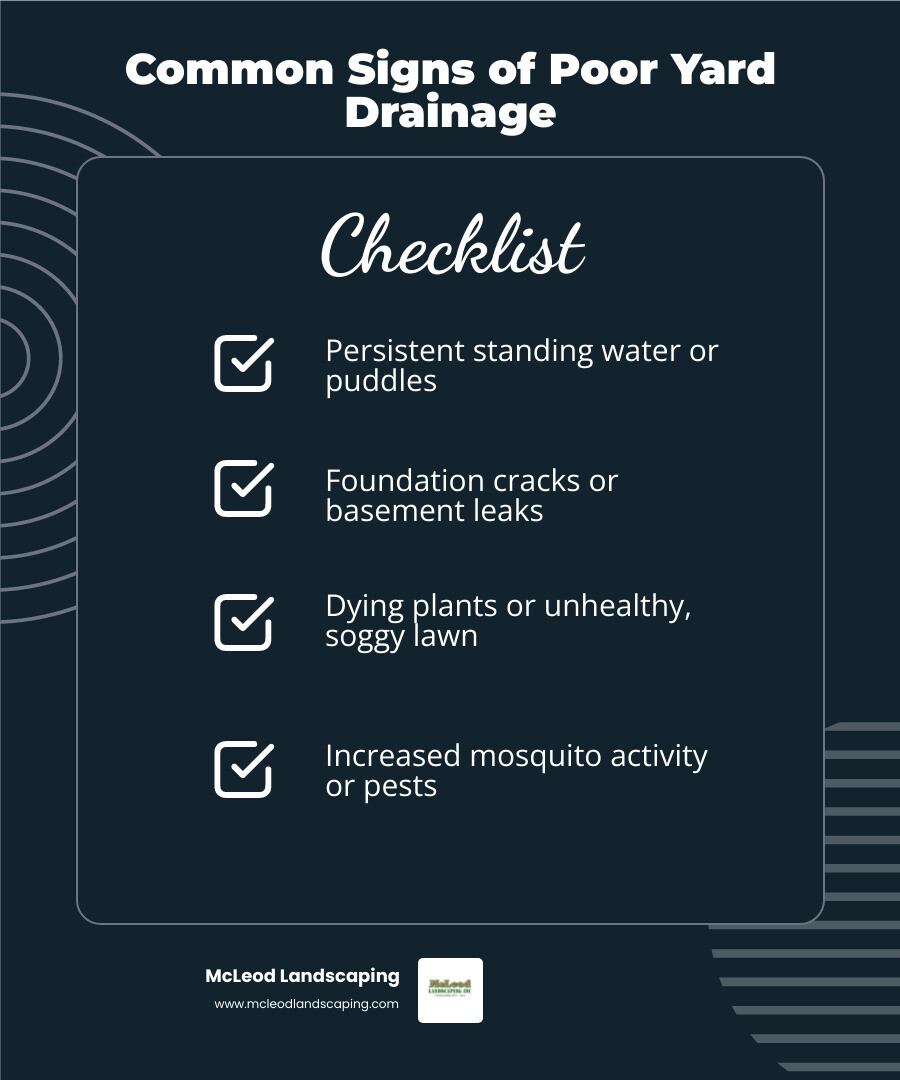
The consequences of poor drainage are far-reaching:
Foundation Damage: Saturated soil exerts immense pressure on your foundation, causing cracks and instability—an expensive, preventable fix.
Basement Leaks: Improper grading lets water seep into basements and crawl spaces, creating damp, mold-prone environments. A sump pump can help, but addressing the source is the real solution.
Soil Erosion: Uncontrolled runoff erodes topsoil, creating gullies and carrying pollutants into waterways.
Pest Breeding Grounds: Standing water breeds mosquitoes and other pests, making your yard unusable.
Property Usability: A muddy, squishy yard is unusable after rain, reducing your property’s enjoyment.
We understand you’ve worked hard to create a beautiful outdoor space. Protecting it with effective landscape drainage solutions is critical. As experts with over 30 years of experience, we’ve seen how crucial proper drainage is in the Andover, Billerica, Burlington, Carlisle, Chelmsford, Concord, Lowell, Tewksbury, Westford, and Wilmington areas.
Sometimes, the simplest solutions are the most effective. Before diving into major renovations, we recommend checking these quick, DIY-friendly fixes that can make a significant difference.
Clean Gutters and Add Downspout Extensions
Clogged or poorly aimed gutters are a common cause of drainage issues near foundations. When gutters overflow, they dump water right where you don’t want it.
Gutter Maintenance: Clean your gutters and downspouts at least twice a year to remove debris that blocks water flow. Ensure gutters are properly sloped towards the downspouts.
Downspout Extensions: Ensure downspouts direct water far from your foundation. Inexpensive flexible extensions are a simple DIY fix. For a permanent solution, bury corrugated tubes to carry water to a swale or other safe area. This is crucial for foundation protection.
Create a Rain Barrel System
Rain barrels manage runoff and conserve water, offering a clever landscape drainage solution.
Water Harvesting: Connect a barrel to a downspout to collect rainwater for your garden, reducing your water bill.
Reducing Runoff: A rain barrel system reduces stormwater runoff, easing the burden on other drainage systems. It’s an eco-friendly approach, but be sure to check local regulations in Massachusetts regarding rainwater collection.
Compacted soil prevents water absorption, causing pooling even with proper grading. Improving soil permeability is a key drainage solution.
Lawn Aeration: Lawn aeration creates small holes to break up compacted soil, allowing water to soak in rather than run off.
Loosening Compacted Soil: Amend dense clay soil with organic matter like compost to improve its structure and drainage. Use a tiller or hand tools to loosen compacted areas.
Professional Aeration Cost: While you can rent equipment, professional aeration for a large lawn can range from $200 to $850. Please note: All prices referenced are average ranges based on internet data and are not actual costs for McLeod Landscaping. High-end pricing is at least 3x the average.
Level 2: Reshaping Your Landscape for Better Flow
Sometimes, you need to reshape your property to guide water where you want it to go. These landscape drainage solutions involve altering your land’s topography to create natural pathways for water.
Method 6: Re-Grade the Land for Proper Slope
Proper grading is a fundamental but often overlooked landscape drainage solution. Ground sloping towards your foundation is a major problem.
Improper Grading: If your lawn isn’t graded properly, water will flow towards your house, causing standing water and potential basement leaks.
Correct Slope: The rule is a consistent slope of 2 to 3 inches every 10 feet away from the foundation. This gentle incline directs water away safely.
Directing Water Away: Minor issues can be fixed with a landscape rake. Significant changes require professional equipment and expertise for lasting results. Proper grading is a protective form of hardscaping.
Understanding how to measure and implement proper slope is critical. For more technical details, explore resources like Understanding Slope and How it’s Measured. You can also learn more about our hardscaping services that incorporate such essential grading.
Methods 7 & 8: Build a Swale or Berm
Swales and berms are excellent natural features for managing water flow.
Swale Construction: A swale is a shallow, vegetated channel that guides stormwater away from problem areas. It only needs a 1-inch drop every 10 feet to be effective, with gentle side slopes. Swales blend into the landscape and can direct water to a safe area or drain.
Berms for Redirection: Berms are raised mounds of soil that act as barriers to redirect water flow. They are a low-cost, low-maintenance way to manage water while adding visual interest to your yard.
Cost Considerations: A swale can cost approximately $5 to $15 per linear foot for a professional to build. Please note: All prices referenced are average ranges based on internet data and are not actual costs for McLeod Landscaping. High-end pricing is at least 3x the average.
These methods can be combined with retaining walls. Learn more about our retaining wall installation services.
Method 9: Install a Dry Creek Bed
Dry creek beds are an aesthetic and functional drainage solution that mimics a natural riverbed.
Aesthetic Drainage: They are an attractive feature when dry and become an active channel during rain, moving water away from sensitive areas.
Functional Decor: These features divert water, prevent erosion, and add visual interest, making them a popular landscape drainage solution.
Gravel and Rocks: A trench is dug, lined with landscape fabric, and filled with gravel and rocks. This creates an efficient, natural-looking channel for water.
Cost Considerations: A dry creek bed costs approximately $3 to $10 per square foot for materials. Please note: All prices referenced are average ranges based on internet data and are not actual costs for McLeod Landscaping. High-end pricing is at least 3x the average.
When surface solutions aren’t enough, it’s time to consider advanced landscape drainage solutions that often involve underground components.
Method 10: Install a French Drain
The French drain is a classic, highly effective landscape drainage solution for collecting and redirecting water.
Underground Drainage: A French drain is a gravel-filled trench with a perforated pipe that collects and redirects surface and groundwater. It’s ideal for soggy areas and protecting foundations.
Perforated Pipe & Gravel Trench: Installation involves digging a trench, lining it with landscape fabric, adding gravel, placing a perforated pipe (holes down), covering with more gravel, and then backfilling. Water seeps into the gravel and is carried away by the pipe.
Water Collection & Redirecting Groundwater: The pipe needs at least a 1% grade (1/8 inch drop per foot) to flow properly. A 4-inch perforated pipe is standard for residential use, with smooth PVC often preferred for its durability.
Cost Considerations: A French drain can cost between $10 to $100 per linear foot to install. Please note: All prices referenced are average ranges based on internet data and are not actual costs for McLeod Landscaping. High-end pricing is at least 3x the average.
Methods 11 & 13: Use Catch Basins and Channel Drains
Catch basins and channel drains are excellent for managing heavy runoff from hardscapes like driveways and patios.
Surface Water Runoff: Impervious hardscapes create significant runoff, which can cause pooling and erosion.
Channel Drains: These are linear grated drains installed in paved areas. They intercept water over a wide surface and direct it to drain pipes.
Catch Basins: These are grated drains installed at low points or under downspouts. They capture stormwater and funnel it into an underground pipe system to prevent pooling.
A dry well is an effective, eco-friendly way to manage stormwater on-site.
Underground Water Storage: A dry well is an underground pit filled with rock that collects water from drains and downspouts.
Water Percolation: The collected water slowly soaks into the surrounding soil, recharging groundwater and reducing strain on storm drains.
Collecting Runoff: A dry well acts as a collection point for other yard drainage methods, especially if you lack a convenient downhill discharge point.
Dry Well Installation Cost: A professionally installed dry well can cost between $1,500 and $5,000. Please note: All prices referenced are average ranges based on internet data and are not actual costs for McLeod Landscaping. High-end pricing is at least 3x the average.
Rain gardens are beautiful, sustainable landscape drainage solutions that use nature to manage stormwater.
Natural Landscape Drainage Solutions: A rain garden is a shallow depression with water-loving native plants that captures and absorbs runoff from impervious surfaces.
Water-Loving & Native Plants: The garden’s plants and soil absorb water and filter pollutants. We select resilient native plants adapted to the Merrimack Valley that tolerate both wet and dry conditions.
Soil Absorption: The soil is often amended to improve absorption. Water slowly soaks into the ground, recharging groundwater.
Rain Garden Zones: Rain gardens use zones: moisture-loving plants like swamp milkweed at the base, moderately tolerant plants like blue flag iris on the slopes, and drought-tolerant plants like coneflower on the edges.
Cost Considerations: A DIY rain garden project costs about $5 to $20 per square foot for materials. Professionally installed rain gardens can range from $4 to $30 per square foot. Please note: All prices referenced are average ranges based on internet data and are not actual costs for McLeod Landscaping. High-end pricing is at least 3x the average.
Permeable pavements are an innovative landscape drainage solution that allows water to pass through, unlike traditional surfaces that create runoff.
Pervious Pavers & Porous Concrete: Materials include permeable pavers, porous concrete, and porous asphalt. They have a rigid but permeable surface.
Driveways and Walkways: Permeable pavers can be used for driveways, walkways, and patios. Water passes through to a base layer and then soaks into the soil.
Reducing Runoff & Groundwater Recharge: This reduces stormwater runoff, minimizes flooding, and helps recharge local groundwater supplies.
Cost Considerations: Pervious paving typically ranges from $8 to $30 per square foot. Please note: All prices referenced are average ranges based on internet data and are not actual costs for McLeod Landscaping. High-end pricing is at least 3x the average.
While many landscape drainage solutions can be DIY projects, there are times when calling experts is essential.
Project Complexity: For extensive problems, multiple affected areas, or complex designs (like properties with a high water table), professional help is invaluable.
Large-Scale Issues: If you have steep slopes (over 5% grade) or are near a cliff or septic system, consult a professional landscape expert or civil engineer.
Utility Lines:Always call 811 before you dig for any underground work. This free service marks underground utility lines to prevent dangerous and costly accidents.
Safety First: Digging deep trenches and moving large amounts of earth can be hazardous. Professionals have the right equipment and experience to complete the job safely.
Choosing the Right Solution: A professional assessment can identify the root cause of your drainage issues and recommend the most effective, cost-efficient long-term solution.
Guaranteed Results: Complex drainage systems require precise installation. Professionals can ensure proper grading and material selection, often providing guarantees for their work.
For large commercial properties in areas like Lowell and Chelmsford, professional guidance is almost always necessary. Learn more about our commercial property maintenance services, which include expert drainage solutions.
Frequently Asked Questions about Landscape Drainage
Here are some common questions we hear from clients in the Merrimack Valley:
What is the cheapest way to drain a yard?
The cheapest method depends on your specific problem.
Swales: These are often the least expensive professional option, typically ranging from $5 to $15 per linear foot.
Regrading: For minor issues, regrading your lawn with a landscape rake is a very low-cost DIY fix.
Downspout Extensions: Inexpensive plastic downspout extensions are a simple DIY solution to direct water away from your foundation.
DIY Yard Drains: Simple yard drains can often be installed by a DIYer for $30 to $100 per unit.
While DIY costs are low, professional installation ensures the job is done right, preventing more expensive problems later. Please note: All prices referenced are average ranges based on internet data and are not actual costs for McLeod Landscaping. High-end pricing is at least 3x the average.
What is the most effective landscape drainage solution?
The most effective solution is site-specific and depends on the problem’s type and severity.
Comprehensive Systems: Often, a combination of solutions is best. For example, proper grading combined with a French drain for subsurface water and catch basins for surface runoff.
French Drains: For collecting and redirecting subsurface water, French drains are highly effective.
Grading: Ensuring a proper slope away from your foundation (2-3 inches per 10 feet) is the most critical step for any effective drainage strategy.
Site-Specific Needs: A professional assessment is crucial to determining the most effective landscape drainage solutions for your unique needs.
How do I know if I have a drainage problem?
Your property will often show clear signs:
Standing Water: Puddles that linger for hours or days after rain.
Soggy Soil: Areas that remain squishy underfoot long after it has rained.
Foundation Moisture: Water stains, musty smells, or dampness in your basement or crawl space.
Plant Death: Plants that consistently look unhealthy or die in specific areas may be suffering from excessive moisture.
Soil Erosion: Visible gullies or washed-out mulch indicate that water is running off too quickly.
Soil Test: Dig a 2-foot deep hole and fill it with water. If it takes more than 12-24 hours to drain, you have a serious drainage problem.
Conclusion
Effective landscape drainage solutions protect your home, preserve your landscape, and improve your quality of life. From simple fixes to complex systems and beautiful rain gardens, a drier, healthier property is achievable.
Understanding your options and knowing when to call a professional will safeguard your investment. McLeod Landscaping serves the Merrimack Valley, providing the expertise and comprehensive services needed to solve your drainage challenges. We create beautiful, functional, and resilient outdoor spaces, turning soggy headaches into sources of pride and enjoyment.
Ready to protect your property from water damage? Explore our hardscaping services and let us help you design and implement the perfect landscape drainage solutions.
Contact Us Today
Contact McLeod Landscaping today at (978) 640-0957 or click here to schedule a consultation for retaining wall installation. Let our experienced team design and install a functional and visually appealing retaining wall that enhances your landscape.