
If you’ve been browsing back deck roof ideas, here’s a quick overview of the most popular options to help you decide what’s right for your space:
Most Popular Back Deck Roof Types at a Glance
| Roof Style | Best For | Coverage Level |
|---|---|---|
| Gable | Classic homes, ventilation, aesthetics | Full |
| Lean-to (shed) | Budget builds, simple framing | Full |
| Flat roof | Modern/minimalist homes | Full |
| Pavilion | Year-round entertaining | Full |
| Pergola | Partial shade, open-air feel | Partial |
| Awning/canvas | Budget-friendly, flexible | Partial |
A covered back deck does more than block rain. It extends your usable outdoor living space into a true second living room — one you can enjoy through spring showers, summer heat, and crisp fall evenings.
The difference between a deck you use three months a year and one you use year-round often comes down to one thing: a roof over your head.
Based on average internet data, costs can range from around $2,000 for a basic canvas or corrugated panel cover all the way up to $60,000 or more (with high-end custom builds reaching at least three times the average project cost) for a fully equipped covered outdoor space with a kitchen and fireplace. Please note that these are average costs based on internet data and do not represent actual costs for McLeod Landscaping. That wide range means there’s a realistic option for almost every budget.
Adding a roof also makes financial sense. A well-designed covered deck can deliver an ROI of 40–65%, and some estimates suggest it can add 8–10% to your home’s overall value.
I’m Scott McLeod, owner of McLeod Landscaping, and after more than 30 years designing and building outdoor living spaces across the Merrimack Valley, I’ve helped hundreds of homeowners evaluate back deck roof ideas that fit both their lifestyle and their home’s architecture. Below, I’ll walk you through everything you need to know to make a smart, informed decision.
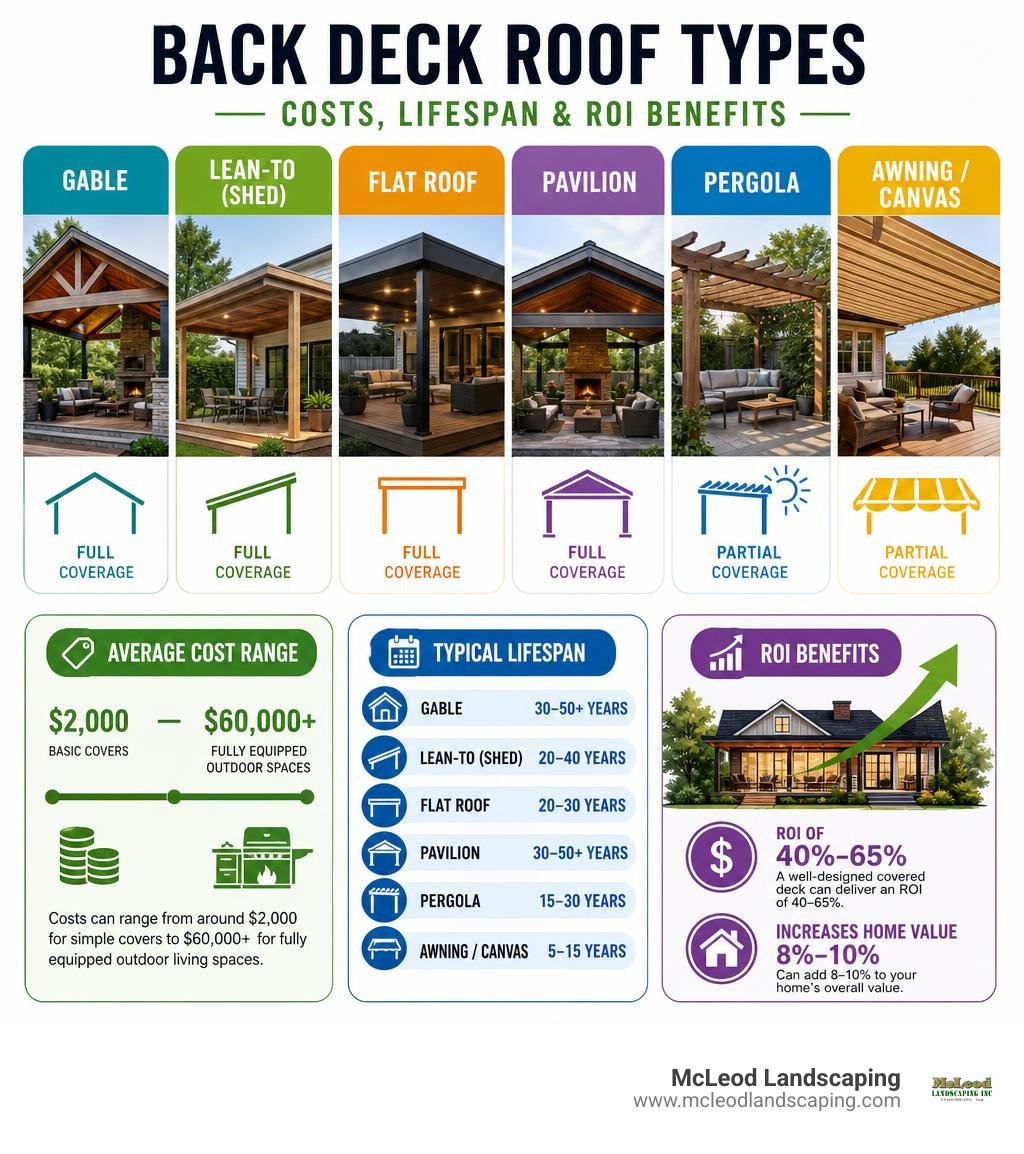
Simple guide to back deck roof ideas terms:
When planning a roof for your deck, matching the architectural style of your home is crucial. A mismatched roof can look like an afterthought, which hurts your home’s curb appeal. On the other hand, a seamless extension elevates your entire property.

Depending on your home’s existing roofline, you have several beautiful structural options to consider. For inspiration on how to layout your entire backyard retreat, take a look at our guide to 75 Beautiful Back Porch Designs.
A gable roof—characterized by its classic triangular shape—is one of the most popular choices for homeowners in the Merrimack Valley. Because it features two sloping sides that meet at a ridge, it creates a vaulted ceiling underneath.
This high, vaulted ceiling offers several distinct advantages:
To customize this look, many homeowners opt to leave the timber framing exposed on the inside, creating a rustic, cabin-like feel. If you prefer a more polished look, you can finish the ceiling with tongue-and-groove cedar or beadboard. For visual inspiration on how these structures look in real backyards, check out these Back Deck with Roof Ideas – Pinterest.
If you prefer clean lines and minimalist design, or if you are working with a tight budget, flat and lean-to (shed) roofs are excellent options.
A lean-to (or shed) roof features a single sloping surface attached to the side of the house. It is highly practical and one of the most cost-effective framing designs to build. Because of its straightforward design, a lean-to roof drains water away from your home efficiently. It works beautifully on modern homes, transitional styles, or simple ranch houses.
A flat roof offers an ultra-modern, low-profile aesthetic. While not completely flat (it must have a slight pitch of at least 1/4 inch per foot to shed water), it creates a sleek, horizontal plane that looks fantastic with contemporary architecture. To learn more about how these structures are attached and framed, review our comprehensive Covered Porch Construction Guide.
If you want a structure that stands out or provides a distinct zone in your yard, pavilions and pergolas are highly versatile options.
The materials you choose for your deck roof will dictate its lifespan, required maintenance, and overall cost. In New England, materials must be durable enough to withstand heavy snow loads, freezing winters, and hot, humid summers.
To help you visualize how different materials fit into your overall landscaping, read our guide on Backyard Patio and Deck Designs. Below is a comparison of the most common deck roof materials:
| Material | Average Lifespan | Pros | Cons | Maintenance Level |
|---|---|---|---|---|
| Wood (Cedar/PT) | 20–30 Years | Natural beauty, highly customizable, strong | Needs regular staining, can rot or warp | High |
| Asphalt Shingles | 20–30 Years | Matches house roof, cost-effective, durable | Heavy, blocks all natural light | Low |
| Polycarbonate | 15–25 Years | Blocks UV rays, lets in light, lightweight | Can scratch, can look less traditional | Very Low |
| Aluminum | 30–40+ Years | Extremely durable, rust-proof, low weight | Can be noisy in heavy rain, higher cost | Low |
For a classic, high-end look, traditional wood framing paired with asphalt shingles is hard to beat.
Pressure-treated lumber is the standard choice for the structural framing due to its resistance to rot and insects. For the visible elements—such as the posts, beams, and ceiling—cedar or redwood is highly recommended. These woods offer gorgeous natural grain patterns and naturally resist decay.
Covering the structure with asphalt shingles that match your home’s main roof creates a highly cohesive, permanent look. This combination provides excellent insulation against heat and sound, meaning you won’t hear the deafening roar of rain on a metal roof. However, keep in mind that wood structures require periodic painting, staining, or sealing every few years to keep moisture at bay.
For homeowners seeking a low-maintenance, modern alternative, aluminum frames and polycarbonate panels have become incredibly popular in 2026.
Polycarbonate panels are engineered polymers that are virtually unbreakable. They offer several unique benefits:
When paired with a heavy-duty, powder-coated aluminum frame, you get a structure that will never rust, warp, rot, or require painting. Many modern kits feature a standing seam design, meaning no screws penetrate the roof panels, ensuring a 100% leakproof seal. If you want to purchase a ready-to-assemble kit with these exact specifications, consider the Roof for Back Porch Kit – 20% Off + Free Shipping.
Before any construction begins, you must decide how the roof will be supported structurally. This choice impacts your budget, your deck’s structural requirements, and local building permit approvals.

Whether you choose an attached or freestanding design, our team at McLeod Landscaping can help you plan the perfect layout. Explore our Deck and Patio Services to see how we integrate these structures into cohesive outdoor living plans.
A ledger-attached roof is bolted directly to the framing of your house using a heavy wooden board called a ledger.
This is the most common method for adding a roof to a deck because it requires fewer support posts on the outside edge, maintaining an open view of your yard. However, because the roof is physically tied to your home, proper installation is critical to prevent structural damage.
If your home’s siding, window placement, or architectural layout makes attaching a ledger difficult, a freestanding roof is the ideal solution.
A freestanding roof stands entirely on its own support posts, which are anchored to deep concrete footings. This design completely eliminates the risk of water intrusion into your home’s framing. However, it does require more posts, which can slightly obstruct views or deck space.
If you are dealing with a second-story deck, structural engineering becomes even more critical. You cannot simply build a heavy roof on top of an existing deck without verifying that the posts, beams, joists, and footings can handle the massive added “dead load” (the weight of the roof itself) and “live load” (such as heavy winter snow accumulation).
For a complete planning checklist for elevated structures, refer to the Covered Second Story Deck With Roof: Your Complete Planning and Building Guide for 2026 – Ifwewereroommates.
Adding a roof to your deck is a major home improvement project that requires careful financial planning and strict adherence to local building codes.
If you are looking for professional assistance to design, permit, and construct your cover, you can easily find local experts through our Patio Cover Contractors Near Me directory.
Please note that the prices discussed in this section are average costs based on national internet data and do not represent actual pricing for custom projects by McLeod Landscaping.
The total cost of building a deck roof varies wildly depending on the size, materials, roof style, and whether you hire a professional or take the DIY route. Here is a general breakdown of what homeowners typically spend, showing a wide range where the high end is at least three times the average pricing of a standard installation:
Key factors that influence your overall price include structural engineering fees, building permit costs, material choices (composite and cedar cost more than pressure-treated wood), and electrical hookups for fans and lights. For a deeper dive into regional cost expectations, check out our Covered Patio Builders Local Guide.
If you are an experienced DIYer looking to save on labor costs, there are several approachable ways to cover your deck. Using pre-fabricated aluminum and polycarbonate kits is highly popular because they come with pre-cut pieces and detailed instructions.
Another fantastic budget-friendly project is building an under-deck drainage system. If you have an elevated, second-story deck, the space underneath is often wasted because water drips through the deck boards whenever it rains.
By installing sloped purlins, custom-cut spacer blocks, and inexpensive corrugated fiberglass panels beneath the upper deck’s joists, you can catch that rainwater and channel it to a gutter system. This instantly creates a dry, shaded patio space underneath for a fraction of the cost of building a new roof. Learn exactly how to execute this project with the step-by-step guide on How to Build an Under-Deck Roof (DIY) | Family Handyman
To help you finalize your plans, we’ve answered some of the most common questions homeowners ask when exploring back deck roof ideas. For additional advice on selecting the right team for your build, read our guide on Finding Expert Covered Patio Builders.
Yes. In almost all municipalities throughout the Merrimack Valley—including Billerica, Burlington, Chelmsford, and Tewksbury—adding a permanent roof structure over an existing or new deck requires a building permit.
Because a roof adds significant weight and must withstand wind uplift and heavy snow loads, local building departments must review your structural plans to ensure safety. Additionally, the finished structure will need to pass building inspections. Failing to secure a permit can result in heavy fines and can prevent you from selling your home in the future.
An insulated, high-quality covered deck is an excellent investment. On average, you can expect a return on investment (ROI) of 40% to 65%.
Beyond the strict financial return, covered decks act as “semi-conditioned” spaces. Home appraisers and buyers in 2026 view these highly functional outdoor living rooms as a major selling point, often increasing a home’s overall market value by 8% to 10%.
The easiest and most budget-friendly permanent roof to construct is a lean-to (or shed) roof. It features a single slope, requires simple framing, and attaches directly to your home’s ledger.
If you want a non-permanent, budget-friendly option, look into retractable canvas awnings or heavy-duty fabric shade sails. While they don’t handle winter snow loads and must be taken down or retracted during storms, they provide excellent sun protection for a fraction of the cost.
Transforming your backyard with a beautiful, functional deck roof is one of the best ways to elevate your lifestyle and add lasting value to your home. Whether you love the dramatic, vaulted look of a timber-framed gable roof, the sleek lines of a modern aluminum cover, or the versatility of a freestanding pavilion, there is a design out there that fits your home perfectly.
At McLeod Landscaping, we have spent over 30 years helping homeowners across the Merrimack Valley—from Andover and Westford to Lowell and Wilmington—bring their outdoor dreams to life. While we specialize in commercial landscaping, our residential hardscaping team is second to none when it comes to designing and installing custom patios, outdoor kitchens, fire pits, and surrounding hardscapes that pair beautifully with your new covered deck.
Ready to take your backyard to the next level? Transform your backyard with McLeod Landscaping’s expert patio design services and let us help you build a stunning outdoor retreat you’ll enjoy for decades to come!
Contact McLeod Landscaping today at (978) 640-0957 or click here to schedule a consultation for retaining wall installation. Let our experienced team design and install a functional and visually appealing retaining wall that enhances your landscape.


1881 Main St Unit 1, Tewksbury, MA 01876