
An automatic lawn irrigation system is a network of underground pipes, sprinkler heads, and controllers that waters your lawn according to a preset schedule, eliminating manual watering. Here’s what you need to know:
Are you tired of dragging hoses across your lawn or forgetting to water during hot summer days? An automatic lawn irrigation system solves these common headaches while potentially reducing your water consumption by up to 50% compared to manual watering methods. By delivering the right amount of water exactly where and when it’s needed, these systems not only save you time and effort but also promote healthier turf growth with deeper root systems.
Properties with extensive irrigation can spend as much as 30% of their water bill on landscape watering. A properly designed automatic system can dramatically reduce this expense while maintaining or even improving your lawn’s appearance. Modern systems range from simple timer-based controllers to sophisticated smart systems that adjust watering schedules based on weather forecasts, soil moisture levels, and seasonal needs.
I’m Scott McLeod, founder of McLeod Landscaping with over 30 years of experience designing and installing automatic lawn irrigation systems throughout the Merrimack Valley. My team has helped hundreds of property owners conserve water while maintaining beautiful, healthy landscapes through properly designed irrigation solutions.
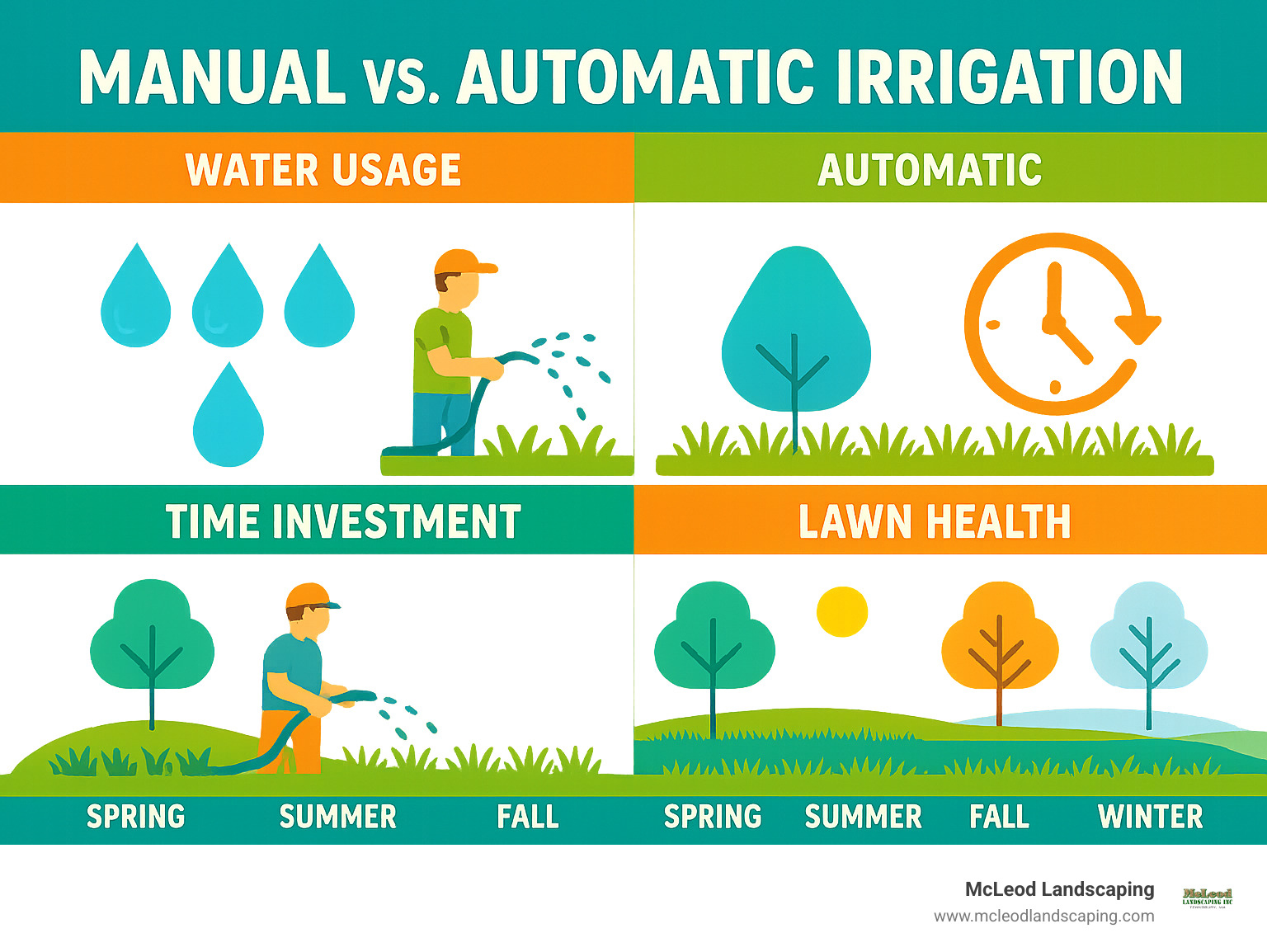
Automatic lawn irrigation system terms simplified:
– drip irrigation systems
– how much do lawn irrigation systems cost
– irrigation sprinkler
Ever wondered how your neighbor’s lawn stays lush and green with seemingly no effort? The secret lies in an automatic lawn irrigation system – your landscape’s best friend that waters precisely when and where needed, all while you sit back and relax.
Think of your irrigation system as a team of hardworking components that collaborate behind the scenes. The controller (or timer) serves as the captain, sending signals to valves that control water flow through underground pipes. These pipes deliver water to strategically placed sprinkler heads that pop up like magic to water your lawn, then disappear when their job is done.
The beauty of an automatic lawn irrigation system goes far beyond convenience. One homeowner I worked with in Tewksbury reclaimed five hours weekly that she previously spent dragging hoses around her yard. But the benefits extend much further:
Water bills often shrink dramatically, with properly designed systems cutting water usage by up to 50% compared to manual methods. This happens because automatic systems deliver water directly to root zones with minimal waste from runoff, evaporation, or overwatering.
Your grass actually grows healthier with consistent, properly timed watering. This promotes deeper root growth and creates turf that stands strong against drought conditions. Plus, there’s that undeniable curb appeal of a perfectly maintained lawn that boosts your property’s value.
Agricultural research confirms these benefits aren’t just marketing talk. Studies on automatic irrigation consistently show these systems reduce labor requirements while decreasing water and nutrient runoff compared to manual watering methods.
The “automatic” in your system comes from several clever technologies working in harmony. Programmable timers form the foundation, allowing you to set specific watering schedules for different zones. Built-in pressure regulators ensure water flows evenly throughout your system, preventing wasteful misting and ensuring complete coverage.
When it rains, rain delay features kick in to prevent your system from watering unnecessarily. For tricky areas like slopes or clay soil, cycle-soak scheduling breaks watering into shorter intervals, giving water time to absorb between cycles rather than running off.
The most advanced systems incorporate evapotranspiration calculations – a fancy term for measuring how much water plants lose through evaporation and transpiration. These smart systems adjust watering times based on temperature, humidity, solar radiation, and wind data, ensuring your lawn gets exactly what it needs regardless of weather conditions.
What makes this truly remarkable is that once set up properly, these adjustments happen automatically without you lifting a finger, even adapting to seasonal changes throughout the year.
Every effective automatic lawn irrigation system relies on several key components working together seamlessly:
Your controller/timer serves as the system’s brain, determining when each zone operates and for how long. Modern options range from simple programmable timers to sophisticated smart controllers that integrate with weather services.
Valves act as gatekeepers, controlling water flow to different landscape zones. They’re typically housed in protective valve boxes for easy maintenance access when needed.
The visible stars of the show are your sprinkler heads, which come in several varieties. Pop-up rotors work best for larger lawn areas, rotating to distribute water in patterns from 40° to a full 360°. Spray heads deliver fixed spray patterns perfect for smaller areas, while drip emitters provide slow, direct watering for gardens and plant beds.
Safety components are equally important. The backflow preventer ensures irrigation water never flows back into your home’s drinking water supply – a critical health protection. Many professional systems also include a master valve that remains closed when the system isn’t running, providing an extra layer of protection against leaks.
Rain and moisture sensors add intelligence to your system, detecting rainfall or checking soil moisture levels to prevent unnecessary watering. All these components connect through an underground network of pipes and fittings, typically made of durable PVC or polyethylene.
For smart systems, a Wi-Fi hub connects your irrigation controller to the internet, enabling remote access from your phone and integration with local weather data.
To see exactly how these components work together in harmony, check out our detailed article on How Does a Lawn Sprinkler System Work?
Choosing the right automatic lawn irrigation system is a bit like picking a new smartphone—do you go with the reliable basic model that gets the job done, or spring for the fancy version with all the bells and whistles? Let’s break down your options in a way that makes sense for your lawn and your lifestyle.
Think of traditional irrigation systems as the trusty pickup trucks of the watering world—reliable, straightforward, and they get the job done without a lot of fuss. These systems run on schedules you set, rain or shine (unless you’ve added a simple rain sensor to prevent watering during downpours).
With a traditional system, you’ll program your watering schedule manually and make adjustments as the seasons change. Many homeowners appreciate their simplicity—fewer technical components mean fewer things that can go wrong. They’re also generally more budget-friendly upfront and work particularly well in areas where the weather follows predictable patterns.
The Rain Bird 32ETI Easy to Install Automatic Sprinkler System represents this category well. It’s designed for DIY installation and covers medium-sized lawns from 1,000 to 3,000 square feet with standard residential water pressure. Its professional-grade pop-up rotary sprinklers distribute water evenly across your lawn, giving you professional results without the complexity.
Smart irrigation systems are the tech-savvy cousins in the irrigation family. They’re designed for homeowners who want precision, convenience, and maximum water efficiency.
The magic of smart systems lies in their connectivity. They tap into local weather data to automatically adjust your watering schedule based on rainfall predictions, temperature changes, and seasonal shifts. You can control everything from your smartphone, whether you’re relaxing on your couch or vacationing across the country. Many systems will even send alerts to your phone if they detect a leak or broken sprinkler head, automatically shutting down to prevent water waste and potential property damage.
For the tech enthusiasts among us, most smart systems work with voice assistants like Amazon Alexa or Google Home, so you can say, “Hey Google, skip tomorrow’s watering,” and consider it done. Many also provide detailed reports on water usage, helping you track consumption and savings over time.
Innovative systems like OtO and Irrigreen take efficiency to another level with programmable zone shapes and precision technology. Irrigreen, for example, “prints” water only where it’s needed rather than spraying indiscriminately, dramatically reducing waste on sidewalks and driveways. One of our customers switched to a smart system and saw their summer water bill drop by nearly 30% while maintaining a healthier lawn.
Want to learn more about these high-tech options? Check out our article on The Benefits of Installing a Smart Irrigation System in Your Home.
Already have a traditional system but feeling a bit of smart-system envy? Good news—you don’t need to start from scratch. Consider these upgrades that offer significant returns on investment:
A smart controller retrofit is the easiest place to start. Swap out your existing controller for a smart version to gain weather-based scheduling capabilities. This simple change can reduce water usage by 10-15% right away.
Adding soil moisture sensors takes efficiency a step further by monitoring actual ground conditions. These clever devices prevent watering when your soil already has adequate moisture, potentially saving an additional 10% on water usage.
Features like wind skip technology found in systems like OtO prevent watering during breezy conditions when much of your water would be lost to drift and evaporation—a small feature with big savings potential.
Zone mapping capabilities allow you to customize programming for different areas of your landscape based on plant type, sun exposure, and soil conditions. Your front lawn, backyard shade garden, and sunny perennial bed all have different needs—zone mapping ensures each area gets precisely what it requires.
Perhaps the most valuable upgrade is flow monitoring and leak detection. One of our customers received an alert from their smart controller about unusual water flow at 2 a.m., allowing them to shut off the system and address a broken pipe before it could cause serious damage to their property. That single incident saved them thousands in potential repair costs and prevented significant water waste.
Not quite ready to commit to a full in-ground system? Several alternatives offer automation benefits without the commitment or expense:
Hose-end timer systems attach to your outdoor faucets and can be programmed to water at specific times. Add a splitter, and you can run multiple zones from a single faucet. These simple devices bring automation to traditional hose-and-sprinkler setups for minimal investment.
Portable above-ground systems use impact sprinklers or shrub misters on stakes connected to programmable timers. These can be set up without any digging and moved as needed. One resourceful homeowner I worked with created a modular system using three four-way splitters, multiple timers, and strategically placed sprinklers for under $500, covering their entire property.
For the technically inclined, Arduino-based DIY systems offer remarkable flexibility. Using microcontrollers, soil moisture sensors, and solenoid valves, these DIY Automated Watering Systems can be built for as little as $50-$100. They’re perfect for specific applications like container gardens or greenhouse irrigation.
Many homeowners find success with hybrid solutions that combine professional in-ground systems for main lawn areas with DIY solutions for gardens or remote areas of the property.
The OtO smart sprinkler represents an interesting middle ground—it’s a portable device that connects to a standard garden hose but offers smart features like custom zone mapping, weather integration, and app control. With a 30-foot radius covering up to 2,800 square feet per unit, it bridges the gap between simple hose timers and full in-ground systems.
At McLeod Landscaping, we’ve helped hundreds of homeowners in the Merrimack Valley find the right automatic lawn irrigation system for their needs—whether that’s a full professional installation or advice on DIY options that complement their existing setup.
Turning your dream of a lush, effortlessly maintained lawn into reality starts with thoughtful planning. Creating an automatic lawn irrigation system isn’t just about placing sprinklers randomly—it’s about crafting a custom solution that works with your unique landscape.
Before you sketch a single sprinkler head, you’ll need to understand what you’re working with. I always tell my clients that a thorough site assessment saves headaches (and money) down the road.
Start by checking your water pressure and flow rate—these numbers determine how many sprinkler heads can run at once. Most homes need at least 40-75 PSI and 6-10 GPM for effective irrigation. Too little pressure, and you’ll get sad little sprinkles instead of proper coverage.
Next, grab a measuring tape and map out your lawn dimensions. Those unusual shapes and narrow strips between driveways and fences? They need special attention to avoid dry spots or wasteful overspray. While you’re at it, mark any obstacles like trees, patios, or utility lines that will affect where sprinklers can go.
Pay close attention to sun patterns too. That shady north side of your house might need half the water of your sun-baked front lawn. And don’t forget about slopes—they’re notorious for causing runoff unless your system is designed with cycle-soak programming to give water time to absorb.
Before you dig, check with your local Massachusetts municipality. Many towns in the Merrimack Valley have specific requirements for permits, backflow prevention, and water conservation measures that must be addressed in your planning.

With your measurements in hand, it’s time to create your irrigation blueprint. Draw your property to scale, including all the features that matter—your house footprint, driveway, walkways, garden beds, and lawn areas.
Think of your yard as a collection of microclimates. That sunny south-facing slope needs different watering than your shaded garden bed. Mark these areas clearly, as they’ll become your irrigation zones based on:
Plant water needs (thirsty annuals vs. drought-tolerant shrubs), sun exposure (full sun areas typically need more frequent watering), soil type (sandy soils drain quickly while clay holds water longer), and slope considerations (areas with significant grade should be on separate zones to prevent runoff).
When placing sprinkler heads, remember the golden rule of irrigation design: head-to-head coverage. Each sprinkler should spray far enough to reach adjacent heads, typically spacing them at 50-60% of their diameter rating. This overlap ensures even watering without dry spots.
Most residential rotary sprinklers cover between 15-35 feet in radius. Use this information to calculate how many heads you’ll need for complete coverage without wasting water on sidewalks or driveways.
For more guidance on selecting the perfect system for your specific conditions, check out our detailed guide on Best Irrigation System for Lawns.
The age-old question: tackle it yourself or call in the pros? Both approaches have their merits.
DIY installation works best for smaller, simpler layouts and can save on labor costs if you have basic plumbing and electrical knowledge. However, be prepared to dedicate 2-4 weekends to the project, and understand that manufacturers typically only warranty the components, not the installation.
Professional installation brings expertise that often pays for itself. A skilled designer will optimize your system for maximum efficiency, select the appropriate heads for each area, ensure compliance with local codes, and typically complete the job in just 1-3 days. You’ll also receive comprehensive warranties covering both parts and labor.
In my 30+ years with McLeod Landscaping serving the Merrimack Valley, I’ve seen countless DIY systems that eventually required professional intervention. While the DIY route can be rewarding for some, professional design often pays dividends through water savings, system longevity, and peace of mind.
When budgeting for an automatic lawn irrigation system, it helps to understand the range of options available.
DIY above-ground systems start around $200-$1,000 for basic timer and hose-based setups, while more comprehensive DIY in-ground kits typically run $1,000-$3,000 (plus any tools you might need to purchase).
Professional in-ground systems generally range from $3,000-$10,000 for typical residential installations, with variables including property size and shape, zone requirements, controller type, sprinkler head selection, soil conditions, obstacles, and backflow prevention requirements.
If you already have an irrigation system but want to upgrade to smart technology, smart controller retrofits typically cost between $200-$600 plus installation if needed, offering significant functionality improvements without replacing your entire system.
The return on investment for a properly designed system is impressive—expect water savings of 30-50% compared to manual watering, reduced landscape replacement costs due to healthier plants, and time savings of 3-5 hours per week during the growing season. Many local water authorities also offer rebates for water-efficient systems.
It’s worth noting that these figures represent internet averages based on national data and not actual costs for McLeod Landscaping services. Local factors in the Merrimack Valley region, including soil conditions, municipal requirements, and property specifics, can significantly impact final pricing.
A well-designed automatic lawn irrigation system is an investment that pays dividends in time, water conservation, and landscape health for years to come. Whether you choose the DIY route or professional installation, taking the time to plan properly will ensure the best results for your lawn and your wallet.
Keeping your automatic lawn irrigation system running smoothly requires some regular attention, especially in New England where our dramatic seasonal changes can impact system performance. Think of your irrigation system like a car—with proper maintenance, it’ll serve you reliably for many years, but neglect it and you’ll face frustrating breakdowns and costly repairs.
The changing seasons in the Merrimack Valley demand specific care routines for your automatic lawn irrigation system. Let’s walk through the year together:
When spring arrives in April and May, it’s time for system wake-up. Start by slowly turning on your main water supply—rushing this step can create a water hammer effect that damages pipes. Next, pop open those valve boxes to check for any unwelcome winter visitors or debris. Spring is also perfect for inspecting and cleaning your sprinkler heads, which often collect soil and debris during winter months.
Take time to run each zone separately, watching for proper coverage and potential leaks. Finally, reprogram your controller for spring’s unique watering needs—plants are actively growing but temperatures are still moderate, so they typically need less water than in summer.
During the summer months of June through August, your system works hardest. Monthly head inspections prevent coverage gaps caused by clogged nozzles or misaligned sprayers. As your landscape grows, you might need to adjust spray patterns to accommodate taller plants or expanding shrubs. This is also when you’ll appreciate a smart controller that automatically adjusts to our sometimes unpredictable New England summer weather patterns.
As fall approaches in September and October, your irrigation needs change again. Cooler temperatures and more frequent natural rainfall mean your system should run less often. This is a great time to clean filters, check valve operation, and clear any accumulated debris from sprinkler heads before winterization.

Perhaps the most critical maintenance task for Merrimack Valley homeowners is proper winterization before the first hard freeze. This process includes shutting off the water supply, draining water from components (especially backflow preventers), and using compressed air to blow remaining water from pipes. Any water left in the system can freeze, expand, and crack pipes or damage expensive components. While some systems advertise “self-draining” features, professional blow-out service provides the most reliable protection against freeze damage in our harsh New England winters.
Even well-maintained systems occasionally develop issues. Here’s how to handle the most common problems without immediately calling for help:
When you notice clogged sprinkler heads creating uneven spray patterns or reduced coverage, the fix is usually simple. Turn off your system, lift the pop-up portion of the head, and remove the internal assembly. A thorough rinse to remove dirt, grass clippings or tiny pebbles often solves the problem. This five-minute fix can save you a service call and ensure your lawn receives even coverage.
Low pressure issues often reveal themselves through weak spray patterns and reduced coverage distance. Before assuming the worst, check for partially closed valves—sometimes a valve gets bumped to a partially closed position during yard work. Also inspect for obvious leaks creating wet spots in your lawn. If these quick checks don’t solve the problem, you might have too many heads operating simultaneously on a single zone, which dilutes your available pressure.
When an entire zone fails to activate, start troubleshooting at your controller. Verify the programming is correct and the zone hasn’t been accidentally turned off or set to “skip.” If programming looks good, you might have a faulty valve solenoid or broken wire connection. You can test the valve manually by turning the solenoid (the small cylindrical part on top of the valve) a quarter turn counterclockwise. If water flows when manually operated but not when signaled by the controller, you’ve narrowed the problem to either the solenoid or the wiring.
For controller operation problems where no zones activate or the display is blank, start with the basics—check for power outages or tripped circuit breakers. If power is flowing to the outlet but your controller remains dead, the transformer might have failed. Most controllers use simple plug-in transformers that can be easily replaced.
Leaking valves typically show themselves through water pooling near valve boxes or zones running when not scheduled. This usually happens when debris prevents the valve from closing completely or when the internal diaphragm becomes damaged. Fixing this requires shutting off the water supply, disassembling the valve, and either cleaning or replacing the internal components.
For more detailed guidance on solving these and other common issues, check out our comprehensive article on Sprinkler System Troubleshooting: Common Issues and Solutions.
1. How often should my system run in New England summers?
For established lawns in our Merrimack Valley region, we typically recommend watering 2-3 days per week during peak summer months. Early morning watering between 4-7 AM minimizes evaporation while giving grass time to dry before evening (reducing disease risk). Most zones need 30-45 minutes for spray heads and 45-60 minutes for rotors to deliver the ideal 1-1.5 inches of water weekly, including rainfall.
Deep, infrequent watering encourages stronger root systems than daily light sprinklings. Smart controllers take the guesswork out of this schedule by automatically adjusting based on actual weather conditions—a particular advantage during our unpredictable New England summers.
2. Do smart controllers work during Wi-Fi outages?
Yes! This is a common concern, but smart controllers are designed with backup functionality. They store your base watering schedule locally in the device’s memory, so even when Wi-Fi connectivity drops, they’ll continue operating according to the last programmed schedule. You’ll temporarily lose the weather adaptation features until connectivity returns, but your lawn won’t go thirsty during internet outages.
3. Can I add drip zones to an existing rotor system?
Absolutely—and many homeowners in Tewksbury, Andover and surrounding towns are doing exactly this to create more efficient hybrid systems. Drip irrigation is perfect for gardens, flower beds and container plants, delivering water precisely where needed with minimal waste. Adding drip zones to your existing system requires installing a pressure reducer and filter for those zones, but they can typically connect to your existing controller and valve system. This approach gives you the best of both worlds: efficient lawn coverage with rotors and precise, water-saving drip irrigation for your specialty plantings.
4. How do I know if my system is actually saving water?
The most straightforward approach is monitoring your water bills before and after installation (accounting for seasonal differences). Many smart controllers also provide usage reports that track consumption patterns and estimate savings compared to conventional systems. For the most precise measurement, consider adding flow meters to your existing system to track exactly how much water each zone uses. One customer reported cutting their summer water bill by nearly 40% after upgrading to a smart controller with soil moisture sensors.
5. Will an automatic system work with my well water?
Yes, but well-water systems often require some additional components. These typically include pressure tanks to maintain consistent flow, sediment filters to prevent clogging of small sprinkler openings, and sometimes chemical injection systems to prevent mineral buildup in pipes and heads. Our team has extensive experience designing automatic lawn irrigation systems for well-water properties throughout Chelmsford, Carlisle, and Westford, where we can address the unique challenges of well water, including iron content and variable pressure issues.
An automatic lawn irrigation system represents one of the smartest investments you can make in your property. Think about it – you’re essentially installing a personal assistant that waters your lawn perfectly every time, without you having to lift a finger. It’s like upgrading from a flip phone to a smartphone – once you experience the difference, you’ll wonder how you ever managed without it.
These systems do far more than just save you from dragging hoses around your yard. By delivering precise amounts of water exactly when and where needed, an automatic lawn irrigation system promotes deeper root growth and healthier turf while actually reducing your overall water consumption. Many of our clients are surprised to find they’re using up to 50% less water than with their previous manual watering methods – all while maintaining more vibrant, resilient lawns.
The technology continues to evolve impressively. Today’s smart irrigation systems offer features that seemed like science fiction just a few years ago: weather integration that automatically adjusts your watering schedule based on rainfall forecasts, soil moisture sensors that prevent watering when it’s not needed, and leak detection that can save thousands of gallons of water (and potentially prevent property damage).
Whether you’re leaning toward a DIY approach, considering a professional installation, or exploring hybrid options, thoughtful planning makes all the difference. The most successful systems account for your property’s unique characteristics – sun exposure patterns, soil types, plant varieties, and even local water regulations. A well-designed system isn’t just about placing sprinkler heads – it’s about creating a customized water management strategy for your specific landscape.
At McLeod Landscaping, we’ve spent over three decades designing, installing, and maintaining automatic lawn irrigation systems throughout the Merrimack Valley. We’ve seen how properly integrated irrigation transforms properties while simplifying our clients’ lives. Our approach ensures your system works in harmony with your overall landscape design for optimal results and maximum efficiency.
Ready to explore how an automatic lawn irrigation system could transform your property? For more information about our comprehensive irrigation services, visit our irrigation sprinkler page or contact us today to schedule a consultation. Our team proudly serves Andover, Billerica, Burlington, Carlisle, Chelmsford, Concord, Lowell, Tewksbury, Westford, and Wilmington, MA with irrigation solutions custom-custom to New England’s unique climate challenges.
Water you waiting for? Your greener, healthier, more sustainable lawn is just a consultation away.

Contact McLeod Landscaping today at (978) 640-0957 or click here to schedule a consultation for retaining wall installation. Let our experienced team design and install a functional and visually appealing retaining wall that enhances your landscape.


1881 Main St Unit 1, Tewksbury, MA 01876