
Brick walkway repair is a straightforward DIY project that restores safety and curb appeal. Most homeowners can fix common issues like sunken pavers, loose bricks, and uneven surfaces in 3-8 hours for under $200 for a small repair, eliminating dangerous tripping hazards.
Quick repair overview:
Brick walkways are durable, but they aren’t immune to problems. Winter freeze-thaw cycles, poor drainage, tree roots, and ground settlement can cause bricks to sink or crack. Fortunately, these issues are easier to fix than you might think, and early repairs prevent small problems from becoming expensive disasters.
A sunken walkway is more than an eyesore; it’s a safety hazard that impacts your property’s value. The longer you wait, the more extensive the damage becomes as water infiltrates the base layers.
As Scott McLeod, owner of McLeod Landscaping, I’ve spent over three decades helping property owners in the Merrimack Valley with brick walkway repair projects. Understanding the process is key to lasting results, whether you do it yourself or hire a professional.
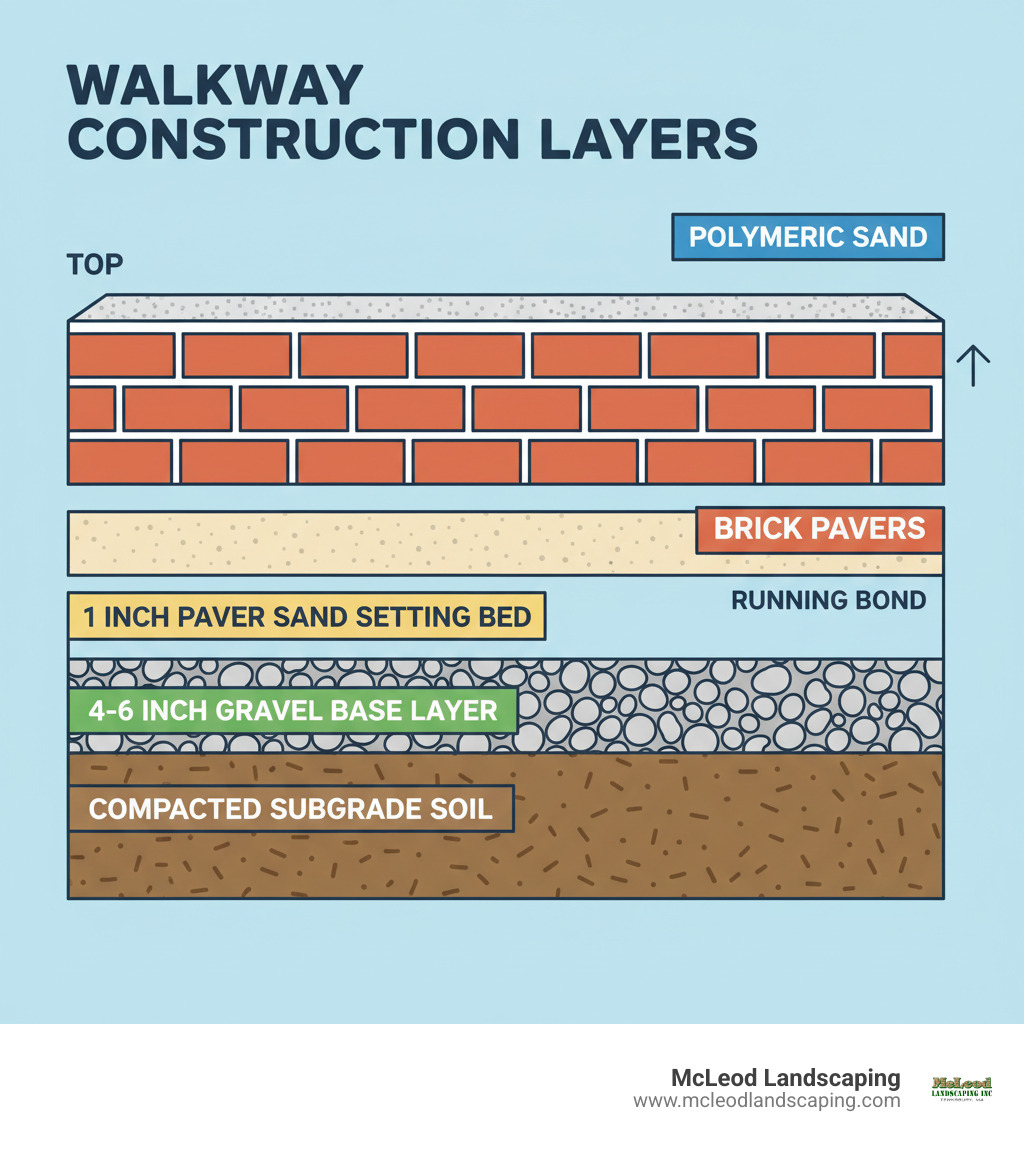
Brick walkway repair basics:
Before starting, it’s crucial to understand what’s causing your brick walkway problems. A proper diagnosis is the difference between a repair that lasts for decades and one that fails next spring.
Walk your brick path and note any issues. Each symptom points to an underlying cause.
Having everything ready beforehand makes the project go smoothly.

Essential Tools:
Materials:
Brick walkway repair is often a manageable weekend project.
The time required depends on the project’s scope. A small, 3-4 square foot repair might take 3-4 hours, while more extensive work could take a full weekend.
For DIY costs, materials for a small repair may cost under $200, while larger projects can exceed $600. Tool rental for a tamper or plate compactor is an affordable option.
Professional brick walkway repair costs vary based on complexity, size, and any additional work like drainage improvement.
Please note: The cost estimates mentioned are based on national average pricing data gathered from online sources and do not represent a quote from McLeod Landscaping. Costs can vary significantly based on your location and the extent of the repair, ranging from under $200 for minor DIY fixes to over $600 for more extensive work.
Catching problems early saves you from more expensive repairs later. A small investment now can add years to your walkway’s life.
This section walks you through each stage of the process, from lifting sunken bricks to creating a level surface that will last for years. With the right approach, any homeowner can tackle a brick walkway repair project.
First, mark your repair area with chalk or spray paint, outlining the entire section that needs attention plus a few inches extra. This gives you room to work.
Next, remove the bricks. Loose pavers may lift out by hand. For stuck bricks, use a pry bar or flat-blade screwdriver to gently work under the edge and wiggle it free. Work carefully to avoid chipping bricks you plan to reuse.
To remove a tightly wedged cracked brick, drill several holes through its center with a hammer drill. Then, use a chisel and hammer to break it apart, working from the outside in to protect the surrounding pavers.
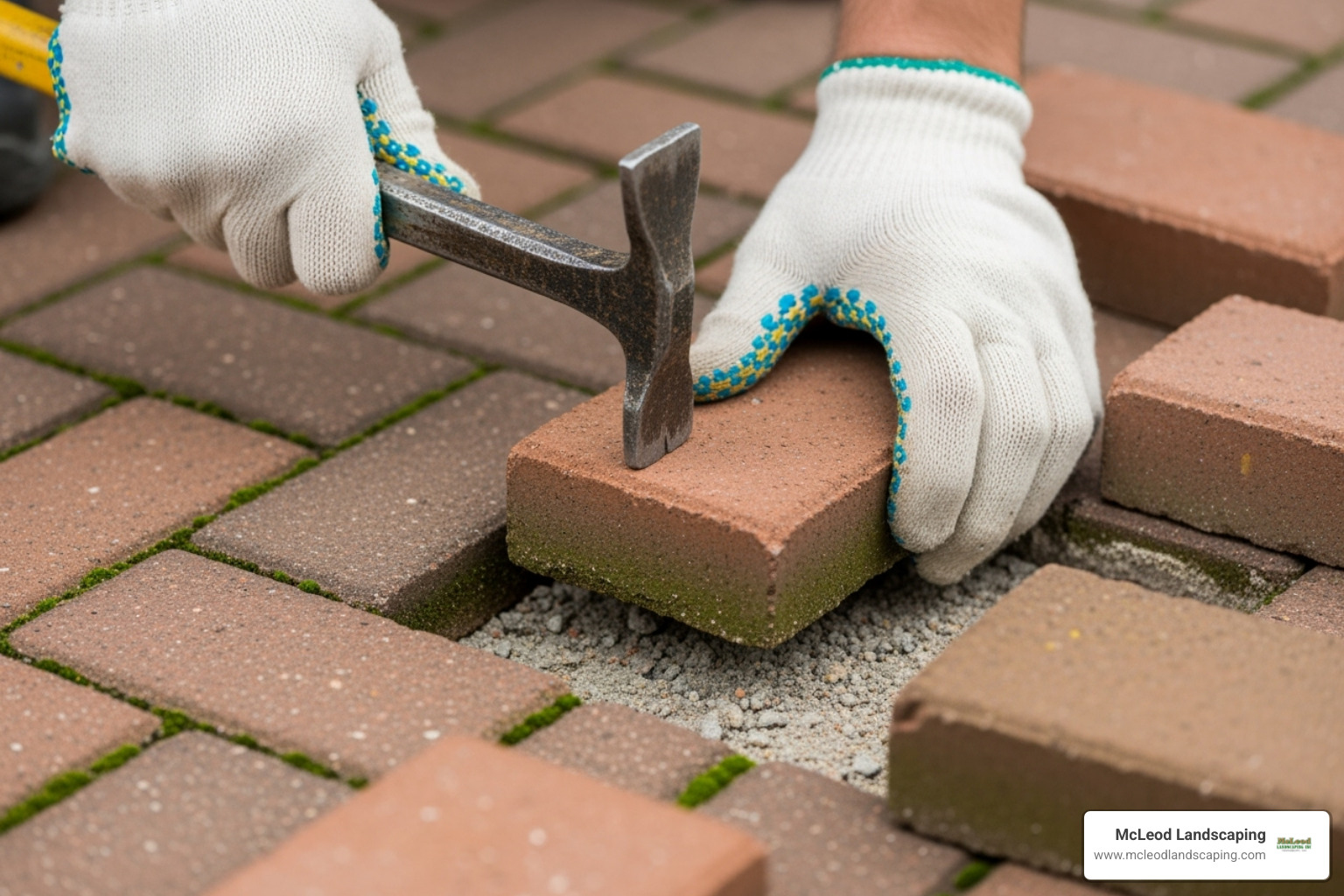
As you remove each brick, clean off old sand and dirt with a wire brush or gloved hand. Stack the reusable bricks nearby and set aside any broken ones for disposal. Reusing original bricks is economical and preserves your walkway’s historic charm.
A walkway is only as good as its foundation. Before digging, address the underlying problem you identified earlier, such as cutting back tree roots or improving drainage. Skipping this means the problem will return.
Excavate the soil in the repair area, digging down about 6 inches below the final walkway height. Extend the excavation 6 inches beyond the repair perimeter for stability. For more details, see this guide on Repairing Sunken Brick or Stone Paving.
Establish a drainage slope of about 1/4 inch per foot, directing water away from structures. Use mason’s line and stakes to set your grade.
Compact the subgrade soil at the bottom of the excavation with a hand tamper or plate compactor until it is firm. This prevents future settling.
Add a 4-inch gravel base layer, spreading 3/4-inch crushed stone in 2-inch lifts. Compact each layer thoroughly with your tamper. This provides crucial drainage and support.
Finally, install edge restraints along the perimeter. Plastic paver edging or a poured concrete border will prevent bricks from shifting outward over time. For ideas on integrating your walkway with other features, see our retaining wall services.
With a solid foundation, you can now relay the bricks.
Spread a 1-inch layer of paver sand or stone dust over the compacted gravel. This is the setting bed that allows for precise leveling.
Screed the sand level by placing a straight 2×4 across your edge restraints and pulling it toward you. This scrapes off excess sand and creates a perfectly flat surface. Add more sand and repeat if you see any low spots.

Now, lay the bricks, starting from a fixed edge and working outward. A running bond pattern is stable and visually appealing. Place each brick gently onto the sand without sliding it, then tap it with a rubber mallet to set it.
Use your level frequently to check for flatness. If a brick is too high, remove a pinch of sand from underneath; if it’s too low, add a bit more. You may need to cut bricks with a masonry saw or chisel to fit edges and curves.
Using your original bricks helps maintain your walkway’s character. If you need replacements, match the size, shape, and color as closely as possible.
This final step locks everything together for a stable, weed-resistant surface.
Spread polymeric sand over the dry brick surface and use a push broom to sweep it into every joint until they are completely full.
Compact the walkway surface with a plate compactor. This settles the bricks into the sand bed and forces the polymeric sand deep into the joints, creating a strong interlock. This step is critical for a long-lasting repair.
After compacting, sweep any excess polymeric sand off the brick faces.
Activate the polymeric sand with water according to the product’s instructions. Typically, this involves lightly misting the surface with a garden hose, waiting 15 minutes, and misting again. Avoid creating puddles.
Allow 24-48 hours of dry weather for curing. Keep foot traffic off the walkway during this time to allow the sand to harden completely.
For more ideas on new hardscaping, check out our walkway installation services.
With the heavy lifting done, these final steps will protect your brick walkway repair and keep it looking great for years.
After the polymeric sand has cured (24-48 hours), scrub the surface with a stiff brush and water to remove any dust or residue.
Next, consider applying a brick sealer. While optional, a sealer is highly recommended in the Merrimack Valley to protect against moisture, stains, and freeze-thaw cycles. It also improves the brick’s natural color. Apply the sealer to a clean, dry surface according to the manufacturer’s instructions, allowing it to dry for 24 hours before use.
To finish, backfill any gaps along the walkway’s edges with topsoil. Refreshing the surrounding landscape with new mulch or plants will help integrate your repair and boost curb appeal.
A proper brick walkway repair requires minimal maintenance, but a little attention goes a long way.
Following these habits will ensure your repaired walkway remains beautiful and functional for decades.
You don’t need to remove all the bricks. One of the main advantages of brick walkway repair is that you can work in targeted sections. Simply remove the bricks in the sunken area, plus one or two rows around it to give yourself room. After lifting the pavers, you can rebuild the base underneath with compacted gravel and sand as detailed in our guide. Then, reset the original bricks so they are flush with the surrounding surface. This focused approach saves significant time and money.
A durable walkway requires a two-part base for stability and drainage.
Failing to properly install and compact these layers is the primary cause of future walkway problems.
No, this is an ineffective, temporary fix that we strongly advise against. Adding sand on top of sunken pavers fails for three key reasons:
For a lasting brick walkway repair, you must lift the pavers and rebuild the base correctly. It’s more work upfront but is the only way to solve the problem permanently.
By following this guide, you can complete a brick walkway repair that restores safety and curb appeal to your property. A successful DIY repair is a rewarding project that addresses hazards, improves your home’s value, and provides valuable knowledge for future maintenance.
However, not every project is right for every homeowner. If the damage is extensive, if you’ve uncovered complex drainage issues, or if you simply prefer to leave the work to experts, that’s where we can help.
The experienced team at McLeod Landscaping has served the Merrimack Valley for over three decades. We don’t just fix walkways; we understand how to solve underlying issues like poor drainage and tree root damage to ensure a repair that lasts for decades.
If you’re dreaming bigger than just a repair, we offer comprehensive hardscaping services to transform your outdoor living space. Explore our patio installation services or ask about our work with retaining wall installation, outdoor kitchens, and custom stairs.
Whether you do it yourself or call in the pros, taking action is what matters. A safe, beautiful brick walkway is an asset to any home.
Contact McLeod Landscaping today at (978) 640-0957 or click here to schedule a consultation for retaining wall installation. Let our experienced team design and install a functional and visually appealing retaining wall that enhances your landscape.


1881 Main St Unit 1, Tewksbury, MA 01876