
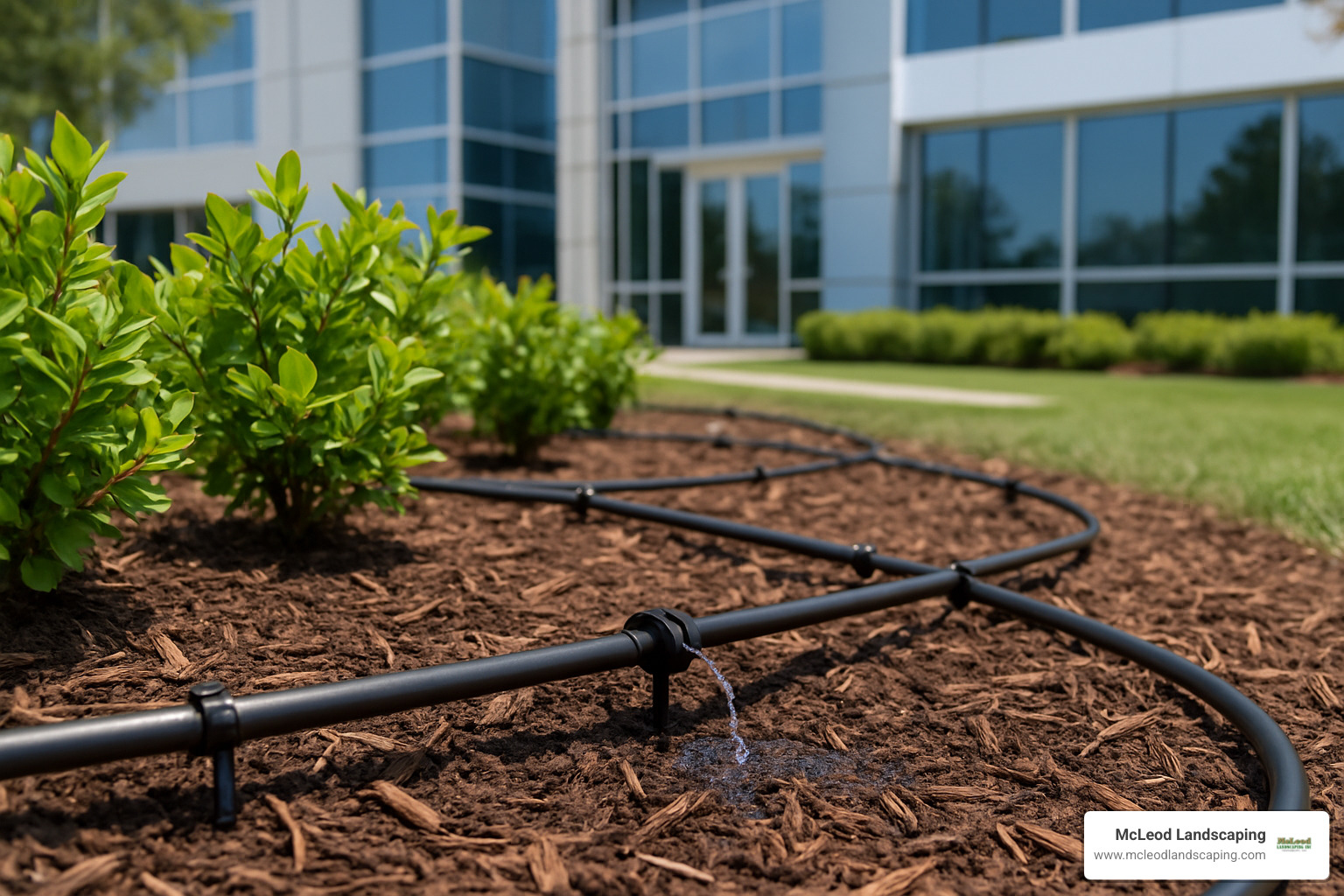
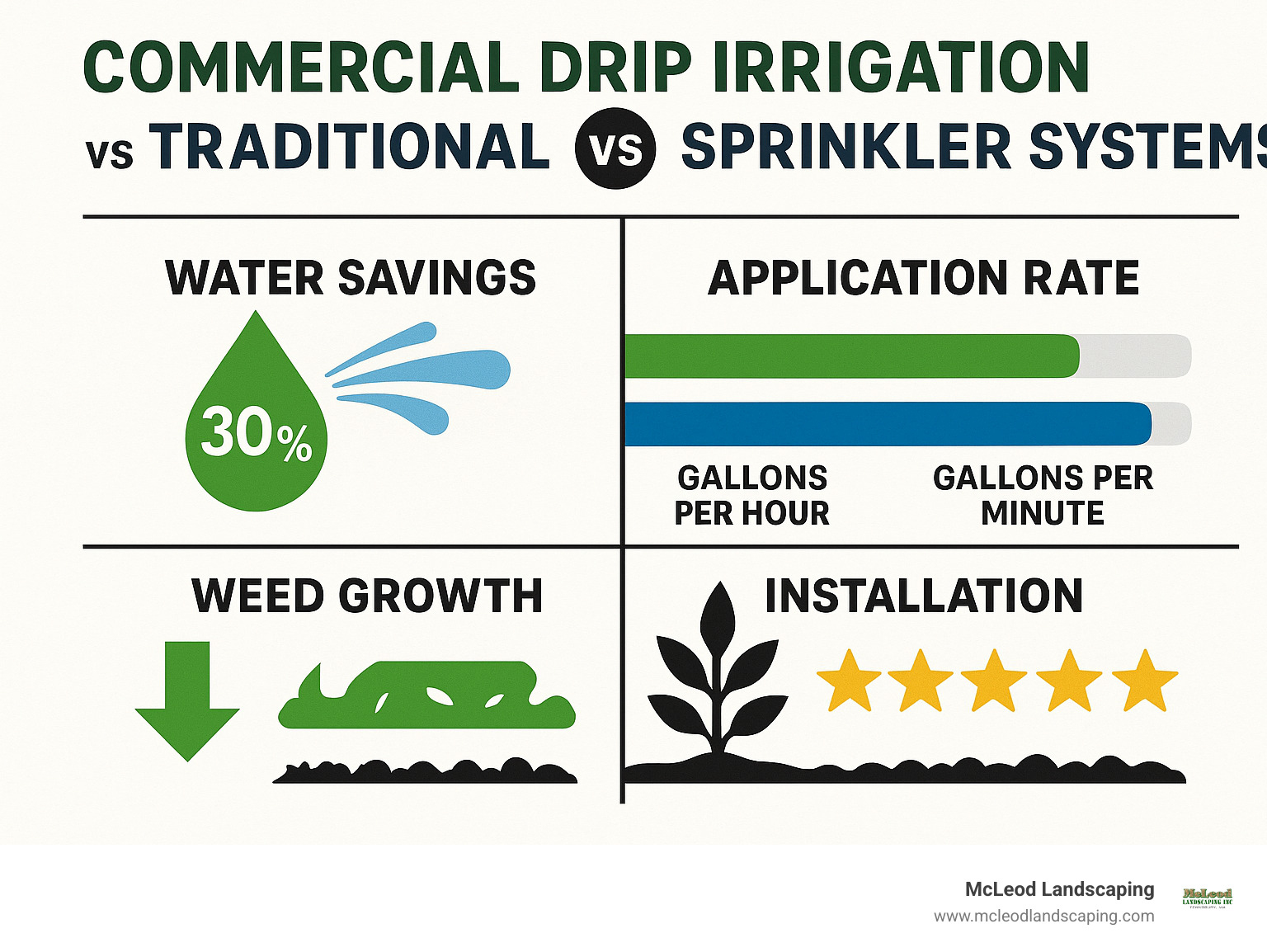
Commercial drip irrigation is a water-efficient irrigation method that delivers water directly to plant root zones through a network of tubing, emitters, and accessories. This system can reduce water usage by 30-50% compared to traditional sprinkler systems.
For commercial property managers considering irrigation options, here’s what you need to know:
Commercial drip irrigation systems apply water slowly—from 0.9 gallons per hour with inline emitters to 24 gallons per hour with point-source emitters—maximizing absorption and minimizing runoff. This precision delivery makes them ideal for irregular landscapes, sloped terrain, and areas where water conservation is critical.
Unlike sprinkler systems that spray water into the air (losing much to evaporation), drip irrigation waters plants directly at the root zone, significantly reducing water waste. The systems can be installed with minimal tools and customized for various applications from commercial agriculture to landscape beds.
I’m Scott McLeod, owner of McLeod Landscaping, and I’ve designed and installed commercial drip irrigation systems for over three decades across numerous commercial properties in the Merrimack Valley area, helping businesses reduce water consumption while maintaining healthy, vibrant landscapes.
Terms related to commercial drip irrigation:
– commercial fertigation systems
– commercial irrigation controllers
– commercial greenhouse watering systems
At its heart, commercial drip irrigation delivers water directly where plants need it most—their root zone. Unlike traditional sprinklers that shower water across large areas, drip systems work with surgical precision, using a network of tubing and emitters to place water exactly where it benefits plants most.
Think of it as the difference between watering your garden with a fire hose versus using an eyedropper—one floods the area while the other provides just what’s needed, exactly where it’s needed.
These systems operate at a gentle 15-30 PSI (pounds per square inch), significantly lower than conventional sprinklers. This low-pressure approach is why drip irrigation achieves up to 90% efficiency compared to sprinklers’ 50-70%—there’s simply less water lost to evaporation, wind drift, or runoff.
“Drip irrigation waters plants directly at the root zone with 90% efficiency, minimizing evaporation and runoff,” explains a water conservation specialist at the EPA WaterSense program. This precision targeting is why so many commercial properties are making the switch.
The magic happens through emitters—small devices that control water flow and deliver consistent moisture to each plant. These can be adjusted based on your specific plant needs, soil conditions, and local climate factors.
Inside a commercial drip irrigation system, water travels through a main supply line (typically ½” to 1″ diameter) before branching into smaller distribution lines (¼” to ½”) containing emitters. These clever little devices create internal friction that reduces water pressure, changing what would be a spray into a gentle drip.
Unlike conventional systems that measure output in gallons per minute, drip emitters deliver water in gallons per hour (GPH)—usually between 0.5 to 4 GPH per emitter. This slow-release approach allows water to soak deeply into the soil rather than running off the surface.
For commercial properties, uniformity is crucial. Irrigation designers calculate what’s called a coefficient of uniformity (CU) to ensure every plant receives equal water regardless of its position along the line. This is particularly important when maintaining consistent appearance across commercial landscapes.
The system’s hydraulic design accounts for pressure loss over distance, elevation changes, and water quality. For sites with significant elevation changes, pressure-compensating emitters maintain consistent flow throughout the entire system—ensuring the plants at the end of the line receive the same care as those at the beginning.
When designing a commercial drip irrigation system, you’ll generally choose between two main emitter styles, each with distinct advantages for different applications.
Point-Source Emitters are individual devices you insert into tubing wherever needed. They’re highly customizable, with flow rates typically ranging from 0.5 to 24 GPH. These are perfect for mixed plantings, container gardens, or anywhere you need precise control. As your landscape evolves, you can add, remove, or adjust these emitters to match changing needs.
Point-source emitters give you the flexibility to target individual plants with precise amounts of water,” notes a commercial landscape irrigation expert. “This is particularly valuable in showcase areas where plant materials have varying water needs.”
Inline Drip Tubing comes with emitters pre-installed inside the tubing at fixed intervals (typically 6″ to 36″ apart). With consistent flow rates between 0.4 and 1.0 GPH per emitter, these systems are ideal for hedgerows, garden beds, and evenly spaced plantings. They offer faster installation for large areas with uniform spacing.
Drip Tape is a specialized form of inline tubing with emission points molded directly into thin-walled tape (6-15 mils thick). It’s primarily used for commercial agriculture in row crops and is typically seasonal, lasting 1-5 seasons. While it’s the most economical option for straight-row applications, it’s less durable than standard inline tubing.
| Feature | Point-Source | Inline Tubing | Drip Tape |
|---|---|---|---|
| Lifespan | 5-10 years | 10-15 years | 1-5 seasons |
| Flow Rates | 0.5-24 GPH | 0.4-1.0 GPH | 0.2-1.0 GPH |
| Installation Complexity | Moderate | Simple | Very simple |
| Customization | High | Limited | Limited |
| Best Applications | Mixed plantings, containers | Hedges, beds | Row crops |
| Pressure Compensation | Available | Available | Rarely available |
| Cost | Higher | Moderate | Lowest |
At McLeod Landscaping, we evaluate your specific landscape needs to determine which type of commercial drip irrigation will provide the best balance of efficiency, performance, and value for your property.
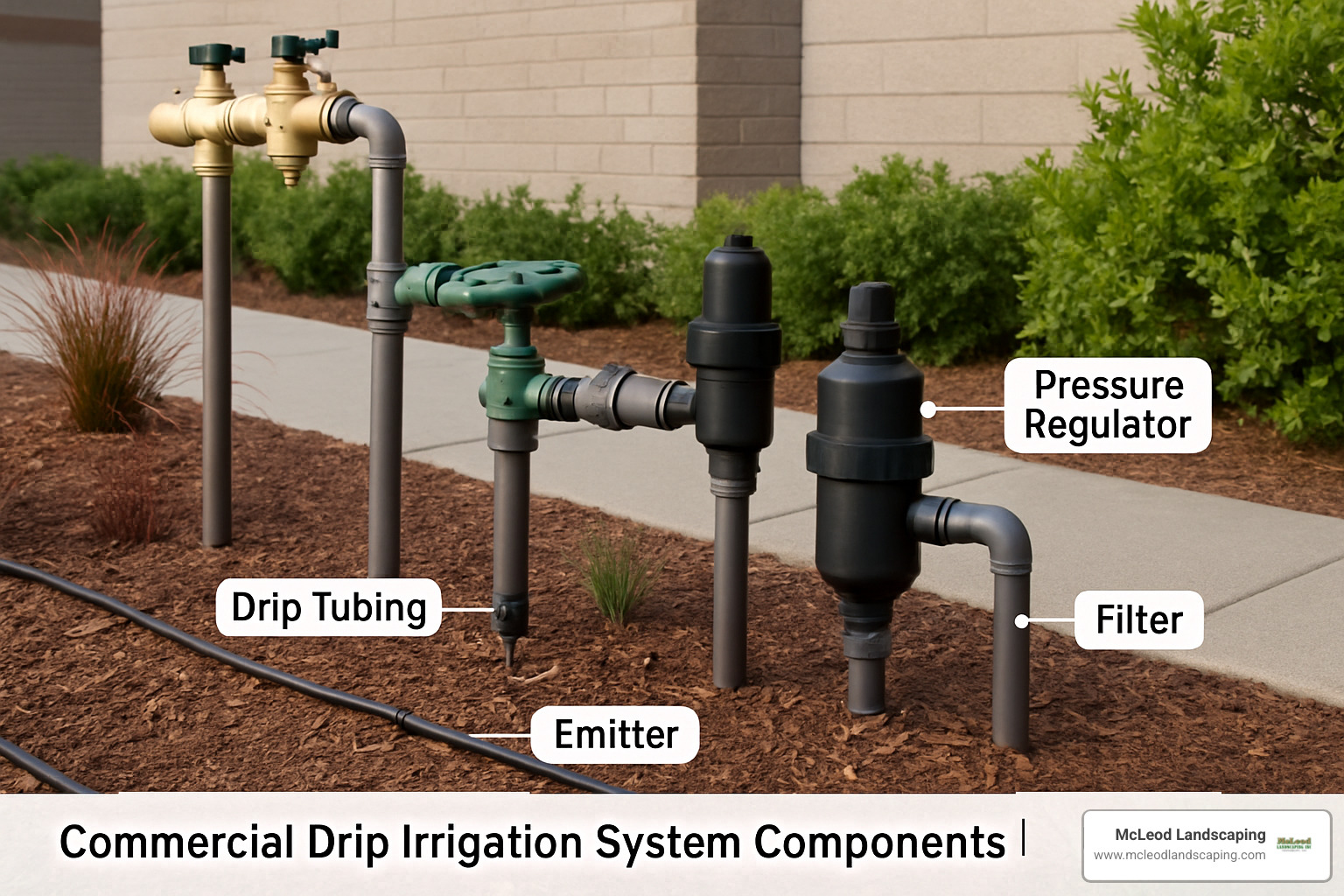
A successful commercial drip irrigation system relies on several key components working together in harmony. Think of these elements as the organs of a living system – each one plays a vital role in delivering water efficiently and reliably to your plants.
Every good system starts with a reliable water source – whether it’s municipal, well, or reclaimed water. For commercial properties, you’ll need proper backflow prevention devices to protect the water supply from contamination. This isn’t just good practice; it’s often required by local building codes.
Filtration is absolutely critical for drip irrigation success. As one of our long-time irrigation specialists likes to say, “Clean water is the lifeblood of any drip system. Without proper filtration, even the best designed system will fail prematurely.” Those tiny emitter passages can clog easily, so depending on your water source, you might need screen filters (great for municipal water), disc filters (perfect for well water with organic matter), sand separators (if you have heavy sediment), or media filters (for water with biological contaminants).
Your commercial drip irrigation system operates at much lower pressures than traditional sprinklers – typically between 15-30 PSI. That’s why pressure regulators are essential components. They protect your system from damage and ensure water is distributed evenly across all your plants.
Most commercial properties divide their irrigation into control zones based on plant water needs, sun exposure, and soil conditions. Each zone needs its own control valves (either manual or automatic), zone control kits with pressure regulation and filtration, and possibly flow meters for larger installations. This zoning approach allows you to water different areas according to their specific needs, saving water and promoting healthier plants.
The backbone of your system consists of mainline and distribution tubing. The mainline (ranging from ½” to 2″ depending on your system size) carries water to the distribution tubing (typically ½”), which then connects to micro-tubing (¼”) for individual emitters. Think of it as the circulatory system of your irrigation setup.
The business end of your commercial drip irrigation system is the emitters and drip lines – these are what actually deliver water to your plants. You might use point-source emitters for individual plants, inline drip tubing with integrated emitters for rows of plants, micro-sprayers for wider coverage, or drip tape for agricultural applications.
Quality fittings and connectors ensure your system stays watertight and functions for years to come. These include compression fittings, barbed fittings, goof plugs (for closing unwanted holes), and end caps with flush valves.
Modern systems benefit from smart controllers and automation that can adjust watering schedules based on weather conditions, monitor soil moisture, detect leaks with flow sensors, and even allow you to control everything from your smartphone. For more advanced control options, explore our guide to Commercial Irrigation Controllers.
Don’t overlook the importance of air relief and vacuum breakers – these prevent soil from being sucked into your emitters when the system shuts down. Similarly, flush valves and end caps allow you to clean accumulated sediment from the system, extending its life and maintaining peak performance.
At McLeod Landscaping, we’ve designed hundreds of commercial drip irrigation systems over our 30+ years in business, and we’ve learned that attention to these essential components makes all the difference between a system that thrives for years and one that constantly needs repairs.
When it comes to watering commercial landscapes, the choice between commercial drip irrigation and traditional sprinkler systems isn’t just about preference—it’s about smart business decisions. Many property managers are finding compelling reasons to make the switch to drip systems.
Commercial drip irrigation shines brightest in its water efficiency. Studies consistently show these systems reduce water consumption by 30-50% compared to conventional sprinklers. This dramatic saving comes from eliminating evaporation loss since water is applied directly at soil level. There’s zero wind drift to worry about, minimal runoff because water is applied slowly enough for proper soil absorption, and precise targeting that ensures water goes only where your plants need it.
The EPA WaterSense program points out that properties with extensive landscaping can spend up to 30% of their water bill on irrigation alone. By cutting that water use in half, drip systems create significant operational savings while demonstrating environmental leadership.
Weed control becomes remarkably easier with commercial drip irrigation. By watering only your target plants and keeping soil surfaces between plants dry, you create an environment where weeds struggle to establish. This translates directly to lower maintenance costs and reduced herbicide use—both meaningful advantages for commercial properties trying to control operational expenses.
Plant health improves dramatically too. Foliar diseases thrive in moist conditions, but drip irrigation helps prevent these issues by keeping foliage dry. With water applied at soil level, you’ll see reduced humidity in the plant canopy and minimal splashing that can spread soil-borne pathogens. For commercial landscapes where appearance matters, this disease prevention means healthier plants with fewer chemical treatments.
The labor efficiency of commercial drip irrigation creates another compelling advantage. These systems operate with minimal human intervention, generate fewer weeds requiring removal, and result in healthier plants that need less frequent replacement. You’ll even spend less time mowing adjacent areas since there’s no overspray onto hardscapes. For maintenance teams, this means more time addressing other property needs.
Unlike rigid sprinkler systems, drip irrigation excels in challenging situations. It works beautifully in irregularly shaped areas, handles sloped terrain with pressure-compensating emitters, accommodates mixed planting beds with varying water needs, and performs perfectly in windy areas where sprinkler drift would waste water.
The environmental benefits extend beyond simple water savings. Commercial drip irrigation reduces energy use through lower pressure requirements, minimizes fertilizer leaching and runoff into local waterways, creates a smaller carbon footprint from reduced water treatment and pumping, and even works compatibly with reclaimed or lower-quality water sources. For properties pursuing LEED certification or sustainability goals, these systems contribute valuable points while demonstrating environmental stewardship.
For the latest research and guidance on landscape water conservation practices, visit the EPA WaterSense program, which provides up-to-date information on water-efficient technologies and practices that can help your commercial property thrive while using fewer resources.
Looking for the perfect commercial drip irrigation solution for your property? The landscape irrigation world has evolved dramatically in recent years, with systems that offer remarkable efficiency and smart features. As we look toward 2025, these five commercial drip irrigation options stand out for their performance, scalability, and exceptional return on investment.
Imagine a lush, perfectly irrigated landscape with absolutely no visible irrigation components. That’s the magic of subsurface drip irrigation (SDI), the hidden champion of commercial drip irrigation technology.
These innovative systems place specialized driplines 4-6 inches below the surface, delivering water directly where it matters most—the root zone. Since everything remains underground, the aesthetic appeal of your landscape stays intact with no visible irrigation components.
For commercial properties concerned about vandalism or damage, subsurface systems offer peace of mind. Since the components are buried, they’re protected from foot traffic, maintenance equipment, and would-be vandals.
“I was skeptical about subsurface systems for our corporate campus until I saw the results,” shares one property manager. “We’ve reduced water usage by nearly 60% compared to our old sprinklers, and the turf has never looked better.”
Most modern subsurface systems include sophisticated root intrusion prevention technologies—either physical barriers or chemical inhibitors built into the emitters themselves. These features help ensure your system will continue performing flawlessly for 15+ years without roots finding their way into the lines.
Maintenance is surprisingly straightforward, typically requiring just periodic line flushing and occasional valve box inspections. Premium systems even include self-flushing technology that automatically cleans the lines at scheduled intervals.
When it comes to large-scale commercial plantings with uniform rows, heavy-duty drip tape delivers exceptional performance at a cost-effective price point. These specialized systems use durable tape available in thicknesses ranging from 6 to 15 mils—with thicker options providing multiple seasons of reliable service.
The beauty of these systems is their versatility. You can install them above ground for seasonal use, under mulch for added protection, or even buried for semi-permanent applications. The tape runs can extend impressively long distances—up to 4,000 feet per run in properly designed systems.
For commercial properties with extensive planting beds or agricultural areas, these systems offer significant labor savings along with precise water delivery. The thicker 15-mil options can often be retrieved and reused for 3-5 seasons, further enhancing their value proposition.
Want to learn more about specialized drip solutions for your specific needs? Visit our Drip Irrigation Systems page for additional insights.
If your commercial property features hilly terrain or requires long irrigation runs, pressure-compensating systems are worth their weight in gold. These sophisticated commercial drip irrigation solutions maintain consistent water delivery despite elevation changes that would cause serious problems for standard systems.
“Before switching to pressure-compensating tubing, plants at different elevations across our sloped corporate campus showed dramatic growth differences,” explains a facilities director. “Now, every plant receives exactly the same amount of water, regardless of its location on the hillside.”
These systems use specialized emitters with flexible silicone diaphragms that automatically adjust to pressure changes. Whether your tubing runs uphill, downhill, or across varying elevations, each plant receives precisely the same amount of water.
Available with emitter spacing options of 9, 12, 18, 24, or 36 inches, these systems can be perfectly custom to match your planting density. Their superior clog resistance through self-flushing emitter design makes them ideal for commercial applications where maintenance time is at a premium.
The marriage of smart technology with commercial drip irrigation has created truly intelligent systems that take the guesswork out of landscape watering. These advanced setups continually monitor environmental conditions and automatically adjust watering schedules for optimal efficiency.
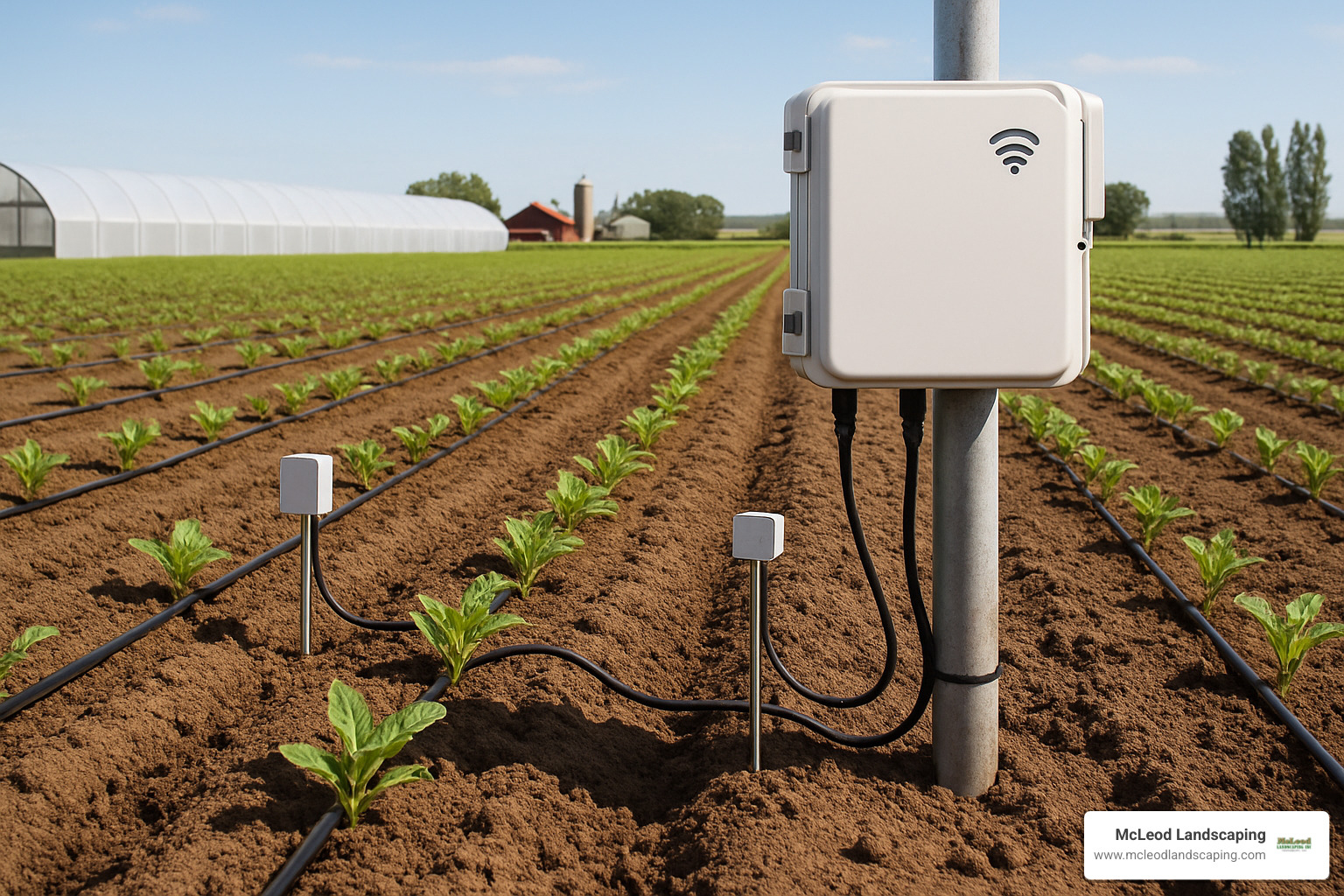
At the heart of these systems are sophisticated components working in harmony: ET sensors measure environmental factors like temperature and humidity, soil moisture probes monitor conditions at various depths, and Wi-Fi enabled controllers allow you to manage everything from your smartphone. Rain shutoff devices prevent wasteful irrigation during rainfall, while flow sensors quickly detect leaks or blockages before they become major problems.
Our smart drip system has practically eliminated irrigation waste,” notes a property manager for a technology campus. “It only waters when plants actually need it, and it’s reduced our landscape water consumption by over 40% while improving plant health.”

These systems shine in commercial settings where water conservation is a priority and maintenance staff may not have time for constant irrigation adjustments. The data analytics platforms included with premium systems provide valuable insights into water usage patterns and system performance, helping you continually optimize your irrigation approach.
Sometimes the perfect commercial drip irrigation solution combines technologies for maximum versatility. Hybrid systems blend the pinpoint efficiency of traditional drip with the broader coverage of micro-sprays, creating an adaptable solution for diverse landscapes.
These systems typically feature 160-degree fan stakes strategically placed to provide broader coverage areas, complemented by traditional drip emitters for targeted watering. This combination approach allows you to efficiently irrigate mixed plantings with varying water requirements.
The micro-spray components prove particularly valuable for nursery beds with closely spaced plants, container garden areas, or situations where soil conditions benefit from larger wetted areas. They’re also excellent for providing cooling effects during extreme heat and can facilitate nutrient delivery through fertigation systems.
The versatility of our hybrid system has been a game-changer,” says a commercial landscape manager. “We can provide gentle overhead misting for delicate new plantings while maintaining efficient drip irrigation for established areas—all on the same zone.”
For properties with diverse landscape elements, these systems offer the perfect balance of efficiency and flexibility, adapting to the specific needs of each planting area while maintaining overall water conservation benefits.
Creating an effective commercial drip irrigation system isn’t just about installing tubes and emitters—it’s about crafting a water delivery solution that perfectly matches your property’s unique characteristics. Think of it as tailoring a custom suit rather than buying off the rack.
Begin with a thorough site assessment before you touch any irrigation components. Walk your property and map existing plantings, noting sun and shade patterns throughout the day. Those sunny western exposures will need different water delivery than shaded northern areas. Take time to identify elevation changes that might affect water pressure and flow direction.
“I can’t tell you how many times I’ve seen people rush into installation without understanding their site,” says Scott McLeod, owner of McLeod Landscaping. “That extra hour of assessment can save days of troubleshooting later.”
Your water source is the heart of your system, so evaluate it carefully. Commercial properties need reliable sources with consistent pressure (ideally 40-60 PSI before regulation) and sufficient flow rate. Don’t forget to check local codes for backflow prevention requirements—this isn’t just about compliance, it’s about protecting your water supply.
When developing your zoning strategy, think like a plant. Group vegetation with similar water needs together—drought-tolerant natives shouldn’t share irrigation zones with thirsty annuals. Create separate zones for areas with different sun exposure and soil types. This thoughtful zoning not only conserves water but promotes healthier plant growth across your property.
For large commercial installations, precise flow calculations become essential. Your design should account for total system requirements, friction loss in lines, and maintain adequate pressure at the furthest emitter. Proper mainline sizing ensures your system can handle peak demand during hot summer days when plants need water most.
Need help with comprehensive system design? Explore our Commercial Irrigation System Design services for expert assistance.
Converting existing sprinkler systems to commercial drip irrigation often makes perfect sense for commercial properties looking to reduce water consumption while improving plant health. Here’s how to approach this change:
Start with a thorough audit of your existing system. Document current sprinkler locations, identify operational zones, and assess pressure and flow characteristics. This becomes your baseline—knowing where you’re starting helps chart the path forward.
Next, develop a thoughtful conversion strategy. Determine which zones make the most sense to convert first (typically ornamental beds rather than turf areas). Consider whether you’ll use existing valve locations or reconfigure for optimal efficiency. Many commercial properties implement changes in phases to spread costs across multiple budget cycles.
Each converted zone will need several key modifications at the head assembly. You’ll need to install pressure regulators to reduce standard irrigation pressure (typically to 20-30 PSI for drip systems), add appropriate filtration based on your water quality, and use conversion adapters to transition from sprinkler risers to drip lines.
When planning your lateral layout, think about both current and future landscape needs. Route mainlines to minimize materials while providing coverage to all planted areas. Remember to include flush valves at the end of each main line—these simple components make system maintenance significantly easier.
“Retrofitting existing sprinklers to drip typically cuts water bills by 30-50%,” notes a water efficiency consultant who’s worked with several McLeod Landscaping commercial clients. “But the improved plant health from consistent soil moisture might be an even bigger benefit in the long run.”
Soil type dramatically influences how your commercial drip irrigation system should be configured. Water moves differently through various soil textures, requiring specific adjustments to your design and scheduling.
In sandy soils, water moves quickly downward with minimal lateral spread. This vertical movement means you’ll need more frequent irrigation with shorter run times to keep root zones moist without wasting water. Higher flow emitters (typically 2 GPH) work best in sandy conditions, and you’ll likely need closer emitter spacing to ensure adequate coverage between drip points. During peak summer heat, sandy soil zones might require daily watering.
Loamy soils offer the ideal balance for drip irrigation, with water moving both downward and laterally at moderate rates. These balanced soils work beautifully with medium flow emitters (around 1 GPH) and standard emitter spacing. Your irrigation schedule for loam zones will typically fall into an every 2-3 day pattern during warm weather, making these areas efficient and low-maintenance.
Clay soils present unique challenges due to their slow absorption rates but excellent lateral water movement. For clay areas, select lower flow emitters (0.5 GPH) to prevent surface puddling and runoff. The good news is you can often use wider emitter spacing since water spreads farther laterally through clay. These zones benefit from longer run times with more days between irrigation cycles—a cycle/soak schedule works particularly well by allowing water to penetrate slowly.
“Understanding your soil isn’t just about water efficiency,” explains Scott McLeod. “It’s about creating healthy root systems that develop properly based on how water moves through your specific soil profile. Get this right, and your plants will thrive with minimal water.”
By tailoring your commercial drip irrigation system to your specific site conditions, soil types, and plant needs, you’ll create an efficient, effective watering solution that conserves resources while keeping your landscape looking its best.
Setting up and maintaining your commercial drip irrigation system doesn’t have to be complicated, but it does require attention to detail. I’ve helped dozens of commercial property managers keep their systems running smoothly over the years, and this checklist covers everything you’ll need for success.
Before you dig that first trench, make sure you’ve handled the preliminaries. Obtain all necessary permits, call your local utility marking service to identify underground lines, and give your water source a good flush to clear out any debris. Take a moment to verify your water pressure and flow rate—these measurements will be crucial for your system’s performance.
When installation day arrives, start with proper backflow prevention that meets local codes. This isn’t just a recommendation—it’s often a legal requirement for commercial properties. Mount your controllers where they’ll be protected from the elements but still easily accessible for programming changes.
Filtration and pressure regulation form the heart of your system. Commercial applications typically require more robust filtration than residential systems, so don’t skimp here. Proper mainline depth (usually 12-18 inches for commercial properties) protects your investment from damage and temperature fluctuations.
“The difference between a system that lasts three years and one that lasts fifteen often comes down to installation details,” I tell my clients. “Take your time with connections, secure your tubing properly, and label everything clearly.”
Once your system is in place, thorough testing is essential. Perform pressure tests before backfilling any trenches, flush all lines completely before installing emitters, and check carefully for leaks at every connection point. Verify that each emitter is functioning correctly and delivering the expected flow rate.
As seasons change, your commercial drip irrigation system will need adjustments. Spring startup involves inspection and repair of any winter damage. During summer’s peak heat, you’ll likely increase watering frequency while maintaining appropriate run times. As fall arrives, gradually decrease frequency, and before winter hits, take steps to prevent freeze damage.
For those in colder climates, proper winterization is critical. Shut off your main water supply, drain above-ground components, and use compressed air to blow out underground lines. Don’t forget to insulate any exposed components and either disconnect controllers or switch them to winter mode.
For detailed guidance on using specialized components, Click here to see how to use our Perma-loc fittings.
Maintaining your commercial drip irrigation system is like caring for a vehicle—regular check-ups prevent breakdowns. I’ve developed this maintenance schedule based on what works best for our commercial clients.
On a weekly basis, take a quick walk through your property to spot any obvious issues. Look for wet spots that might indicate leaks, check filter pressure differential if your system has gauges, and verify your controller is following the correct schedule. Pay attention to your plants—they’re often the first to show signs of irrigation problems through wilting, yellowing, or unusual growth patterns.
Monthly maintenance requires a bit more attention. Clean both main and zone filters thoroughly—this simple task prevents countless headaches. Take pressure readings at various points in your system to identify potential problems before they become serious. Don’t forget to flush mainlines and laterals through the end caps to remove any accumulated sediment.
I can always tell which commercial properties skip their monthly maintenance,” says one of our technicians. “The systems that get regular attention perform better and use significantly less water.”
Quarterly, conduct a more comprehensive check-up. Test for clogged emitters, verify pressure regulator operation, and check soil moisture at various depths. This is also the perfect time to update your controller programming for seasonal changes and inspect for UV damage on any exposed components.
Your annual maintenance routine should include a complete system evaluation and documentation. Test your water quality and adjust filtration if needed. This is also the time to update your system maps with any modifications made throughout the year, replace batteries in sensors and controllers, and evaluate overall system efficiency.
With proper care, your commercial drip irrigation system can provide reliable service for 10-15 years or more—a substantial return on your investment.
Even the best commercial drip irrigation systems occasionally need a little TLC. After three decades in the business, I’ve seen every possible issue, and most have simple solutions.
When plants start showing signs of stress in isolated areas, clogged emitters are often the culprit. Simply remove and clean or replace the affected emitters. The best prevention? Proper filtration and regular system flushing—an ounce of prevention truly is worth a pound of cure.
Wet spots at joints or fittings typically indicate leaking connections. For a quick fix, cut out the damaged section and install a coupler, or carefully tighten compression fittings without overtightening. Using high-quality fittings from the start helps avoid this issue altogether.
Pressure problems show up as inconsistent water delivery across your system. Some areas might be drowning while others remain bone dry. Installing additional pressure regulators or adjusting existing ones usually solves the problem. For long-term prevention, design your system with appropriate zoning and pressure compensation from the beginning.
When you spot water bubbling from tubing, you’re dealing with punctured lines. Small holes can be fixed with “goof plugs” (yes, that’s really what they’re called!), while larger damage requires cutting and repairing with couplers. Protect your investment by installing tubing under mulch and marking locations to prevent future damage.
If zones are running at incorrect times or durations, you’re likely facing controller programming errors. Reprogramming and verifying settings usually resolves the issue. I always recommend documenting all programming decisions and using weather-based controllers that adjust automatically to changing conditions.
“The most frequent mistake I see is over-pressurizing drip systems,” I often tell new commercial clients. “These systems are designed to operate at low pressure—typically 15-30 PSI. Higher pressure doesn’t improve performance; it just creates headaches and repairs.”
Other common mistakes include inadequate filtration, mixing incompatible components, exceeding maximum run lengths, and forgetting to install flush valves at line ends. Avoiding these pitfalls will save you time, money, and frustration.
For visual guidance on making common repairs, here to see our how to video.
Investing in commercial drip irrigation makes good business sense, though it does require an initial commitment. Like most smart business investments, the upfront costs are offset by significant long-term savings that continue to benefit your property year after year.
Based on average internet data (not McLeod Landscaping pricing), installing a commercial drip irrigation system typically ranges from $1,000–$8,000 per acre. This wide range reflects several factors that influence your specific project: the complexity of your landscape, component quality, site accessibility, level of smart technology integration, and your property’s unique soil conditions.
“What sells our clients on drip irrigation isn’t the technology—it’s the math,” explains a commercial property management consultant. “As water costs continue climbing, the financial case becomes more compelling every year. Most properties see complete ROI within 2-5 years, depending on local water rates.”
The operational savings tell a compelling story. Most commercial properties experience water usage reductions of 30-50% compared to traditional sprinkler systems. This dramatic decrease comes with a corresponding drop in your water bill. Beyond direct water savings, you’ll likely see maintenance labor reduced by 20-60%, as less weeding and plant care is required.
For properties that incorporate fertigation (delivering fertilizer through the irrigation system), fertilizer use typically drops by 20-40% through more precise application. Plant replacement costs often fall by 30-50% thanks to healthier growth from consistent watering. Even weed pressure decreases by 40-70%, reducing both labor and herbicide expenses.
The payback timeline varies by region, with water costs being the primary factor. Properties in high water cost areas often recoup their investment in just 2-3 years. Those in moderate water cost regions typically see complete returns within 3-5 years, while even low water cost areas generally reach payback within 4-7 years.
Consider a typical one-acre commercial landscape in Massachusetts as an example. A traditional irrigation system might use 1.5-2.5 million gallons annually, while a drip system could reduce that to 0.75-1.25 million gallons. At average commercial water rates, this translates to $3,000-$5,000 in annual water savings. Add another $1,500-$3,000 in reduced maintenance costs, and your total benefit reaches $4,500-$8,000 per year.
Many properties find additional financial benefits beyond direct savings. These can include water authority rebates and incentives for efficiency upgrades, reduced stormwater management issues, lower chemical costs, extended landscape lifespan, and improved property aesthetics that improve overall property value.
For more detailed information about system costs, visit our Commercial Irrigation System Cost page.
Commercial drip irrigation systems deliver remarkable environmental benefits that go well beyond simply saving water. These systems have become a cornerstone of sustainability efforts for forward-thinking commercial properties across Massachusetts.

When it comes to water conservation, the numbers speak for themselves. Typical commercial drip irrigation systems reduce water consumption by 30-50%, while those equipped with smart sensors can push those savings to an impressive 70%. This translates to less strain on groundwater in well-dependent regions and reduced pressure on municipal water supplies, especially during those challenging drought periods we sometimes face in New England.
“The environmental benefits of commercial drip irrigation extend far beyond the property line,” explains a sustainability consultant who specializes in commercial landscapes. “By reducing water consumption, preventing runoff, and minimizing chemical use, these systems contribute to watershed health and community water security.”
Nutrient management sees dramatic improvements too. The precise application of water minimizes nutrient leaching, while optional fertigation systems deliver fertilizer directly to root zones where plants can actually use it. This means less fertilizer runoff making its way into our local waterways and lower overall fertilizer requirements – a win-win for both your budget and the environment.
The slow, targeted application rates of commercial drip irrigation prevent surface runoff and reduce soil erosion, particularly important on sloped sites. This minimizes chemical transport to storm drains and reduces landscape damage from water accumulation. I’ve seen properties transform from having persistent puddles and erosion issues to stable, healthy landscapes within a single growing season.
Energy conservation is another often-overlooked benefit. Lower water volume means reduced pumping requirements, decreased treatment energy for municipal water, and a smaller carbon footprint for overall landscape maintenance. It’s a ripple effect of positive environmental impacts.
Material sustainability has become increasingly important in the irrigation industry. Many manufacturers now offer components made with recycled content, and end-of-life recycling programs for used drip lines help close the materials loop. These systems typically enjoy extended lifespans, reducing replacement frequency and generating less plastic waste compared to frequently replaced sprinkler components.
A corporate office park in Tewksbury, MA, partnered with McLeod Landscaping to convert 30% of their traditional lawn areas to water-efficient landscape beds using commercial drip irrigation. The change was nothing short of remarkable.
The project involved 1.2 acres of turf converted to mixed native plant beds, with subsurface drip irrigation installed throughout these new areas. We integrated smart controllers with soil moisture sensors while maintaining sprinkler irrigation in the remaining turf areas.
The water impact was immediate and significant – a 30% reduction in the overall property water bill and a whopping 62% reduction in irrigation water use for the converted areas. Previous runoff issues that had affected parking areas disappeared, and the property came into compliance with local water conservation ordinances without any struggle.
Beyond water savings, the landscape itself thrived. The property now enjoys extended bloom periods throughout the growing season, reduced maintenance requirements, elimination of mower damage to building facades and windows, and improved stormwater infiltration that reduced flooding issues.
“The change was remarkable,” the property manager told us. “Not only did we achieve significant cost savings, but the property’s appearance actually improved with the more diverse plantings. The drip irrigation system ensures the plants stay healthy with minimal oversight.”
The financial outcomes were equally impressive: water bill savings of approximately $4,800 annually, maintenance cost reduction of $7,200 annually, a one-time local water authority rebate of $3,500, and a payback period of just 2.8 years. After that, it’s all savings straight to the bottom line.
As sustainability becomes a higher priority, many of our commercial clients ask about responsible disposal options for irrigation components. I’m happy to report that the industry has stepped up with several environmentally responsible solutions.
Leading manufacturers now offer take-back programs for used drip irrigation components, particularly larger-volume items like mainline tubing and drip tape. These materials are typically collected at designated drop-off points, cleaned and processed at specialized facilities, and recycled into new irrigation components or other plastic products.
Innovative “ReGen” programs have emerged that convert used drip lines into new irrigation components, landscape edging and stakes, planting containers, and even construction materials. “The irrigation industry has made significant strides in closing the materials loop,” as one circular economy specialist puts it. “What was once a disposal challenge is increasingly becoming a resource opportunity.”
For best results when recycling irrigation components, separate different plastic types before recycling, remove metal components from plastic parts, and clean soil from tubing. It’s also wise to contact local recycling facilities for specific guidelines and consider manufacturer take-back programs for large-volume replacements.
Many of our forward-thinking commercial clients now include end-of-life planning in their initial irrigation system specifications, ensuring that sustainability extends throughout the system’s lifecycle. It’s this kind of holistic thinking that makes commercial drip irrigation not just a water-saving technology, but a comprehensive environmental solution for modern landscapes.
Running your commercial drip irrigation system isn’t a one-size-fits-all schedule. Unlike traditional sprinklers that might run a few times weekly, drip systems typically need more frequent watering but for shorter periods – and several factors influence the ideal schedule.
Your soil type plays a crucial role in determining frequency. If you’re working with sandy soil, you’ll need more frequent watering (often daily during summer months) but for shorter durations of about 20-30 minutes. The water simply moves through sandy soil too quickly to apply all at once.
For properties with loam soils, you can usually water every 2-3 days for medium durations of 30-45 minutes. And if you’re dealing with clay soils, less frequent irrigation (every 3-4 days) but longer run times (45-60 minutes) works best since clay absorbs water slowly but retains it longer.
“The goal is to maintain consistent soil moisture at the root zone without creating saturated conditions,” as one irrigation scheduling expert puts it. “This often means more frequent but shorter irrigation cycles compared to conventional systems.”
Your watering schedule should also shift with the seasons. Spring typically needs 2-3 waterings weekly as plants establish new growth. Summer heat demands increased frequency, while fall allows you to scale back as temperatures drop. Winter requires minimal irrigation in cooler climates but maintenance watering in warmer regions.
For truly optimal results, smart controllers that adjust based on weather conditions or soil moisture can fine-tune these schedules automatically, often saving significant water compared to manually programmed systems.
One of the greatest strengths of commercial drip irrigation is its flexibility with mixed plantings. Unlike conventional sprinklers that apply the same amount of water everywhere, drip systems can deliver precisely what each plant needs – even within the same zone.
To successfully irrigate mixed plantings, you’ll need thoughtful design strategies. Use pressure-compensating emitters to ensure consistent flow regardless of elevation changes across your property. For areas with varying plant sizes, incorporate different emitter flow rates within the same zone – perhaps 0.5 GPH for smaller plants and 2-4 GPH for larger specimens.
For trees and larger shrubs, install multiple emitters around the root zone to provide adequate coverage. Micro-tubing is perfect for targeting specific plants within a mixed bed, while inline drip tubing with varying emitter spacing works well for different planting densities.
The key to success with mixed plantings is understanding the water requirements of each plant type and designing the system to deliver the appropriate amount to each,” explains a commercial landscape irrigation designer who works with complex mixed plantings.
This versatility makes commercial drip irrigation ideal for diverse applications – from commercial landscape beds containing trees, shrubs and perennials to agricultural settings with multiple crop types. Public gardens, green roofs, and even vertical gardens benefit from this adaptable approach.
Many modern commercial systems now include zone-specific flow control, allowing your maintenance team to fine-tune water delivery as plant needs change throughout the growing season.
When designing commercial drip irrigation systems with long runs, paying careful attention to pressure management and filtration becomes critical for success. Without proper planning, you’ll face uneven watering and frequent clogging issues.
For optimal pressure, aim for incoming water pressure between 45-60 PSI. At your zone valves, you’ll typically want to regulate this down to 25-30 PSI for most commercial applications. Even at the furthest emitter – which naturally experiences some pressure loss – you need a minimum of 15 PSI for consistent operation.
As an irrigation engineer explains, “Pressure compensation becomes increasingly important as run length increases. Without it, emitters at the beginning of a long run will deliver significantly more water than those at the end.”
Filtration requirements vary based on your water source. For municipal water, you’ll need minimum 120-150 mesh (100-125 micron) filtration. Well water demands finer 150-200 mesh (75-100 micron) filtration. If you’re using surface water from ponds or lakes, you’ll need multi-stage filtration including sand separators and 200 mesh filters. Reclaimed water requires specialized filtration systems with 200+ mesh and possibly UV treatment.
For long runs, standard systems typically shouldn’t exceed 200-400 feet. However, with pressure-compensating emitters, you can extend runs to 800-1,000 feet. Consider using larger diameter mainlines (3/4″ or 1″) for any runs exceeding 300 feet, and install pressure regulation both at the zone valve and at intervals along very long runs.
Don’t forget to include flush valves at the end of each long run for regular maintenance. For extremely long runs exceeding manufacturer recommendations, multiple feed points often provide the best solution.
“For commercial installations with runs exceeding 300 feet, we typically recommend upgrading to pressure-compensating emitters and larger diameter mainlines,” advises a commercial irrigation specialist I work with regularly. “The additional material cost is justified by improved performance and system longevity.”
Commercial drip irrigation truly stands as the gold standard in precision watering technology. As water becomes an increasingly precious resource and operational costs continue climbing, smart property managers are recognizing that these systems deliver best efficiency, versatility, and performance for commercial landscapes and agricultural operations.
The benefits of professional drip systems extend far beyond simply saving water. Property managers who make the switch typically see substantial operational savings through reduced water bills, less frequent maintenance visits, and fewer plant replacements. The environmental benefits are equally impressive – minimal runoff means fewer chemicals entering local waterways, while lower water use reduces your property’s overall carbon footprint.
Many of our clients at McLeod Landscaping are surprised by how quickly they notice improved landscape appearance after installation. Plants simply thrive with consistent moisture at their root zones, developing stronger root systems and showing greater resilience during hot weather. The reduction in leaf wetness also means fewer disease issues, while targeted watering minimizes weed pressure in mulched beds.
“We’ve seen remarkable changes across dozens of commercial properties in the Merrimack Valley,” shares Scott McLeod. “One office park reduced their summer water use by nearly 40% while actually improving their landscape quality. Their property manager told me it was the easiest budget win she’d ever delivered.”
For properties in areas with water restrictions, drip irrigation often provides regulatory compliance with increasingly stringent conservation requirements. Many municipalities now offer fast-track permitting for projects that incorporate water-efficient irrigation technology.
Beyond practical benefits, installing efficient irrigation demonstrates sustainability leadership to clients, tenants, and the wider community. In today’s environmentally conscious marketplace, this visible commitment to conservation can become a meaningful competitive advantage.
Having designed and installed commercial drip irrigation systems throughout the Merrimack Valley for over three decades, our team at McLeod Landscaping has learned that quality matters. The initial investment in professional design and premium components consistently delivers better long-term results than cutting corners with DIY or budget systems.
Whether you’re developing a new commercial property, updating an aging irrigation system, or simply looking to reduce operational costs, commercial drip irrigation offers a proven solution with measurable returns. Today’s systems are more sophisticated than ever, with smart sensors, weather-based controllers, and improved materials delivering unprecedented reliability and efficiency.
As we face increasing pressure to conserve our natural resources, the precision and adaptability of drip irrigation position it as the clear irrigation method of choice for forward-thinking commercial property managers and landscape professionals.
For more information about how commercial drip irrigation can benefit your property, explore our Commercial Irrigation Systems page or contact our team of irrigation specialists at McLeod Landscaping. We’re committed to helping commercial properties throughout Tewksbury, Andover, Billerica, and the entire Merrimack Valley region achieve sustainable, beautiful landscapes through precision irrigation technology.
Contact McLeod Landscaping today at (978) 640-0957 or click here to schedule a consultation for retaining wall installation. Let our experienced team design and install a functional and visually appealing retaining wall that enhances your landscape.


1881 Main St Unit 1, Tewksbury, MA 01876