

When it comes to managing water resources for your commercial property, commercial irrigation controllers are game-changers. These sophisticated devices do far more than just turn sprinklers on and offthey’re the brains behind efficient landscape irrigation that saves water, time, and money.
If you’re researching options for your property, you’ll find several types of controllers, each designed for specific needs. Smart weather-based controllers excel in varied landscapes, automatically adjusting watering schedules based on local conditions and offering impressive water savings. For sprawling campuses and golf courses, satellite controllers provide long-range communication to manage multiple zones from a central location. Property managers overseeing multiple sites often prefer central control systems with comprehensive dashboards and data analytics.
When installation flexibility matters, decoder-based systems reduce wiring costs and offer easy expandability, while wireless and battery-powered controllers are perfect for remote locations or retrofits where trenching isn’t practical.
Today’s commercial irrigation controllers have evolved dramatically from the simple timers of yesteryear. Modern systems integrate real-time weather data, soil moisture readings, and sophisticated flow monitoring to deliver precisely the right amount of water exactly when your landscape needs it. This intelligent approach not only conserves our precious water resources but also promotes healthier plant growth and significantly reduces ongoing maintenance requirements.
The impact on water conservation is substantial. According to EPA estimates, properties that upgrade to smart irrigation technology can reduce their outdoor water consumption by up to 50% compared to conventional controllers. For commercial properties with extensive landscapes, this translates to meaningful utility savings and a stronger sustainability profile.
Unfortunately, many businesses still rely on outdated irrigation technology that wastes thousands of gallons annually. By upgrading to modern commercial irrigation controllers, property managers gain remote management capabilities, automatic leak detection, and intelligent adjustments based on changing weather patternsall accessible from smartphones or computers.
With over 30 years of experience installing and maintaining irrigation systems throughout the Merrimack Valley, I’ve seen how the right controller can transform property management. Our team at McLeod Landscaping specializes in matching commercial properties with the perfect irrigation control solution, ensuring you achieve that sweet spot between water conservation and vibrant, healthy landscapes.
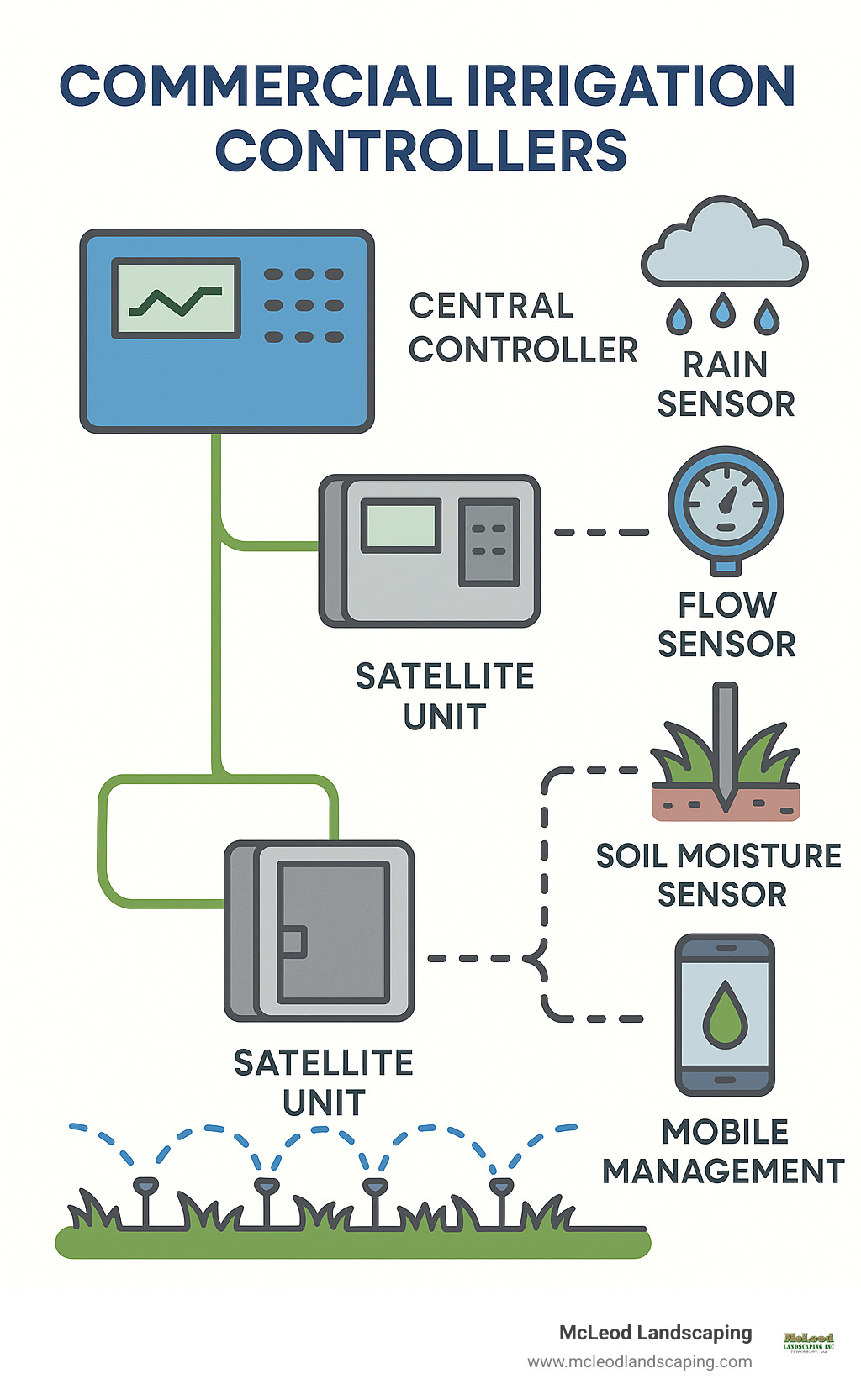
Simple commercial irrigation controllers glossary:
Commercial irrigation controllers are in a completely different league from what you’d find at the local home improvement store. While they share the basic principle of operating 24-VAC solenoid valves, the similarities pretty much stop there. These systems are engineered for the big leagues built to handle larger spaces, tougher conditions, and more complex watering needs.
The most striking difference is sheer capacity. Your typical home controller might manage 4-12 zones, but commercial irrigation controllers can handle an impressive 24, 36, 48 or more zones from a single unit. Some advanced central systems even coordinate hundreds of stations across multiple properties, giving you command over vast landscapes from one control point.
These controllers aren’t just biggerthey’re tougher too. Commercial-grade enclosures come NEMA-rated for serious weather resistance, constructed from cold-rolled steel or industrial-grade plastic that stands up to whatever Mother Nature dishes out here in New England.
The numbers speak for themselves: EPA WaterSense data shows properties using smart commercial irrigation controllers can slash outdoor water usage by up to 50% compared to traditional timing systems. That’s particularly valuable as Massachusetts and neighboring states continue to tighten water conservation regulations.
For more information about selecting the right system for your specific needs, check out our guide to choosing the right irrigation system.
When businesses invest in commercial irrigation controllers, they’re buying more than just equipmentthey’re investing in efficiency and peace of mind.
The labor savings alone can be dramatic. As one landscape manager at a commercial research park shared with us, “We saved 25 million gallons and $120,000 in one season using smart irrigation technology across our 55 acres.” Imagine eliminating those constant manual adjustments and service visits!
Multi-site control is another game-changer. Property managers no longer need to physically visit each location to make scheduling changeseverything can be handled remotely. This becomes especially valuable when weather conditions change suddenly.
Many businesses also find themselves needing to meet specific water conservation requirements set by local municipalities. Modern controllers help them stay compliant while maintaining beautiful landscapes.
Plant health improves too, as different landscape zones receive precisely the water they needno more, no less. As irrigation expert Kurt Thompson notes, “Measuring moisture of the soil is a more accurate way to know when there’s enough moisture in the soil to not irrigate.” Commercial irrigation controllers make this precision possible on a scale that matches your business needs.
Perhaps most impressive is the leak detection capability. When a pipe bursts at 2 AM, the last thing you want is water gushing until someone notices hours later. Advanced controllers can detect unusual flow and automatically shut down the system, potentially saving thousands in water damage.
The gap between commercial and residential controllers extends far beyond just size:
| Feature | Commercial Controllers | Residential Controllers |
|---|---|---|
| Station capacity | 24-200+ | 4-12 |
| Enclosure durability | NEMA-rated, vandal-resistant | Basic weather protection |
| Remote access | Multi-user with permission levels | Single user/homeowner |
| Sensor inputs | Multiple (flow, moisture, ET, rain) | Limited (typically just rain) |
| Programming complexity | Multiple programs, cycle/soak features | Basic scheduling |
| Connectivity | Cellular, WiFi, Ethernet, radio | Typically WiFi only |
| Expansion capability | Modular design for growth | Fixed capacity |
Commercial systems are built with professional landscape managers in mind. They offer sophisticated programming options that account for soil types, plant varieties, slope considerations, and seasonal changes. Their robust reporting capabilities deliver detailed water usage analytics that help businesses track consumption patterns and identify opportunities for further savings.
Many commercial irrigation controllers can also integrate with broader building management systems, creating a unified approach to resource management across your entire property. This holistic view helps businesses make smarter decisions about their overall environmental impact.
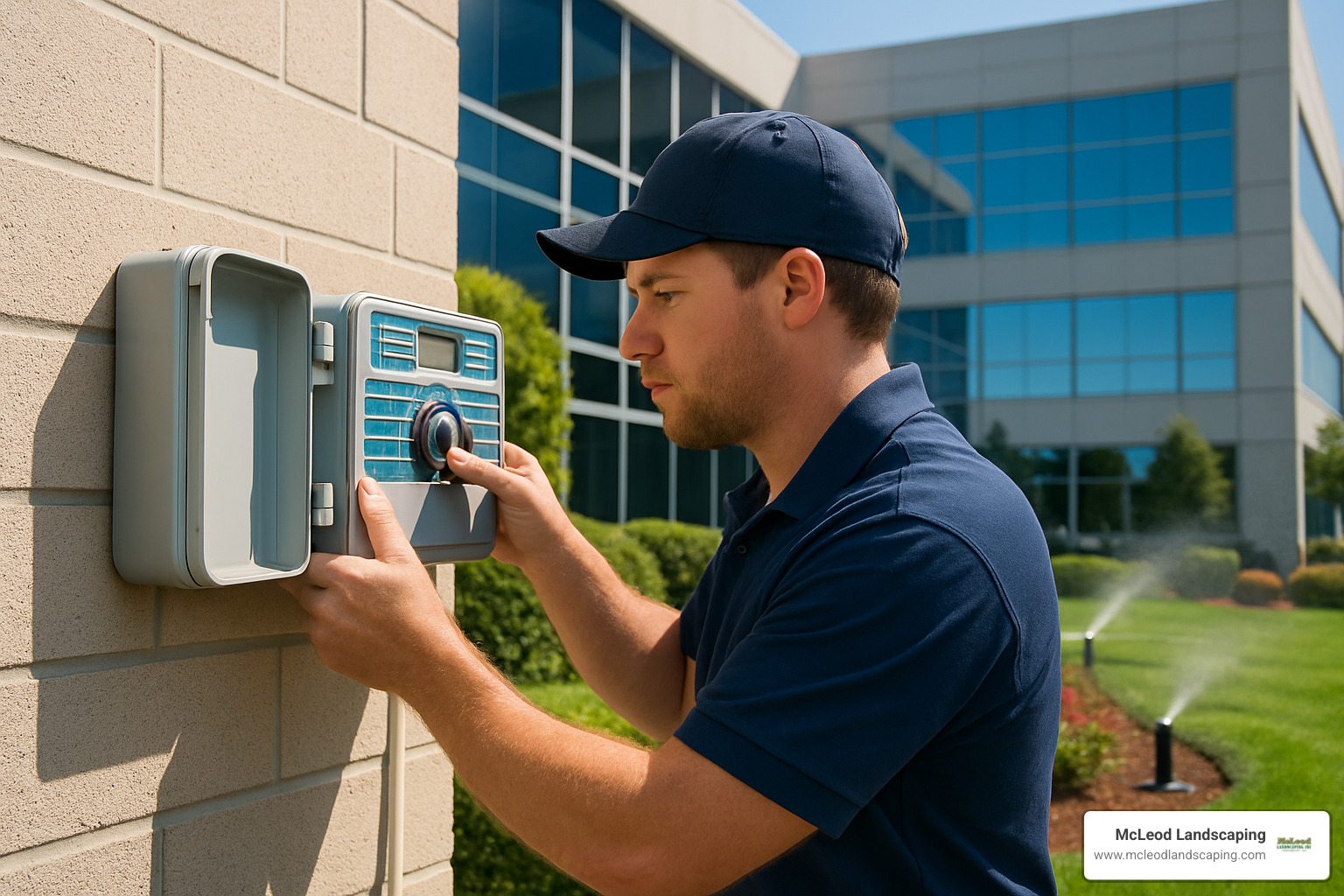
Managing irrigation across sprawling properties like university grounds or golf courses used to mean hours of driving around making manual adjustments. Not anymore! Satellite controllers have revolutionized how we handle watering for these massive spaces.
Think of satellite controllers as the field commanders in your irrigation army. These specialized commercial irrigation controllers work as remote units that stay in constant communication with a central command system. This setup allows your landscape team to coordinate watering across dozens or even hundreds of acres without wearing out their shoe leather.
“Before upgrading to satellite controllers, we had staff members driving around the course making manual adjustments constantly,” shared a golf course superintendent in Chelmsford. “Now, I can adjust irrigation for all 18 holes from my office based on current conditions. When we have a tournament coming up, we can dial in exactly the firmness we want for the greens with precision.”
These systems rely on radio telemetry to maintain their connection to home base. Take the Toro satellite controllers, for instancethey can simultaneously operate up to 7 valves plus a master valve from a single Commander FM transmitter. That’s some serious multitasking!
You’ll typically find these controllers housed in sturdy pedestal enclosures made from cold-rolled steel or industrial-grade plastics. These tough outer shells protect all the sensitive electronics from weather, vandalism, and accidental damage from maintenance equipment. They’re built to withstand years of New England weather while keeping everything inside working perfectly.
When you’re dealing with massive properties, you need technology that can go the distance. Commercial irrigation controllers in satellite configurations use several clever approaches to extend their reach:
Long-range FM transmission systems like the TRC Commander use specialized PDTFM (Pulse Duration Transmission Frequency Modulation) technology to communicate reliably up to 2 miles in open conditions. That’s like being able to adjust your sprinklers from the next town over!
For security, these systems employ private group codes up to 9,999 unique combinations in some models. This prevents unauthorized access and ensures your neighbor’s system won’t accidentally start controlling yours.
Modern systems also incorporate cellular back-haul as either a backup or primary communication method. This eliminates the need for direct line-of-sight between controllers, which is particularly helpful in areas with lots of buildings or rolling terrain.
Some of the most advanced systems create self-healing mesh networks where each controller acts as a relay point. This clever design extends the network’s reach without requiring additional infrastructureeach new controller actually strengthens the whole system.
One of the biggest advantages of satellite systems is their impressive scalability. Many can control up to 199 receivers per group code from a single transmitter. This makes them perfect for phased development projects where your irrigation needs grow alongside your property.
For sites with challenging layouts like properties with hills, valleys, or multiple buildings that might block radio signals hybrid systems combine wireless communication with hardwired connections. This ensures you maintain uninterrupted control throughout your entire landscape, no matter how complex it might be.
With satellite controllers, you’re not just saving water you’re saving time, labor, and headaches while delivering more precise irrigation exactly where and when it’s needed.
At the heart of modern commercial landscape management lies central control systemscomprehensive solutions that bring together all irrigation components under a unified software dashboard. These sophisticated commercial irrigation controllers represent the pinnacle of irrigation technology, offering unprecedented control and data analysis capabilities.
Central control systems typically consist of a software platform that communicates with field controllers through various networkswhether hard-wired, wireless, or a combination of both. The WeatherTRAK system, for example, leverages LTE cellular technology to ensure controllers always have the latest ET (evapotranspiration) weather data and system updates.
These systems truly shine in multi-property management scenarios. Imagine a property management company overseeing dozens of commercial sites across the Merrimack Valleythey can control irrigation for all properties from a single interface. As David Grover, an irrigation professional, puts it: “A mobile app that will allow you to program and operate the controller from your phone will improve efficiencies, saving both you and your customer money.”
The real magic of central control systems comes from their ability to weave together real-time data from multiple sources. Weather stations provide localized climate data, flow sensors monitor water usage and detect leaks, soil moisture sensors measure actual root zone conditions, and ET data calculates plant water needs based on environmental conditions.
When a flow alarm triggersperhaps indicating a broken pipe or malfunctioning valvethe system springs into action, automatically shutting down the affected zone and sending immediate alerts to maintenance staff. This proactive approach prevents water waste and potential property damage before they become serious problems.
According to research published in the Journal of Irrigation and Drainage Engineering, properties using central control systems with weather-based adjustments demonstrate water savings of 30-50% compared to traditional timer-based irrigation. These systems typically achieve return on investment within 1-3 years depending on property size and water costs. Scientific research on smart irrigation ROI confirms these impressive results.
The true intelligence of modern commercial irrigation controllers comes from their ability to integrate data from multiple sensor types. These sensors create a network of information that helps the system make smart watering decisions.
Flow sensors provide real-time monitoring of water usage, offering immediate leak detection and automatic shutdown when problems occur. They also collect historical flow data for water audits and conservation planning, while verifying that valves are operating correctly.
A facilities manager for a Burlington office park shared a telling story: “Our flow sensors detected a main line break at 2 AM on a Sunday. The system automatically shut down the affected zone and alerted our maintenance team. Without that feature, we would have had significant flooding and landscape damage before anyone noticed on Monday morning.”
Rain sensors come in two primary varietieson-site physical sensors that measure actual rainfall and signal-based sensors that receive data from weather networks. As David Grover emphasizes: “It’s critical to have a rain sensor or weather station as close to the property as possible.” This is because rainfall can vary significantly within a one-mile radius, affecting irrigation needs differently across a large property.
Soil moisture sensors provide the most accurate picture of actual plant water needs by measuring available moisture in the root zone. These sensors prove particularly valuable for areas with different soil types, landscapes with varied sun/shade patterns, and properties with multiple microclimates.
When properly integrated, these sensors create a comprehensive feedback loop that ensures irrigation occurs only when and where needed. An independent study in a variable-rainfall region found rain sensors cut annual water use by 22.1% and soil moisture sensors by 66.2%, with ROIs of 87% and 200% in year one, respectively.
Decoder-based systems represent one of the most significant advancements in commercial irrigation controllers over the past decade. These innovative systems dramatically simplify wiring complexity while offering unprecedented scalability for large commercial properties.
Traditional multi-wire systems require a separate wire path from the controller to each valve in the system. As station counts increase, so does the complexity of wiring—creating a potential maintenance nightmare. Decoder systems, by contrast, use just two wires that run throughout the entire irrigation system in a loop, daisy chain, or branch configuration.
Along this two-wire path, small decoder modules are installed at each valve location. Each decoder has a unique address that the controller uses to communicate specifically with that valve. When the controller sends a signal down the two-wire path, only the decoder with the matching address responds by activating its valve.
The benefits of this approach are substantial:
A landscape manager for a Lowell corporate campus that recently converted to a decoder system told us: “The installation was completed in half the time we expected, with significantly less disruption to our landscape. Now, when we develop new areas of the campus, adding irrigation is as simple as tapping into the existing two-wire path and adding decoders.”
| Factor | Decoder (2-Wire) System | Conventional Multi-Wire System |
|---|---|---|
| Cost per foot for main runs | Lower (single 2-wire path) | Higher (multiple wires per zone) |
| Maximum station count | Virtually unlimited (100+ stations) | Limited by controller capacity (typically 48-64) |
| Troubleshooting time | Faster with diagnostic tools | Often requires wire tracing |
| Future expansion | Simple – add decoders to existing wire | Complex – run new wires to controller |
| Initial hardware cost | Higher (decoders add cost) | Lower (simpler components) |
| Wire connections | Fewer (reduced failure points) | Many (more potential failures) |
| Surge protection | Better (fewer paths to protect) | More complex (multiple wires) |
For commercial properties expecting growth or renovation, decoder systems offer significant advantages. The initial investment may be slightly higher, but the long-term flexibility and reduced maintenance costs typically deliver superior value over the system’s lifespan.
It’s worth noting that some modern commercial irrigation controllers offer hybrid capabilities, supporting both conventional wiring and decoder systems. This flexibility allows for phased upgrades, where existing conventional zones can continue operating while new areas are developed using decoder technology.
When trenches and wires just won’t work, wireless and battery-powered commercial irrigation controllers come to the rescue. These innovative solutions have transformed how we approach challenging irrigation sites, bringing smart water management to locations previously considered impractical.
Unlike traditional controllers, these systems feature valve-mounted nodes that operate independently, each with its own battery power source. No electrical connections, no complex wiring diagramsjust streamlined, flexible control where you need it most.
Setting up these systems is refreshingly simple. Most use Bluetooth connectivity for the initial programmingjust walk up to each node with your smartphone, connect, and set your schedule. The more sophisticated systems maintain ongoing communication through radio signals or cellular networks, giving you the same remote management capabilities as their wired counterparts.
A municipal parks manager in Andover told us about their experience with a historic town green: “Traditional trenching wasn’t an option because of protected tree roots and archaeological concerns. Wireless controllers gave us a professional irrigation system with minimal ground disturbance. We only change batteries once per seasonit’s been a game-changer for us.”
Municipal medians and traffic islands practically beg for wireless solutions. Running electrical service to these isolated green spaces is often prohibitively expensive, and trenching across roadways requires permits, traffic disruption, and plenty of patience. Wireless commercial irrigation controllers let these highly visible spaces stay green and beautiful without the infrastructure headaches.
Historic sites with archaeological significance benefit tremendously from wireless technology. A preservation specialist working on a historic property in Concord explained it perfectly: “We needed to protect the site’s integrity while providing adequate irrigation for the period gardens. Wireless controllers let us install a modern system without compromising the historical landscape.”
Seasonal beds and temporary installations that change from year to year love the flexibility these systems provide. When this season’s display gives way to next year’s design, your controllers can move right along with the changes.
Rocky terrain, high water tables, or contaminated soils where trenching creates more problems than solutions are perfect candidates for wire-free control. Why fight the landscape when you can work with it?
While these systems offer compelling advantages in challenging sites, they do have a few limitations worth noting. You’ll need to monitor battery life and schedule replacements, communication range may be limited in some environments, and initial costs might be higher than conventional wired solutions.
For many commercial applications, however, the installation savings and flexibility more than offset these considerations. When you factor in the reduced landscape disruption and elimination of trenching costs, wireless commercial irrigation controllers often emerge as the most practical and cost-effective option for specialized applications.

Investing in the right commercial irrigation controllers isn’t just about buying technology—it’s about finding a solution that fits your unique landscape like a glove. Before making this important decision, I always recommend starting with a thorough site audit to really understand what you’re working with.
Your landscape likely has diverse areas with different watering needs—sunny open lawns, shaded tree areas, perhaps slopes or flower beds. Each of these zones has distinct requirements that your controller will need to manage. Take stock of your existing infrastructure too. What wiring do you have? Where are your valves located? Understanding these elements helps determine whether you need a complete overhaul or can build upon what’s already there.
Communication reliability is absolutely critical for modern commercial irrigation controllers. As David Grover wisely points out, “In most cases, smart controllers that solely rely on Wi-Fi for connectivity are not compatible in a commercial setting.” This is because corporate networks often have security protocols that don’t play nicely with third-party devices. For most commercial properties, cellular connectivity proves to be the most dependable option, though it does come with subscription costs.
Don’t forget to think ahead! If you’re planning landscape expansions in the next few years, choosing a controller that can easily scale will save you headaches down the road.
Based on internet data, expect to invest anywhere from $1,500 for simpler systems to $9,000+ for comprehensive central control solutions. While this might seem substantial upfront, the ROI through water conservation and reduced labor typically recovers these costs within 1-3 years—making it one of the smartest investments for your property.
As irrigation expert Kurt Thompson notes: “The general rule of thumb is it takes two or three seasons, two growing seasons to get it to where it’s actually doing about as good as it can.” This highlights why selecting a system with robust fine-tuning capabilities matters so much for long-term performance.
The quality of installation can make or break even the most advanced commercial irrigation controllers. Proper grounding is non-negotiable—it protects your investment from lightning strikes and power surges. Install ground rods according to manufacturer specifications, use shielded cable for sensitive communications, and add surge arrestors at key junction points.
Thoughtful valve wire organization saves countless hours during future maintenance. Color-code or clearly label all connections, document wire paths on your as-built drawings, and group valves logically by zone. Your future maintenance team will thank you!
Strategic controller placement significantly impacts system reliability. Indoor models should be mounted in weather-protected locations with proper service clearance. Position controllers away from sources of radio interference and secure them against unauthorized access—especially important for properties with public traffic.
Sensor placement requires equal consideration. Rain sensors should be in open areas away from building overhangs, flow sensors need straight pipe runs as specified by manufacturers, and soil moisture sensors must be placed in representative root zones to provide accurate readings.
As one seasoned irrigation technician shared with me: “The quality of the installation is just as important as the quality of the equipment. I’ve seen expensive systems perform poorly due to improper installation, and basic systems perform exceptionally well when installed correctly.”
Even the smartest commercial irrigation controllers need regular attention to keep performing at their peak. During irrigation season, monthly check-ins should become routine: review controller logs for unusual patterns, verify sensor readings against actual conditions, and check for any alert notifications.
Seasonal adjustments keep your system in harmony with changing conditions. As plants grow, flow sensing baselines may need recalibration. Seasonal adjustment percentages should be updated as weather patterns shift, and rain delay settings reviewed for appropriateness.
Annual maintenance ensures long-term reliability. Perform complete controller diagnostics, update firmware to the latest versions, and back up all programming data. Test surge protection components, verify weather data accuracy, and clean cabinet ventilation screens to prevent overheating.
In New England, proper winterization is essential. Document all current settings before shutdown, power down according to manufacturer guidelines, and protect outdoor enclosures from freeze damage. Some sensitive sensors may need removal and indoor storage during harsh winter months.
A facilities manager from a Billerica corporate campus shared this insight: “We maintain detailed records of all controller adjustments and performance metrics. This data has proven invaluable for continuous improvement of our irrigation efficiency. Each year, we’re able to fine-tune the system based on historical performance, resulting in incremental water savings.”
The most successful irrigation systems aren’t just installed and forgotten—they’re continuously monitored, adjusted, and improved over time. This ongoing relationship with your irrigation technology is what transforms a good system into a great one, delivering the perfect balance of landscape health and water conservation for years to come.
Today’s commercial irrigation controllers are impressively versatile when it comes to managing different water supplies. For properties using a mix of city water, reclaimed water, or harvested rainwater, these smart systems can be your water-juggling experts.
Think of it as having a water traffic controller for your property. The system uses dedicated master valves for each source, with sophisticated programming that knows exactly when to tap into which supply. One property manager I worked with in Burlington put it perfectly:
“Our corporate campus primarily uses reclaimed water for irrigation, but we keep city water as our backup. The controller is smart enough to only switch to municipal water when our reclaimed supply runs low. It’s saved us thousands on water bills.”
The real magic happens through flow sensing technology that monitors each source separately, creating detailed usage reports for each water meter. This makes regulatory compliance straightforward and helps with accurate billing allocation – especially important for properties with multiple tenants or departments sharing costs.
For properties in drought-prone areas, these controllers can be programmed to respect water window restrictions automatically, giving priority to non-potable sources whenever available.
When clients ask me about sensors, I always say it depends on their specific needs – but there are definitely some “must-haves” for most commercial properties.
Rain sensors are the absolute baseline. They’re simple devices that prevent your sprinklers from running during or after rainfall – which not only saves water but also prevents that embarrassing scenario where your sprinklers are running while it’s pouring rain. Many municipalities actually require these by law now.
Flow sensors are like having insurance for your irrigation system. They monitor water flow in real-time and can automatically shut things down if they detect a broken pipe or malfunctioning valve. One of our clients avoided major flood damage when their flow sensor detected a broken mainline at 2 AM and shut the system down before anyone even arrived on site.
Soil moisture sensors take things to the next level by measuring what’s happening in the actual root zone. Rather than guessing when plants need water, these sensors provide direct feedback about soil conditions. They’re particularly valuable for high-visibility areas like entrance landscapes or specialty garden areas.
Weather stations or ET sensors are the premium option, collecting comprehensive climate data that helps your controller make smart decisions based on evapotranspiration rates – essentially how quickly moisture is being drawn from your plants and soil.
For most commercial properties, I recommend starting with rain and flow sensors at minimum, then adding soil moisture sensors for your showcase landscape areas. The investment typically pays for itself quickly through water savings.
Absolutely! This is one of the most powerful features of modern commercial irrigation controllers. Cloud-based platforms like Hydrawise, WeatherTRAK, and Rain Bird’s IQ are specifically designed with multi-property management in mind.
Imagine sitting at your desk (or honestly, on your couch at home) and being able to adjust irrigation schedules across dozens of properties with a few taps on your phone. These platforms let you organize properties by client, location, or whatever grouping makes sense for your operation.
One landscape management company I work with oversees irrigation for more than 30 commercial properties throughout the Merrimack Valley. Their irrigation manager told me: “When we get an unexpected heat wave, I can adjust watering schedules for all affected properties in about 10 minutes. Before our smart controller upgrade, that would have been days of driving around to each controller.”
These systems also offer customizable permission levels, so you can give your maintenance team access to make basic adjustments while keeping more significant changes restricted to management. You can even set up different alert notifications – maybe you want leak alerts sent to your maintenance supervisor immediately, but water usage reports sent to the property owner monthly.
For property management companies or landscaping services with multiple clients, this capability isn’t just convenient – it’s a complete game-changer for operational efficiency and consistent landscape quality.
The evolution of commercial irrigation controllers has transformed landscape management from an imprecise art to a data-driven science. Today’s controllers offer unprecedented capabilities for water conservation, remote management, and landscape health optimization that were simply unimaginable just a decade ago.
Water is becoming an increasingly precious resource, with regulations growing more stringent each year. Investing in advanced irrigation control technology isn’t just a nice-to-have anymoreit’s essential for responsible commercial property management. The powerful combination of environmental benefits, substantial cost savings, and noticeably improved landscape quality creates a compelling business case for upgrading outdated irrigation systems.
What we’ve learned about commercial irrigation controllers throughout this guide boils down to some impressive benefits. Smart, weather-based controllers typically reduce water consumption by 30-50%, with most properties seeing a complete return on their investment within just 1-3 years. The remote management capabilities dramatically cut labor costs, while flow monitoring prevents potentially costly water damage from system failures. When you integrate multiple sensor types, you get precisely controlled irrigation that keeps landscapes healthy while minimizing waste.
At McLeod Landscaping, we’ve had the privilege of helping businesses throughout the Merrimack Valley modernize their irrigation systems with state-of-the-art controllers custom to their specific needs. Our three decades of experience in the region gives us unique insight into the local climate challenges and water conservation requirements that commercial properties face here.
Whether you’re responsible for a sprawling corporate campus, a busy retail center, municipal property, or multi-family housing development, the right commercial irrigation controller can completely transform your approach to landscape management. The results speak for themselves: water conservation, healthier plants, reduced maintenance costs, and improved property appearance that boosts your organization’s image.
For more information about commercial irrigation systems and how the right controller can benefit your property, visit our Commercial Irrigation Systems page or contact our irrigation specialists for a consultation.
Contact McLeod Landscaping today at (978) 640-0957 or click here to schedule a consultation for retaining wall installation. Let our experienced team design and install a functional and visually appealing retaining wall that enhances your landscape.

1881 Main St Unit 1, Tewksbury, MA 01876