
Commercial irrigation heads are specialized sprinkler components designed for large-scale properties like office complexes, retail centers, and industrial parks. Unlike residential systems, these professional-grade heads deliver consistent performance across vast areas while withstanding heavy use and potential vandalism.
Key benefits include heavy-duty construction, higher water pressure tolerance (45-50+ PSI), and vandal-resistant designs. They also offer advanced features like pressure regulation and debris flushing, leading to water savings of up to 30%. Common types include:
The choice between commercial and residential heads comes down to durability and performance. As Hunter Industries proved with their PGP rotary sprinkler in 1981, professional-grade equipment delivers long-term value through superior engineering. Commercial properties face unique challenges—from foot traffic to precise watering needs—that standard heads can’t handle.
I’m Scott McLeod, and with 30 years of experience maintaining commercial properties in the Merrimack Valley, I’ve seen how the right commercial irrigation heads improve water efficiency and landscape health. My team at McLeod Landscaping has installed and serviced these systems on everything from retail complexes to industrial parks, giving us deep insight into what works best.
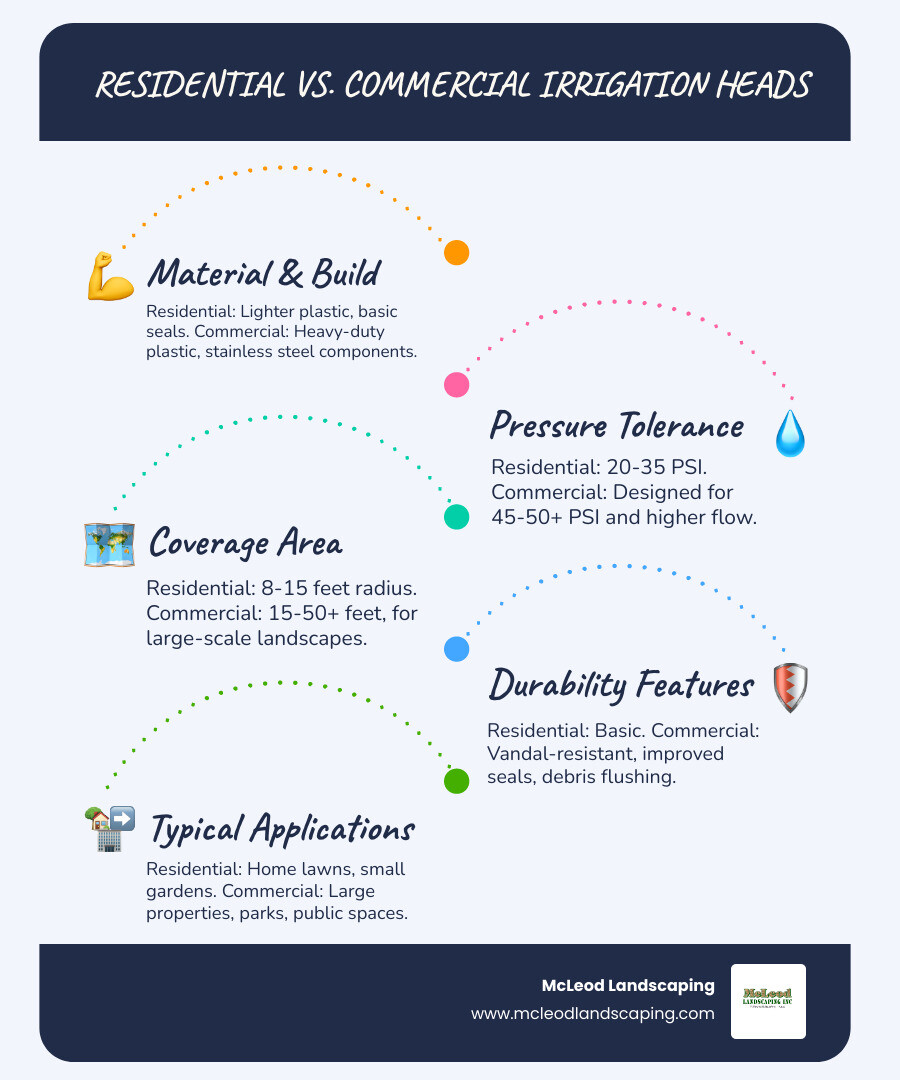
Commercial irrigation heads terms explained:
Choosing the right commercial irrigation heads means matching the tool to the job. You wouldn’t use the same sprinkler for a parking lot island as you do for a sprawling lawn. Understanding the different types is key to water efficiency and landscape health.
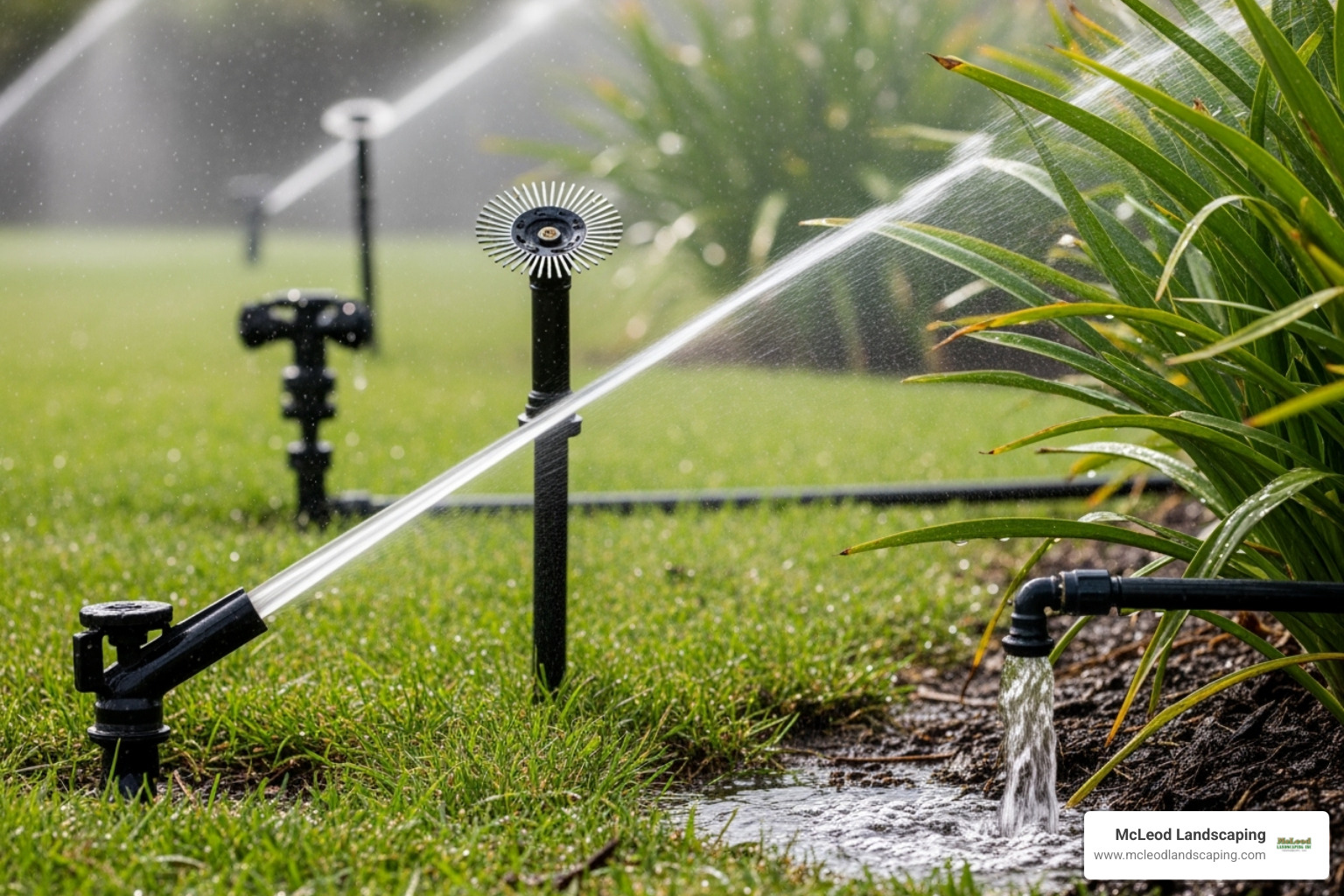
When you need to cover serious ground, rotor sprinklers are the solution. They can throw water 15 to 50+ feet, making them perfect for sports fields, parks, and large corporate lawns.
Rotors use a gear-driven mechanism to slowly rotate the water stream. This slow rotation delivers water at a lower precipitation rate, giving soil time to absorb it and reducing runoff. This method promotes deep root growth, creating healthier, more drought-resistant turf. They operate best at 45-50 PSI and provide even coverage, making them a water-conserving choice for large spaces. For property managers, one rotor can do the work of several smaller heads, simplifying maintenance.
You can learn more about optimizing these systems in our guide to Irrigation Systems for Lawns.
While rotors handle large areas, spray heads excel at precision work in shrub beds, small lawns, and irregularly shaped areas. They deliver water in a fixed spray pattern with no moving parts for reliable coverage.
Most commercial spray heads are pop-up bodies (in 4, 6, or 12-inch heights) that retract when not in use, protecting them from damage and keeping landscapes looking clean. The key technology is Matched Precipitation Rate (MPR) nozzles, which ensure all heads in a zone apply water at the same rate, regardless of their pattern. This eliminates overwatered corners and dry spots. Spray heads have a higher precipitation rate than rotors, so they require careful planning to avoid runoff, especially on slopes.
For maximum precision and water efficiency, drip emitters and bubblers deliver water exactly where plants need it with minimal evaporation and waste.
Drip irrigation uses a network of tubing and emitters to deliver water direct-to-root, ideal for flower beds, trees, and shrubs. Pressure compensating emitters ensure a consistent flow, even on sloped terrain. Bubblers create a concentrated flow to deeply soak the soil around individual plants like trees and large shrubs, encouraging deep root growth.
Both systems offer high water efficiency, with potential savings of 30-50% over traditional spray methods. They are also unaffected by wind and eliminate overspray onto sidewalks. While they require occasional checks for clogs, they have no moving parts to wear out.
For more on implementation, see our Commercial Automatic Drip Irrigation System page.
Selecting commercial irrigation heads is more complex than a trip to the hardware store. A commercial property’s unique demands require careful consideration of multiple factors to create an efficient, reliable system. A system failure can impact your business image and operational costs, so understanding these factors is crucial.

Commercial properties face heavy foot traffic, maintenance equipment, and potential vandalism. Key features to look for include:
For ongoing support, our team specializes in keeping these systems running smoothly. Learn more about our Commercial Irrigation Repair services.
The nozzle determines the effectiveness of your irrigation. Proper selection requires balancing several factors:
The choice between adjustable arc nozzles for irregular spaces and fixed pattern nozzles for standard areas depends on your landscape’s specific layout.
Explore our approach to Commercial Irrigation System Design.
Ensuring your new commercial irrigation heads are compatible with your existing system is essential.
Understanding these compatibility factors prevents costly mistakes. For more on how these components work together, visit our guide on How Does a Lawn Irrigation System Work?.
Today’s commercial irrigation heads are smarter and more efficient thanks to cutting-edge technology. These advances offer unprecedented automation and control, translating to real cost savings and more sustainable water management.
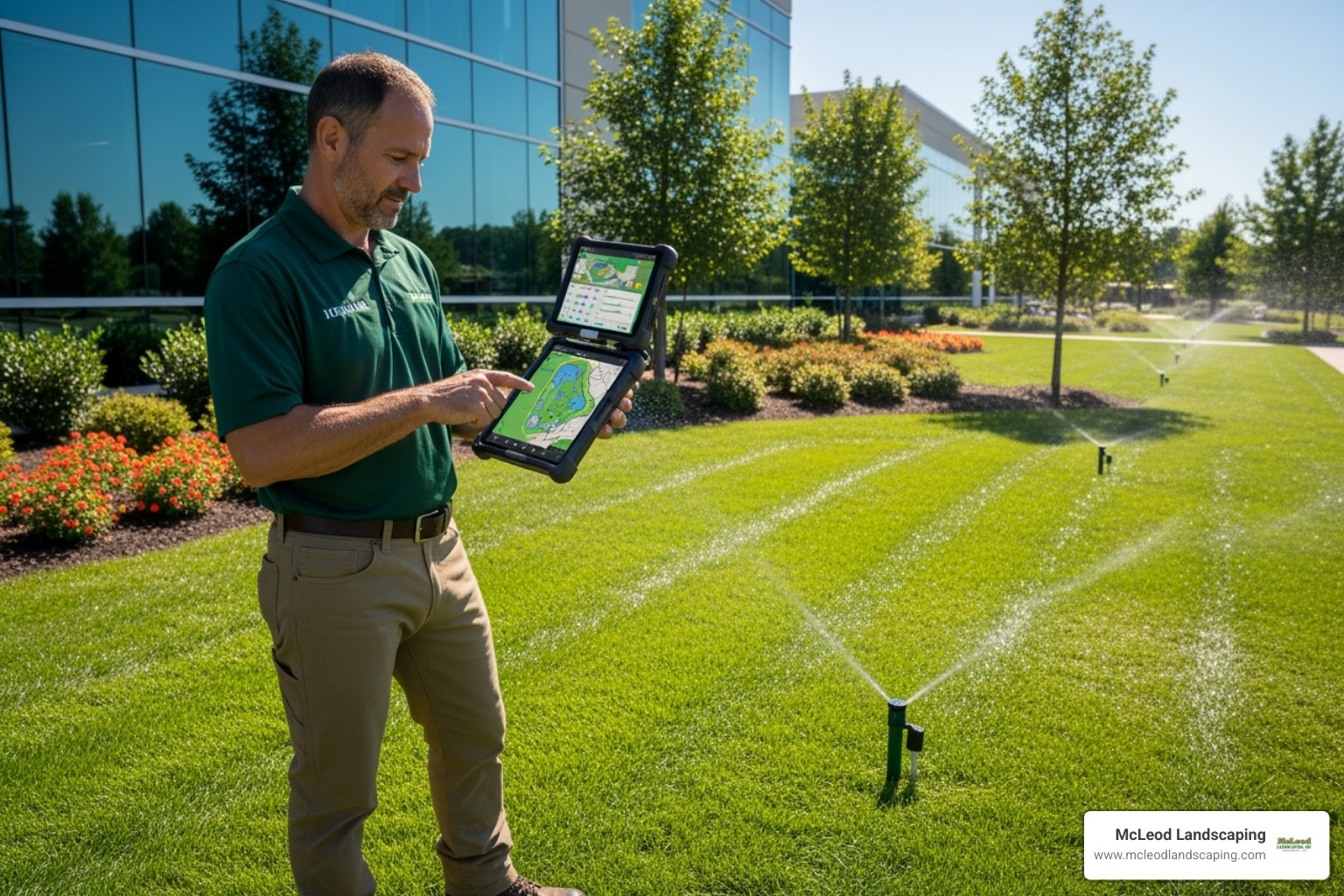
What used to require constant manual oversight can now be automated, monitored remotely, and optimized in real-time. This evolution is about creating cost-effective systems that deliver better results with less water.
Sophisticated engineering within commercial irrigation heads is key to modern water conservation.
The EPA recognizes these technologies. Learn more at EPA WaterSense.
The shift toward smart control and connectivity has revolutionized commercial irrigation. Wi-Fi enabled controllers allow you to manage your system from a smartphone or computer.
These intelligent systems integrate with real-time weather data, Evapotranspiration (ET) sensors, and soil moisture sensors to calculate exactly how much water is needed. Watering is automatically skipped during rain and increased during dry spells. Remote system access allows for instant troubleshooting and management of multiple properties from a single interface. The detailed water usage reporting is invaluable for budgeting and demonstrating conservation efforts.
These advances also benefit residential systems, as discussed in our guide on The Benefits of Installing a Smart Irrigation System in Your Home. Combining advanced heads with smart control creates an intelligent, responsive system designed to save water and money.
While the initial price of professional-grade commercial irrigation heads and smart systems can seem high, it’s an investment that pays dividends for years. The real value appears in lower water bills, healthier landscapes, and the reliability of a system that works.
The ROI from upgrading to efficient commercial irrigation heads and smart systems can be significant. For example, the University Research Park invested in smart irrigation and it paid for itself within the first season, saving 25 million gallons of water and $120,000 on water bills across 55 acres.
Other benefits include:
Independent research supports this. One study found that rain sensors reduced water use by 22.1%, while soil moisture sensors achieved a 66.2% reduction. The ROI was 87% for rain sensors and up to 200% for soil moisture sensors within the first year.
Please note that any cost estimates mentioned are average costs based on internet data and do not reflect specific pricing for McLeod Landscaping. Costs can vary significantly based on property size, system complexity, and regional factors, with total project costs potentially being 3x the average or more.

Choosing professional-grade commercial irrigation heads isn’t an expense—it’s an investment in your property’s future.
For a general understanding of installation costs, see our guide on How Much Does it Cost to Install an Irrigation System?.
Over three decades working with commercial properties in the Merrimack Valley, I’ve answered countless questions about commercial irrigation heads. Here are the most common ones.
The primary difference is durability and performance. Commercial heads are built with heavy-duty plastic and stainless steel to withstand higher water pressures (45-50+ PSI), heavy use, and potential vandalism. They also offer a wider range of features like pressure regulation and improved seals not typically found on residential models, which are designed for lower pressures (20-35 PSI) and less demanding environments. This robust construction ensures reliability and a longer lifespan in challenging commercial settings.
A best practice is to perform “wet checks” of every zone at least monthly during the watering season. This involves running the system to visually inspect for leaks, broken heads, clogged nozzles, or poor coverage. Catching problems like puddles or dry spots early allows for immediate repairs, which conserves water and protects the landscape. Additional checks are wise after severe weather events. A small leak caught early is a minor fix; left unchecked, it can become a major expense.
No, this is not recommended. Different head types (rotors, sprays, bubblers) have vastly different precipitation rates. Mixing them in one zone causes severe overwatering in some areas and underwatering in others, which wastes water and stresses plants. A properly designed system groups similar head types into distinct zones to ensure each area receives uniform water coverage. This is a fundamental principle of professional irrigation design for maintaining a healthy landscape and maximizing efficiency.
Choosing commercial irrigation heads is a smart investment in your landscape’s future. These professional-grade systems deliver tangible benefits far beyond simple watering.
The durability of commercial heads means fewer repairs and headaches, while their water efficiency—boosted by features like pressure regulation and high-efficiency nozzles—can cut water use by up to 30%, significantly lowering your bills. When paired with advanced technology, irrigation becomes an automated, intelligent system that saves time, labor, and resources. This leads to significant long-term savings and a consistently healthy landscape that improves your property’s value and professional image.
At McLeod Landscaping, we have over 30 years of experience designing and installing irrigation systems across Andover, Billerica, Burlington, Carlisle, Chelmsford, Concord, Lowell, Tewksbury, Westford, and Wilmington. Our McLeod Landscaping expertise ensures you get a system designed for years of reliable, efficient service.
Ready to upgrade your property’s irrigation? Contact us for your Commercial Irrigation Systems needs and let’s discuss how we can help your landscape thrive.
Contact McLeod Landscaping today at (978) 640-0957 or click here to schedule a consultation for retaining wall installation. Let our experienced team design and install a functional and visually appealing retaining wall that enhances your landscape.


1881 Main St Unit 1, Tewksbury, MA 01876