
Looking for the right commercial irrigation sprinkler heads for your property? Here’s a quick overview of the main types:
Commercial irrigation sprinkler heads are the critical components that determine how effectively and efficiently your landscape receives water. Unlike their residential counterparts, these workhorses are built with heavier-duty materials, higher flow capacity, and greater durability to withstand the demands of daily operation in high-traffic environments.
Selecting the right heads for your commercial property isn’t just about keeping your landscape green—it’s about conserving water, reducing utility costs, and maintaining your property’s curb appeal. According to the EPA, properties with extensive irrigated landscapes can spend up to 30% of their water bill on irrigation alone. The right sprinkler heads can dramatically reduce this expense.
Modern commercial heads offer impressive features that older systems simply can’t match: pressure regulation that saves up to a gallon of water per minute, check valves that prevent drainage and erosion, and precision-engineered nozzles that ensure uniform coverage without wasteful overspray.
Whether you’re irrigating a corporate campus, retail center, sports field, or multi-family property, the sprinkler heads you choose will make or break your irrigation system’s performance.
I’m Scott McLeod, owner of McLeod Landscaping Inc., and with over three decades of experience installing and maintaining commercial irrigation sprinkler heads throughout the Merrimack Valley, I’ve seen how the right components can transform a property’s appearance while reducing maintenance headaches and water bills.
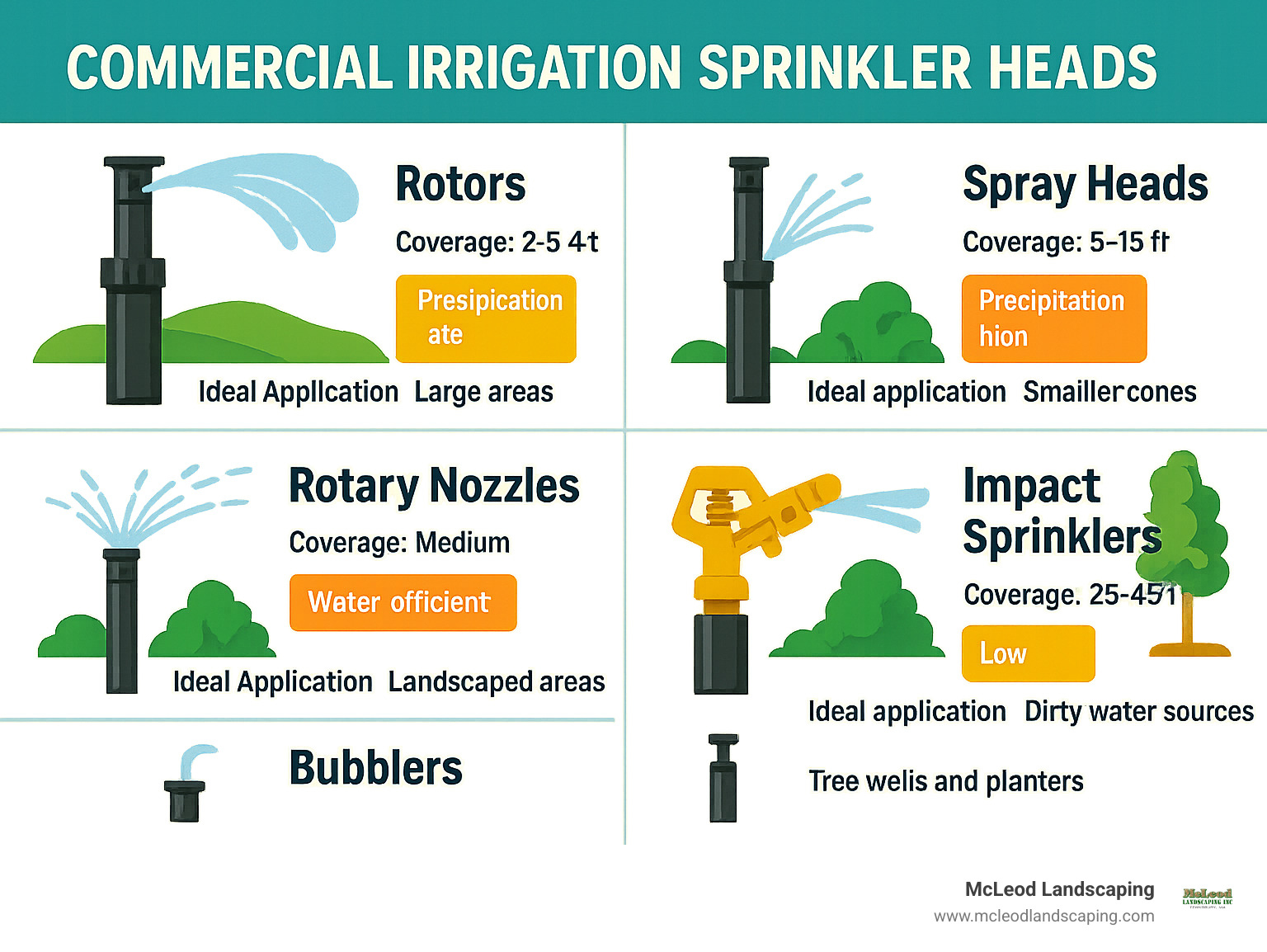
Commercial irrigation sprinkler heads terms at a glance:
– commercial irrigation controllers
– commercial irrigation system design
– automatic sprinkler system
When it comes to commercial irrigation sprinkler heads, understanding the differences between types is crucial for designing an efficient system. Each type serves a specific purpose and excels in different applications.
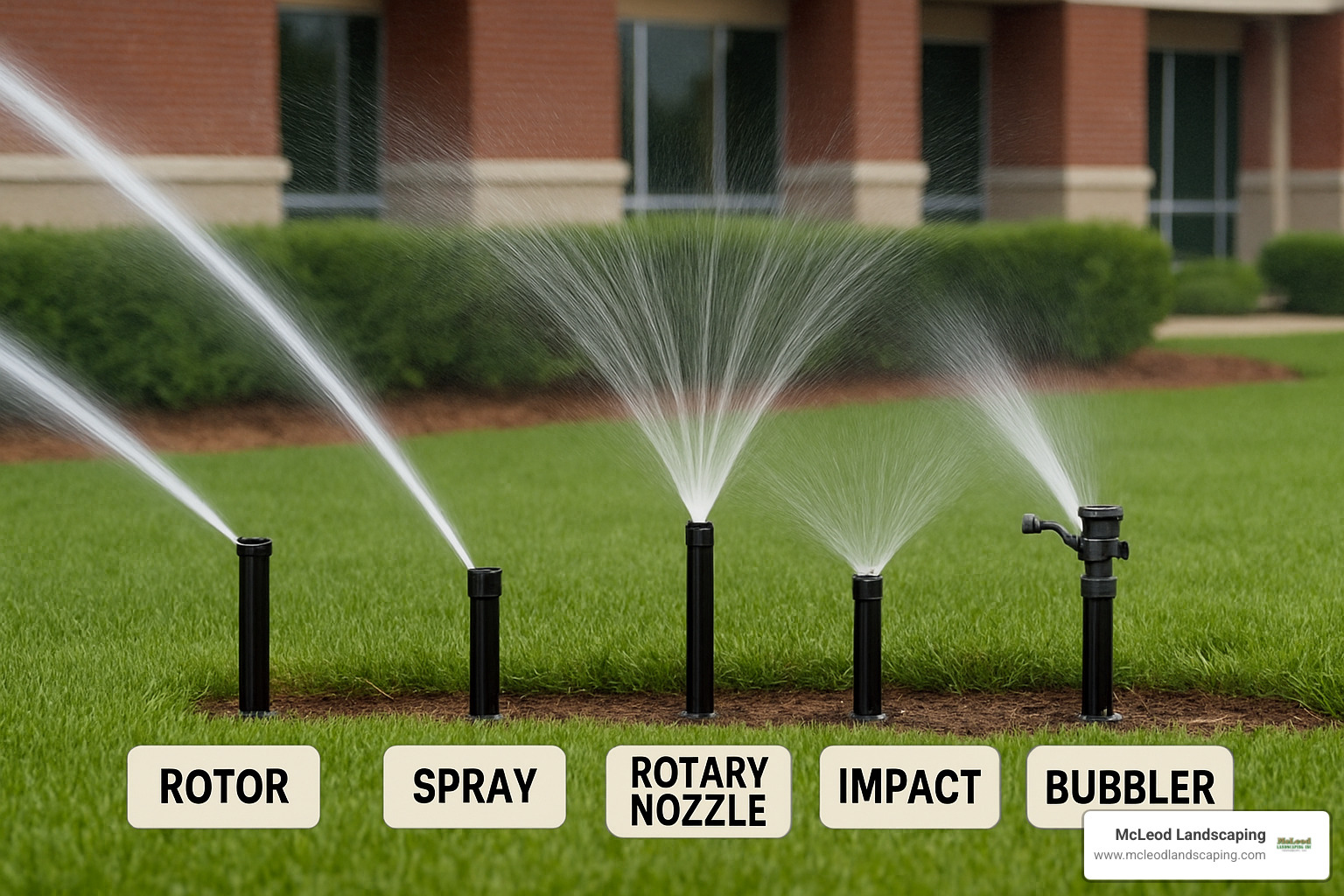
Picture this: a corporate campus with expansive green lawns that seem to stretch for acres. This is where rotor heads truly shine. These rotating marvels deliver water in concentrated streams that rotate slowly across large areas, making them the undisputed champions of wide-open spaces.
Rotors can throw water an impressive 8 to 81 feet, perfect for those sprawling commercial lawns, sports fields, and open green spaces where coverage is key. What makes them especially valuable is their low precipitation rate—they deliver water more slowly over time, giving the soil a chance to properly absorb moisture without creating wasteful runoff, particularly important on sloped terrain.
On those breezy Massachusetts days, rotors have another advantage: their concentrated streams cut through wind far better than the fine mist produced by spray heads. This means the water actually reaches its intended target rather than blowing onto sidewalks or parking lots.
The Hunter PGP series exemplifies commercial-grade rotors, designed for spacings between 25 and 45 feet. These workhorses need at least 30 PSI to operate effectively and feature interchangeable nozzles that let us customize precipitation rates to match your specific soil conditions.
When we’re designing your system, we follow Stryker’s Rule: the distance between rotor heads (measured in feet) should never exceed the operating pressure (in PSI). This industry standard ensures adequate coverage without dry spots.
For those smaller, more intricate areas of your commercial property, spray heads are your best friends. Unlike rotors, spray heads emit a fixed fan of water that blankets the entire target area at once—think of them as the precision instruments in your irrigation orchestra.
Commercial irrigation sprinkler heads of the spray variety excel in courtyards, narrow strips between walkways, smaller lawn sections, and planting beds. Their versatility is remarkable—available in fixed patterns (full, half, quarter, third circles) or adjustable from 0-360 degrees to fit exactly the space you need to water.
Commercial properties often have varying landscape features, which is why these heads come in pop-up heights ranging from 2″ to 12″. This allows them to clear taller turf or groundcover while still retracting safely below mowing height when not in use.
The Rain Bird 1800 Series has earned its place as the world’s leading commercial-grade irrigation spray brand. These tough performers feature co-molded wiper seals that stand up to grit, pressure fluctuations, and New England’s sometimes harsh environmental conditions.
One of the smartest innovations we recommend is pressure-regulating stems (PRS). These water-saving champions can save up to a gallon per minute compared to standard models by maintaining optimal nozzle pressure regardless of what’s happening with your water supply. That adds up to significant savings on your water bill while ensuring consistent coverage.
When it comes to trees, shrubs, and planters around your commercial property, bubblers and flood emitters offer specialized watering that standard heads simply can’t match.
Think of bubblers as the gentle giants of the commercial irrigation sprinkler heads family. They deliver water in a concentrated area where it’s needed most—directly to the root zone. This targeted approach not only conserves water but promotes healthier plant growth by encouraging deeper root development.
These specialized heads typically operate at lower pressures than conventional sprays, with adjustable flow rates ranging from 0.25 to 2 gallons per minute. This flexibility allows us to customize the water delivery based on the specific needs of your landscape plants.
For commercial properties where public access is a concern, many bubbler models feature vandal-resistant caps that prevent tampering—an important consideration for retail centers, office parks, and municipal properties.
Flood heads are particularly valuable for tree wells in commercial settings. They deliver water directly to the root zone without wetting trunks (which can lead to disease) or creating unsightly splashing onto adjacent hardscapes. For newly installed trees on your property, this targeted watering approach helps establish strong roots while using water efficiently.
Selecting the right commercial irrigation sprinkler heads feels a bit like matchmaking—you’re pairing your landscape’s unique personality with the perfect watering partner. It’s not just about grabbing whatever’s on sale; it’s about understanding the specific needs of your commercial property.
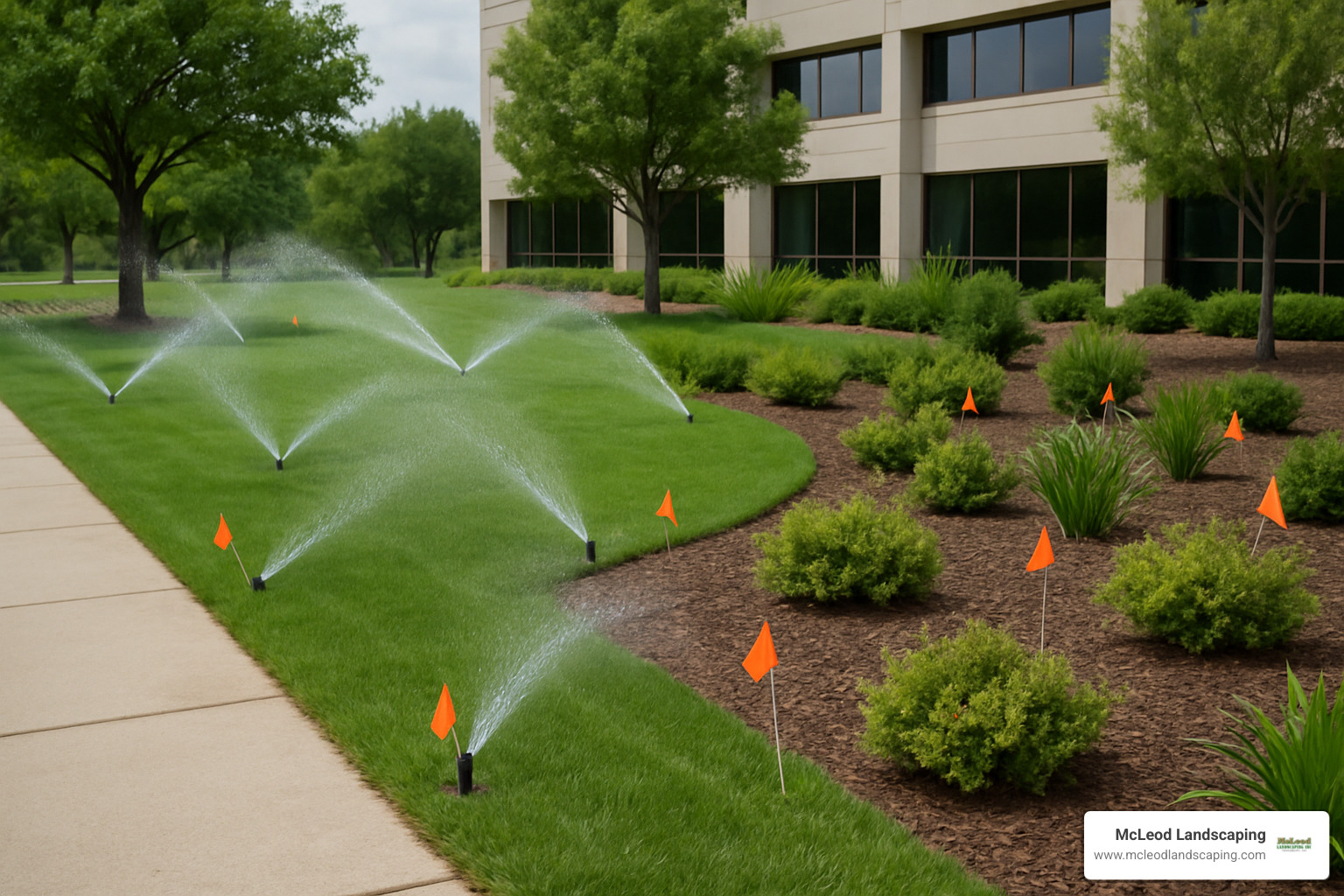
Your site’s characteristics play a huge role in this decision. Heavy clay soil? It drinks water slowly, so you’ll want heads with lower precipitation rates to avoid puddles and runoff. Working with sandy soil? It’s thirsty but drains quickly, so you might need higher flow rates.
Those sloped areas on your property deserve special attention too. The steeper the hill, the slower you’ll want to apply water to prevent it from racing downhill before it can soak in. And let’s not forget about your plant mix—your Kentucky bluegrass has very different needs than your drought-tolerant shrubs or thirsty maple trees.
Behind the scenes, your water system’s pressure and flow capacity are the unsung heroes (or potential villains) of your irrigation setup. Without adequate pressure, even the fanciest sprinkler heads won’t perform their magic properly.
Think of your landscape as a neighborhood with different districts, each with its own watering requirements. Commercial irrigation sprinkler heads need to be sized appropriately for each zone.
For your expansive lawn areas over 30 feet wide, rotors are the champions. They’ll comfortably cover 25-45 feet between heads, delivering water in a steady, rotating pattern that mimics natural rainfall. Medium-sized lawns between 15-30 feet wide? Rotary nozzles hit the sweet spot with their 15-30 foot reach. For those cozy lawn areas under 15 feet, traditional spray heads with their 8-15 foot spacing will do the trick.
Your shrub beds need a different approach altogether. Tall shrubs benefit from either 12-inch pop-up spray heads or shrub adapters mounted on risers that peek above the foliage. Medium plantings work well with 6-inch pop-ups, while ground cover areas can make do with 4-inch pop-ups.
Those tricky narrow strips along walkways or between buildings? They’re perfect candidates for specialized strip pattern nozzles that distribute water in rectangular patterns rather than circles.
If you’re considering converting some areas from traditional sprays to water-saving drip irrigation, you don’t need to start from scratch. Many modern spray heads can be fitted with threaded caps that accept drip line adapters—giving you the best of both worlds.
Water pressure is to sprinkler heads what fuel pressure is to a car engine—get it wrong, and performance suffers dramatically. Commercial irrigation sprinkler heads are designed to operate within specific pressure ranges.
Most commercial rotors need between 30-70 PSI to perform their best, while spray heads typically require a more modest 15-30 PSI. If your property has high water pressure (a common issue in many commercial settings), consider pressure-regulating stems (PRS) that act like traffic cops, controlling the flow to an optimal level. These smart devices can save approximately one gallon per minute per head—savings that add up quickly across a large property.
Flow requirements vary significantly between head types too. Rotors typically use between 2-7 gallons per minute, while spray heads consume anywhere from 0.5-4 GPM depending on the nozzle size and arc pattern you choose.
Hunter Pro-Spray models demonstrate this flexibility, operating effectively across pressures from 15 to 100 PSI. For best results, group similar heads together in zones—this way, you won’t have high-flow rotors competing with low-flow sprays for the same water supply.
Want to dig deeper into designing the perfect system for your property? Our Commercial Irrigation System Design page offers more detailed guidance custom to commercial properties.
The nozzle is where the rubber meets the road—or in this case, where the water meets your landscape. This is where fine-tuning happens to match your property’s exact needs.
For areas plagued by wind or with tree canopies overhead, low-angle jets deliver water closer to the ground, reducing drift and evaporation. Those narrow parking lot islands and medians? They’re perfect for strip pattern nozzles designed specifically for rectangular areas.
Corner areas present unique challenges, but corner nozzles with precise quarter-circle coverage ensure water stays exactly where it belongs without wasteful overspray. Many quality nozzles also offer adjustable radius features, allowing you to reduce coverage by up to 25% without changing out the entire nozzle—perfect for fine-tuning your system.
If your property faces drought restrictions (increasingly common in many regions), high-efficiency nozzles are worth their weight in gold. Hunter’s MP Rotator and Rain Bird’s R-VAN rotary nozzles deliver larger water droplets that resist wind drift and evaporation, using up to 30% less water than traditional spray nozzles while maintaining beautiful green spaces.
One pro tip: Be cautious with quarter-circle (90°) nozzles that flow under 2 GPM—they’re particularly vulnerable to wind drift. Either use them only in sheltered areas or opt for higher-flow models in exposed locations for more consistent coverage.
With thoughtful selection of commercial irrigation sprinkler heads, you’ll create a system that maintains a lush, healthy landscape while being kind to both your water bill and the environment.
Proper installation of commercial irrigation sprinkler heads is just as important as selecting the right components. Even the best heads will perform poorly if improperly spaced or installed.
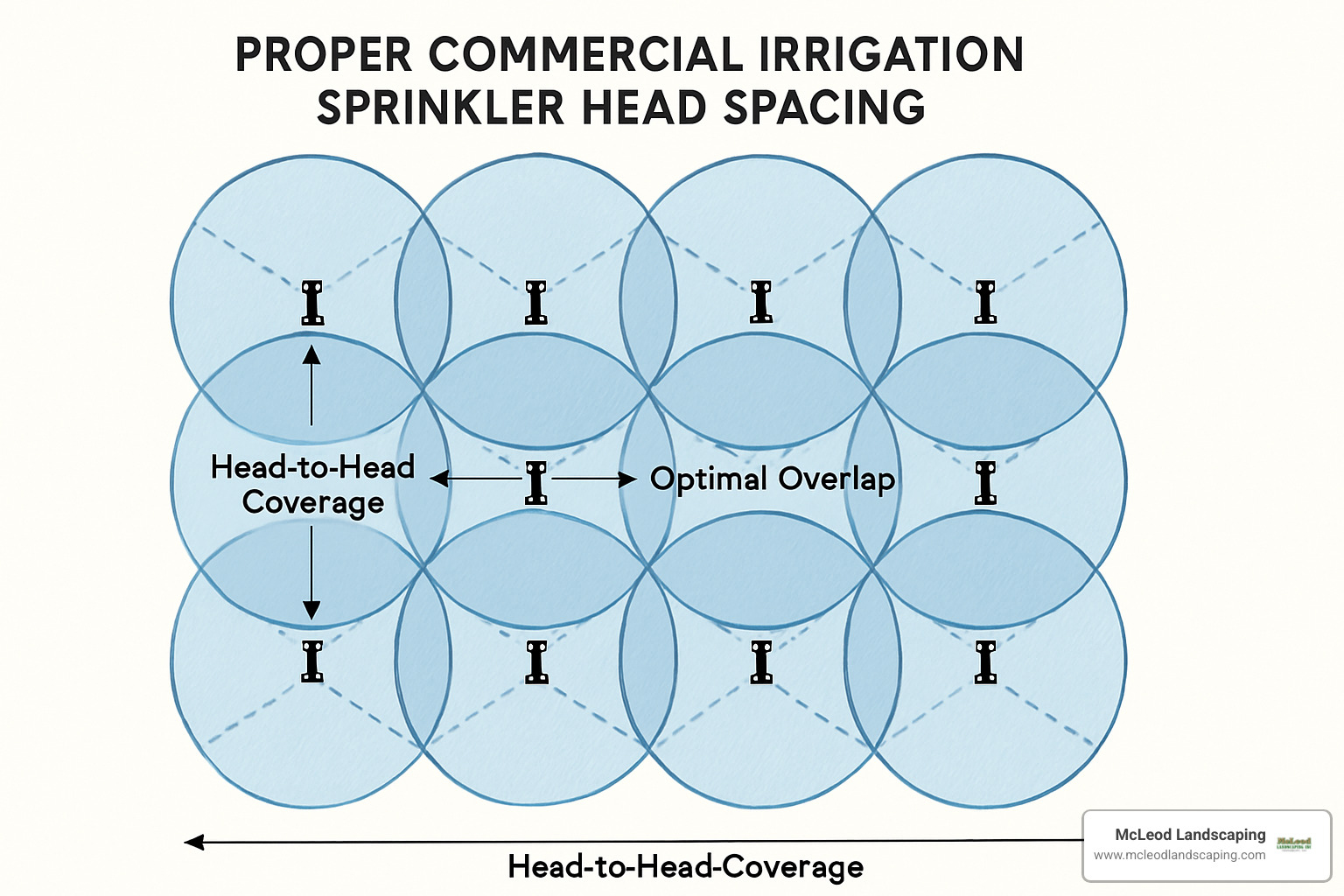
The golden rule of sprinkler layout is head-to-head coverage. This isn’t just industry jargon—it means each sprinkler should throw water all the way to the adjacent heads. Without this overlap, you’ll end up with those frustrating dry spots that turn your lush green landscape into a patchy eyesore.
When we design systems at McLeod, we rely on triangular spacing as our go-to pattern. It’s simply the most efficient way to achieve uniform coverage while using the fewest heads possible—good for both your budget and water conservation. We also follow what’s known as Stryker’s Rule: the spacing between heads (in feet) should never exceed the operating pressure (in PSI). This practical guideline helps ensure your system has enough oomph to perform as designed.
Don’t forget about those swing joints—these flexible connections are worth their weight in gold. They prevent damage when someone inevitably runs over a head with a mower, and they make height adjustments a breeze during installation or future maintenance.
As our friends at Sprinkler Warehouse wisely note, “The goal of adding an irrigation system to your yard is to have lush green grass and plants…” Proper spacing isn’t just a technical detail—it’s the foundation of a beautiful landscape.
Installing commercial irrigation sprinkler heads isn’t rocket science, but it does require attention to detail and proper sequencing. Here’s how we approach it:
First, we plan the layout by marking head locations based on the coverage radius and required overlap. This step saves countless headaches down the road. Next comes pipe sizing—a critical but often overlooked step. Those lateral lines need to be sized properly to maintain adequate pressure at even the furthest heads.
After installing mainlines and valves (positioned for easy access, of course), we run lateral lines to each head location. Then come those swing joints or risers I mentioned earlier—absolutely essential for protecting your investment from damage.
Setting the proper riser height is crucial, especially in commercial settings. We recommend at least 6″ pop-up height for turf areas to ensure heads will clear the grass even after a few weeks of growth. There’s nothing more frustrating than a sprinkler that can’t pop up high enough to do its job!
Before we install any heads, we always flush the system thoroughly. This simple step clears out debris that could clog your new heads on day one. Then we install the heads at grade level (never sticking up where they could be damaged or cause trips) and make our initial arc and radius adjustments.
The final step is always a complete test and adjustment phase. There’s no substitute for seeing the system in action and making those fine-tuning adjustments that transform a good system into a great one.
While tackling installation yourself might seem like a money-saver, commercial irrigation systems are one area where professional expertise truly pays dividends.
Based on internet averages (not McLeod prices), professional installation labor typically ranges from $1,500 for small systems to $6,000+ for large commercial properties. The commercial irrigation sprinkler heads themselves cost between $5 for basic spray heads to $35+ for high-end rotors with all the bells and whistles like check valves and pressure regulation.
Don’t forget those additional costs that often surprise DIYers: permit fees, backflow prevention devices, controllers, and sensors can add up quickly.
The professional advantage goes beyond just proper installation. You’re also getting expert system design that accounts for your specific site conditions—sun exposure, plant types, and slope variations. We ensure compliance with local codes (which can be a maze to steer) and provide warranty protection on both parts and labor.
Perhaps most importantly, a professionally designed system delivers long-term water savings that often offset the higher initial investment. After three decades of installing irrigation throughout the Merrimack Valley, we’ve developed an intimate knowledge of local soil conditions, water pressure variations, and regulatory requirements. This isn’t knowledge you can easily pick up from a YouTube tutorial!
When your sprinklers work properly from day one, you avoid the costly cycle of troubleshooting, replacing damaged components, and watching parts of your landscape suffer from improper watering. Sometimes the most affordable option in the long run isn’t the cheapest upfront.
Regular maintenance of commercial irrigation sprinkler heads isn’t just a good idea—it’s essential for keeping your investment working efficiently for years to come. While a neglected system might fail within just a few years, a well-maintained one can serve your property for 15+ years while saving thousands of gallons of water along the way.
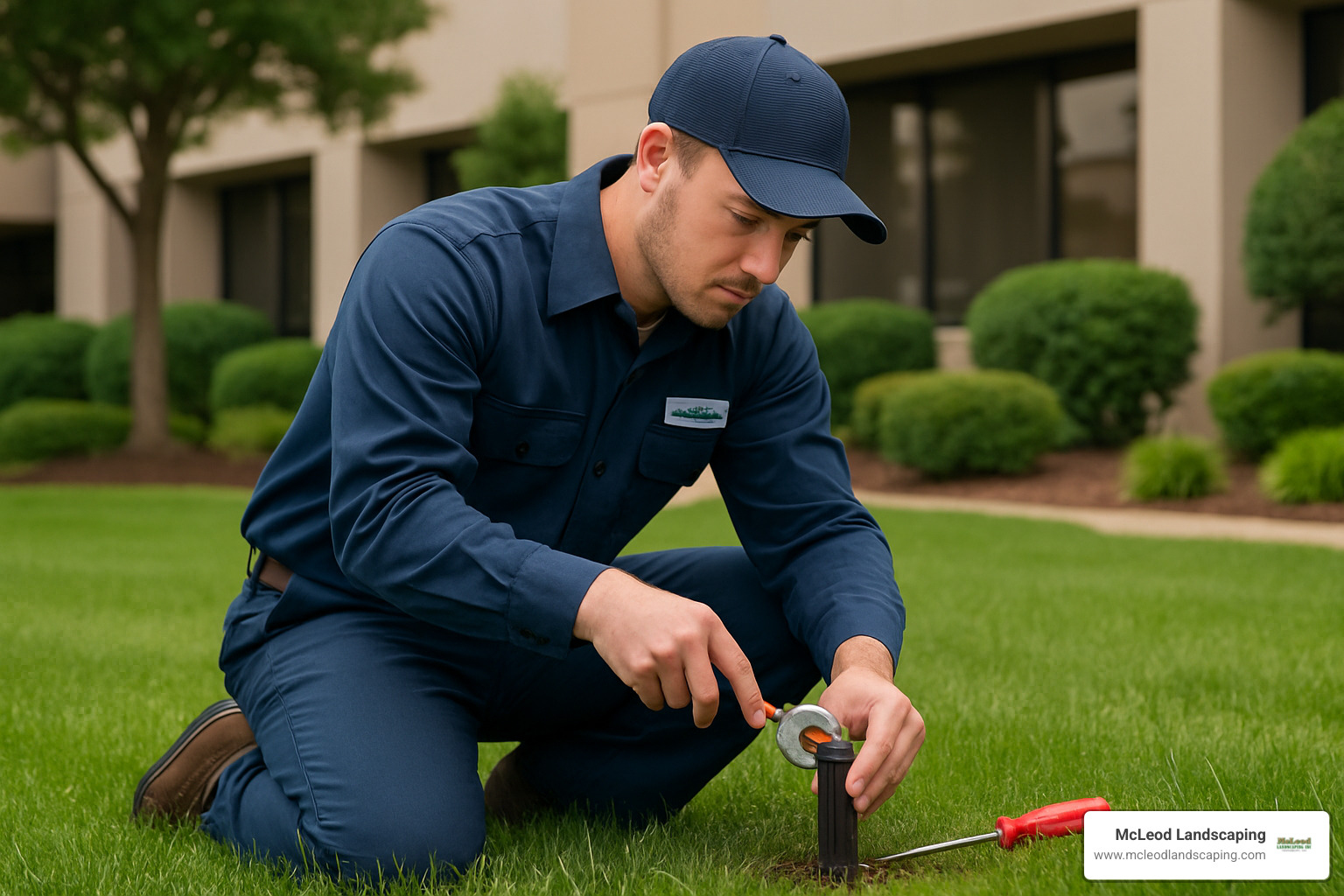
Most commercial properties benefit from following a seasonal maintenance schedule that keeps everything running smoothly:
In spring, we perform a thorough start-up that includes inspecting the entire system, checking valve operations, programming your controller for the growing season, and aligning all those sprinkler heads that might have shifted during winter.
Mid-season, your system deserves a comprehensive tune-up—this is when we evaluate performance, maintain valves, make controller adjustments, and ensure everything is working at peak efficiency during the hottest months.
When fall arrives, proper winterization becomes critical in our New England climate. This includes careful system drainage, closing valves, adjusting controllers, and protecting components from freezing temperatures.
Need to make a quick adjustment yourself between service visits? You’ll find helpful guidance on how to adjust a sprinkler head in this practical resource.
The benefits of regular maintenance go beyond just preventing headaches—they translate directly to your bottom line. Industry data shows that preventive maintenance typically extends equipment lifespan while reducing water waste by up to 30%. That’s real savings you can measure on your water bill.
For a full overview of our installation, maintenance, and upgrade options, I invite you to visit our Irrigation System Services page.
Even the best commercial irrigation sprinkler heads can develop problems over time. After thirty years of servicing systems throughout the Merrimack Valley, I’ve seen just about every issue imaginable—and most have straightforward solutions.
When you spot a leaking head, the culprit is typically a damaged seal, loose cap, or cracked body. Often, simply tightening the cap solves the problem, but sometimes you’ll need to replace the seal or install a new head if the body is cracked.
Seeing a fine mist instead of defined streams? That’s a classic sign of excessive water pressure at the nozzle. Installing pressure-regulating stems or adjusting pressure at the valve will transform that wasteful mist into efficient irrigation.
Sunken heads are particularly common in our region’s freeze-thaw cycles. As soil settles or lawn thatch builds up, heads can disappear below grade. Raising them using risers or digging and resetting at the proper height restores their effectiveness.
Those frustrating dry spots in your landscape often point to poor head spacing or misaligned spray patterns. Adjusting the arc and radius—or sometimes adding heads for better coverage—can bring those brown patches back to green.
Clogged nozzles happen to everyone eventually, especially with our mineral-rich water. Remove and clean the nozzles, and consider installing mesh filters at the valve to prevent future clogs.
For commercial properties, we strongly recommend quarterly inspections to catch these issues early. It’s much easier (and less expensive) to fix a minor problem before it leads to landscape damage or significant water waste.
The irrigation technology landscape has changed dramatically in recent years, offering exciting ways to improve the efficiency of your existing commercial irrigation sprinkler heads without replacing your entire system.
WiFi controllers have revolutionized irrigation management, allowing you to adjust watering schedules from anywhere using your smartphone. Imagine being able to shut off your system remotely when an unexpected rain shower hits while you’re across town.
Weather-based scheduling takes this convenience a step further by automatically adjusting watering times based on local weather data. Your system becomes smart enough to skip watering when rain is forecast, potentially saving thousands of gallons annually.
Flow monitoring capabilities offer peace of mind by detecting leaks and breaks in real-time, automatically shutting down affected zones before minor issues become major problems. One broken head can waste hundreds of gallons in a single hour—technology prevents this waste.
Soil moisture sensors bring precision to your watering by preventing irrigation when soil moisture is already adequate. Instead of watering on a fixed schedule regardless of conditions, your system waters only when your plants actually need it.
Simple rain sensors are among the most cost-effective upgrades, automatically skipping scheduled watering during and after rainfall. It’s a small investment that pays for itself quickly in water savings.
One of my favorite upgrades is retrofitting standard spray heads with high-efficiency rotary nozzles. This simple change—often completed in minutes per head—can reduce water use by up to 30% while improving distribution uniformity.
For more information about bringing smart control to your property, check out our Commercial Irrigation Controllers page.
When it comes to commercial irrigation sprinkler heads, thinking long-term pays off. While premium heads might have a higher price tag upfront, they deliver impressive returns through water savings and durability. Quality commercial heads typically last 7-10 years—about twice as long as budget alternatives—making them the smarter investment for property managers who think beyond the current fiscal year.

Did you know the EPA has found that properties with extensive landscaping can spend up to 30% of their water bill just on irrigation? That’s a significant chunk of your operating expenses potentially flowing straight into the ground—often inefficiently. Upgrading to water-smart commercial irrigation sprinkler heads can dramatically reduce this expense in several ways:
Pressure-regulating stems are perhaps the simplest upgrade with the biggest impact, saving approximately one gallon per minute per head. Multiply that across dozens or hundreds of heads on a large property, and the savings add up quickly.
Similarly, high-efficiency nozzles can reduce water consumption by 20-30% while actually improving plant health through more uniform coverage. And don’t overlook check valves—these simple mechanisms prevent low-head drainage, saving up to two gallons per cycle per head by keeping water in the lines rather than letting it drain out when the system shuts off.
Most of our commercial clients see their investment in upgraded commercial irrigation sprinkler heads pay for itself within 1-3 years through reduced water bills alone. When you factor in lower maintenance costs and extended system lifespan, the financial case becomes even stronger.
For a comprehensive breakdown of system costs and potential savings, I encourage you to visit our detailed Commercial Irrigation System Cost page.
The benefits of efficient commercial irrigation sprinkler heads extend far beyond your bottom line. Today’s environmental consciousness isn’t just good ethics—it’s good business.
Modern irrigation heads significantly reduce runoff by applying water at rates that allow proper soil absorption. This means less water carrying fertilizers and pesticides into local waterways and storm drains. It’s a win-win: you keep more water on your property where it benefits your landscape, and you minimize your environmental footprint.
Proper irrigation also promotes healthier soil biology. When soil isn’t constantly waterlogged or bone dry, beneficial microorganisms thrive, improving plant health naturally and potentially reducing the need for chemical interventions.
There’s also the broader impact to consider. Commercial irrigation sprinkler heads with higher efficiency mean less energy consumed in water treatment and pumping across municipal systems. It’s a ripple effect—your property-level decisions contribute to community-wide resource conservation.
As water restrictions become increasingly common across the country, having an efficient irrigation system isn’t just environmentally responsible—it’s future-proofing your property. Properties that can maintain attractive landscapes with minimal water use will have a distinct advantage as resources become more constrained and regulated.
At McLeod Landscaping, we’ve seen how these efficiency upgrades have helped our clients in the Merrimack Valley not only reduce their operating costs but also strengthen their reputation as responsible community members. After all, customers and tenants increasingly prefer to associate with businesses that demonstrate environmental stewardship.
Finding the sweet spot for water pressure is crucial for commercial irrigation sprinkler heads to perform their best. Think of it like finding the perfect shower pressure—too little and you’re left frustrated, too much and you’re getting sprayed in the face!
For spray heads, you’ll want 15-30 PSI at the nozzle (which typically means 30-45 PSI at the valve). Rotor heads need a bit more oomph to get that satisfying rotation, requiring 30-50 PSI at the nozzle (45-65 PSI at the valve). If you’ve upgraded to water-saving rotary nozzles, aim for 30-40 PSI at the nozzle. And for those gentle bubblers watering your trees and planters, 10-30 PSI will do the trick.
When your heads operate outside these ranges, you’ll notice the consequences quickly—misting and drift with pressure that’s too high, or weak coverage and dry spots when it’s too low. For properties with high municipal water pressure (we see this often in parts of the Merrimack Valley), investing in pressure-regulating heads isn’t just a nice-to-have—it’s essential for proper performance and water conservation.
Just like your car needs regular maintenance, your commercial irrigation sprinkler heads need consistent attention to perform their best. For commercial properties, we’ve developed a rhythm that works well:
A quick monthly visual inspection catches obvious issues before they cause damage—those broken heads from lawn mowers or misaligned sprays watering the parking lot instead of the lawn.
Every three months, schedule a quarterly comprehensive inspection where you’ll clean out debris, adjust spray patterns, and check for leaks or pressure issues. This deeper dive prevents small problems from becoming costly repairs.
As seasons change, your irrigation needs change too. Seasonal adjustments to your controller settings and sometimes even nozzle types will keep your landscape looking its best while using water wisely.
Finally, an annual professional audit provides peace of mind that your entire system is operating at peak efficiency. At McLeod, we often catch issues during these audits that property managers didn’t even know existed—like that zone that’s been running at 2 AM when nobody’s watching!
A small issue like a partially clogged nozzle might seem insignificant, but over time it creates dry spots, stresses plants, and wastes water—all while making your landscape look uneven and poorly maintained.
Good news! You don’t need to rip out your entire irrigation system to make it smarter. Most smart controllers work beautifully with your existing commercial irrigation sprinkler heads without modification. The controller simply manages the when and how long, while your existing heads handle the where and how much.
That said, to get the full benefit of today’s smart irrigation technology, consider these complementary upgrades that work together like a well-orchestrated team:
Flow sensors act like a security system for your irrigation, alerting you to problems like broken heads or pipes before they create flooding or damage. Master valves provide fail-safe shutdown capability when these leaks are detected, potentially saving thousands of gallons and preventing property damage.
Upgrading to high-efficiency nozzles amplifies the water-saving potential of your smart controller’s weather-based scheduling. And adding pressure regulation ensures your nozzles perform consistently regardless of those frustrating municipal pressure fluctuations we often see throughout the day.
The math makes a compelling case: smart controllers with weather-based scheduling typically reduce water use by 15-30% on their own. But when paired with efficient sprinkler heads and these complementary technologies, we’ve seen savings exceed 40-50% compared to traditional systems. For many of our commercial clients, these upgrades pay for themselves within just a couple of irrigation seasons through reduced water bills alone.
Choosing the right commercial irrigation sprinkler heads isn’t just a technical decision—it’s an investment in your landscape’s future. When you select heads that balance water efficiency, coverage uniformity, and durability, you’re setting the stage for years of lush, healthy greenery without wasteful water consumption or constant maintenance headaches.
Here at McLeod Landscaping, we’ve spent more than three decades helping businesses throughout the Merrimack Valley create irrigation systems that truly stand the test of time. There’s something satisfying about seeing a system we installed years ago still performing beautifully, keeping landscapes vibrant while conserving water and saving our clients money.
What makes working with a single, experienced partner like us so valuable for your irrigation needs? For one thing, you get seamless integration between the design, installation, and maintenance phases. Every component—from sophisticated controllers down to the smallest nozzle—works together in perfect harmony. You also benefit from consistent quality standards across your entire system and clear accountability for how it performs.
As your landscape evolves and grows, we’re right there with you, providing ongoing support and adjustments. And because we’ve been serving this region for so long, we bring expert knowledge of local conditions, soil types, and regulations that out-of-town companies simply can’t match.
Whether you’re planning a brand-new irrigation system for your commercial property, looking to upgrade outdated components, or simply aiming to reduce your water consumption (and bills!), navigating commercial irrigation sprinkler heads doesn’t have to be overwhelming. With the right partner, it can actually be quite straightforward.
For more information about our comprehensive approach to commercial irrigation, visit our Commercial Irrigation Systems page or reach out to schedule a consultation. As your neighbors and local irrigation experts serving Andover, Billerica, Burlington, Carlisle, Chelmsford, Concord, Lowell, Tewksbury, Westford, and Wilmington, we’re committed to helping you achieve a greener, more sustainable landscape that makes your property shine while respecting our shared environmental resources.
Contact McLeod Landscaping today at (978) 640-0957 or click here to schedule a consultation for retaining wall installation. Let our experienced team design and install a functional and visually appealing retaining wall that enhances your landscape.

1881 Main St Unit 1, Tewksbury, MA 01876