
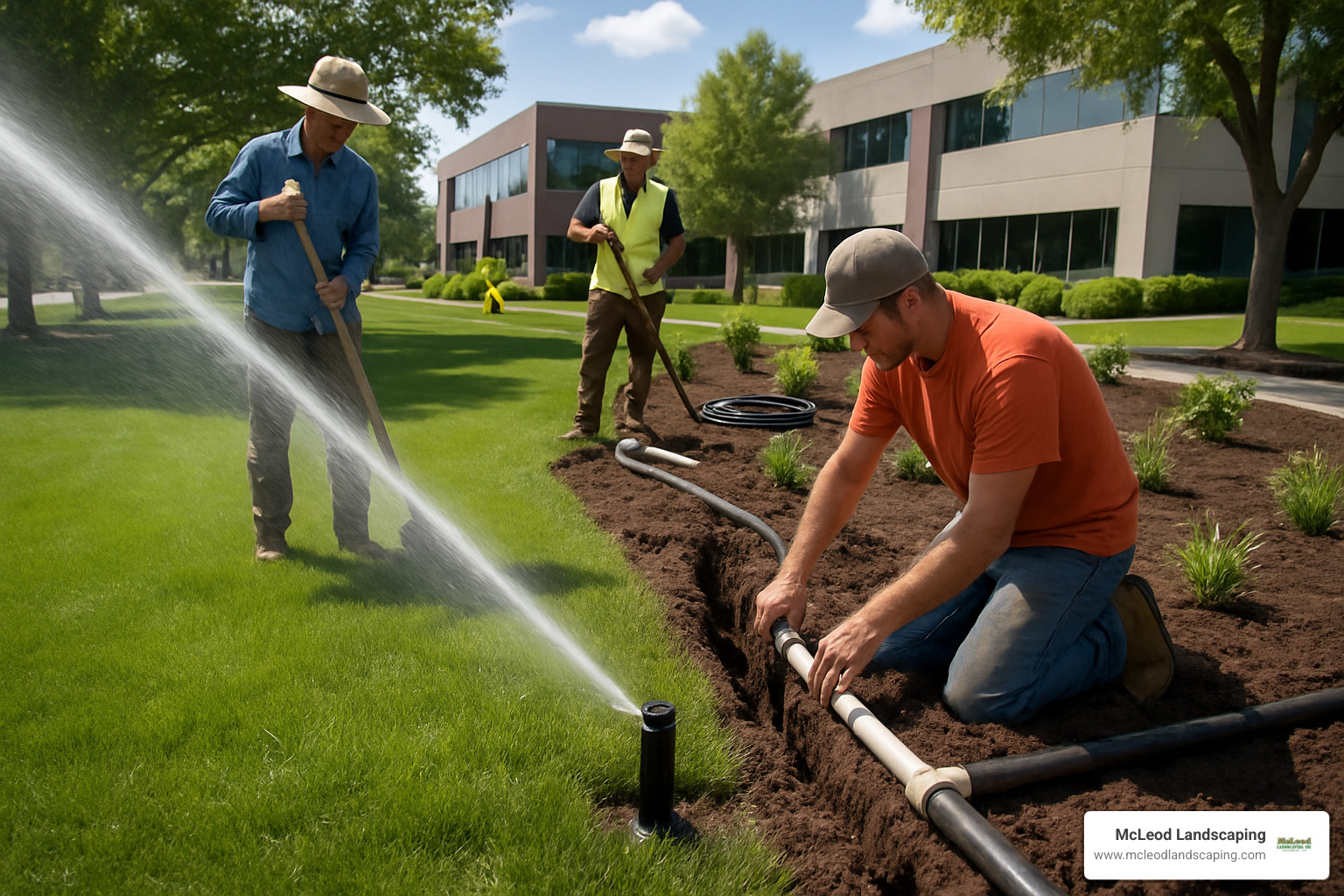
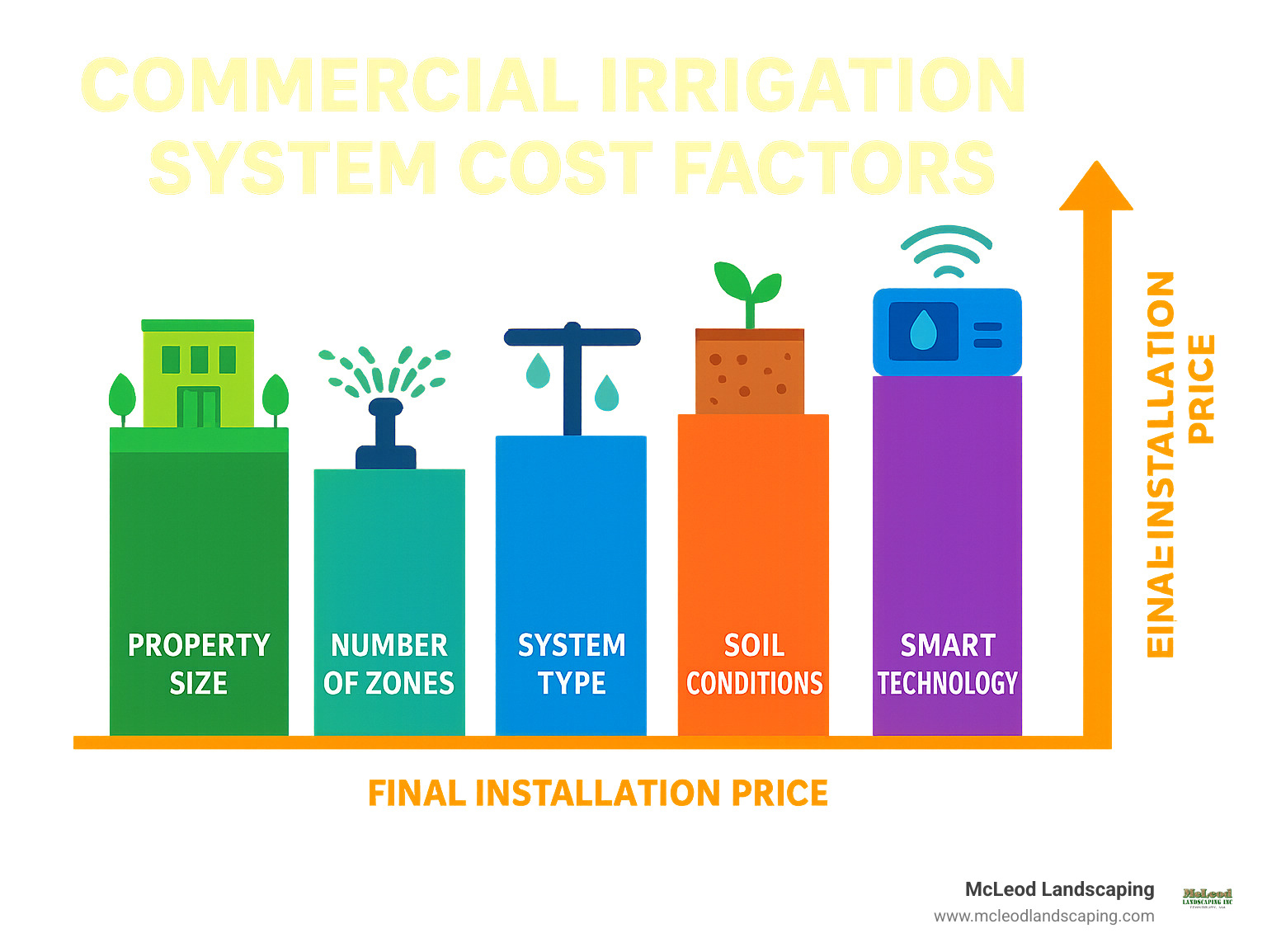
Commercial irrigation system cost is a complex consideration for property managers seeking water-efficient landscaping solutions. When comparing costs for a commercial irrigation system, several key factors influence the final price:
For typical commercial properties, irrigation systems represent about one-third of the total landscaping budget, with installation costs varying significantly based on property requirements and design complexity.
Most commercial property managers find that professional installation offers the best long-term value, despite higher upfront costs compared to residential systems. A well-designed commercial system can last 20-25 years with proper maintenance, making it a worthwhile investment for property aesthetics and water conservation.
I’m Scott McLeod, owner of McLeod Landscaping, and I’ve helped countless commercial clients steer commercial irrigation system cost decisions throughout my 30+ years in the landscaping industry. My team and I understand the unique irrigation challenges faced by property managers in the Merrimack Valley area and can help you find the most cost-effective solution for your specific needs.
Basic commercial irrigation system cost glossary:
– commercial irrigation system design
– commercial fertigation systems
– commercial irrigation controllers
When budgeting for a new commercial irrigation system in 2024, understanding the complete cost breakdown helps you plan accurately and avoid surprises. At McLeod Landscaping, we’ve noticed many commercial clients are taken aback by just how many factors influence the final investment.
“What gets measured gets managed,” as the saying goes, and this is especially true for commercial irrigation system costs. Let’s walk through what you can realistically expect to pay for professional installation.
First, a friendly disclaimer: all pricing discussed in this article represents industry averages based on internet research, not actual costs for McLeod Landscaping services. Your specific project may vary significantly based on your property’s unique characteristics and needs.

For commercial projects, skilled labor typically runs between $50-$100 per hour, with materials making up the lion’s share at 55-60% of total project cost. Design fees might add another 5-15% depending on complexity. Most commercial installations take anywhere from 1-6 weeks from start to finish, depending on your property size and system requirements.
Here’s a helpful comparison of installation costs by property size:
| Property Size | Typical Zones | Average Cost Range | Installation Timeline |
|---|---|---|---|
| ¼-acre | 1-3 | $2,500-$7,500 | 1-3 days |
| 1-acre | 4-8 | $6,000-$20,000 | 1-2 weeks |
| 5-acres | 15-25 | $30,000-$100,000 | 3-6 weeks |
These figures can swing significantly based on your location, soil conditions, and specific design requirements. For more detailed information about irrigation installation costs, our installation costs page offers additional insights.
The commercial irrigation system cost per acre typically ranges from $6,000 to $20,000, with larger properties benefiting from economies of scale. This means that while your overall investment increases with property size, the cost per acre often decreases as the project grows larger.
For perspective, a recent project in Austin, TX for a mid-sized hotel property ran between $35,000 and $50,000 for the irrigation system alone. This represented roughly one-third of their entire landscaping budget, which aligns with what we typically see in commercial projects throughout the Merrimack Valley.
Martin, one of our senior irrigation specialists, puts it this way: “Commercial properties need more robust components than residential systems. The pipe diameters are larger, the valves are commercial-grade, and we often install more sophisticated controllers to handle the increased number of zones. All these factors contribute to the higher per-acre cost compared to residential installations.”
Looking at commercial irrigation system cost by zone gives you a more granular view of expenses. On average, each irrigation zone costs between $650 and $1,200 to install, with costs per zone decreasing as you add more zones due to shared components like controllers and backflow preventers.
The major components contributing to zone costs include controllers ($300-$3,000 depending on features), pumps if needed ($1,000-$5,000 based on capacity), backflow prevention devices ($300-$1,200), commercial-grade valves ($150-$400 each), trenching ($4-$12 per linear foot), and commercial-grade sprinkler heads ($10-$40 each).
Andy Villaescusa, an experienced irrigation installer on our team, notes that “more zones actually lower your per-zone costs” because fixed components like timers and backflow preventers are one-time expenses that get distributed across the entire system.
There’s a notable price difference between commercial and residential irrigation systems, with commercial installations typically costing 2-3 times more than residential systems of comparable size. This price gap exists for several important reasons.
Commercial systems require larger pipe diameters to handle increased water flow and higher-grade components built for heavier use. They also include flow sensors and master valves as standard safety features, require additional insurance coverage, face more complex permitting processes, and must manage higher water demand due to diverse plant material with varying water needs.
According to the EPA’s research on outdoor water use, commercial properties can use significantly more water than residential properties, making efficient irrigation design even more critical for cost savings over time.
When you factor in these differences, it’s easy to see why commercial irrigation represents a larger investment. However, the return on that investment—in terms of water savings, landscape health, and property value—makes it worthwhile for most commercial property owners.
Understanding the factors that drive commercial irrigation system cost will help you budget more accurately and make informed decisions. Here are the eight primary cost drivers we consider when providing estimates to our commercial clients:
When it comes to budgeting for your commercial irrigation system, size matters—but it’s far from the only consideration. Property size naturally affects material quantities and labor hours, but the complexity often lies in the details. The number of watering zones your property requires will significantly impact costs, as each zone needs its own valve, wiring, and controller capacity.
Don’t underestimate the impact of what’s beneath the surface! Soil composition can dramatically affect your bottom line—rocky soil can double or even triple trenching costs compared to sandy loam. Similarly, terrain slope creates special design challenges that may require pressure-regulating devices and strategic head placement to prevent runoff and ensure even coverage.
Your water source decision—whether municipal, well, or reclaimed water—brings its own set of requirements and costs. Municipal connections typically require backflow preventers, while wells need pumps and pressure tanks. Many of our forward-thinking clients are incorporating smart technology into their systems. While weather-based controllers and soil moisture sensors add upfront costs, they typically pay for themselves within 2-3 years through water savings.
The regulatory landscape can’t be ignored either. Permits and regulations typically add $50-$500 to your project depending on your location, with commercial permits generally falling on the higher end of that spectrum. Finally, local labor rates vary significantly by region, with irrigation specialists in the Northeast commanding different rates than those in other parts of the country.
At McLeod Landscaping, we’ve developed expertise in designing systems that balance these factors to provide the most cost-effective solution for each unique property. Learn more about our approach to Commercial Irrigation System Design.
The installation process follows a predictable sequence, and understanding this timeline helps with project planning and budgeting:
The journey begins with survey and design, typically taking 1-2 weeks. This crucial phase involves comprehensive site analysis, water source evaluation, and detailed system design that sets the foundation for everything that follows.
Next comes permitting, which can stretch from 1-4 weeks depending on your local authorities. “The permitting process often begins up to a year before actual installation,” explains Martin from our installation team. “This is especially true for large commercial projects where water usage is a significant consideration.”
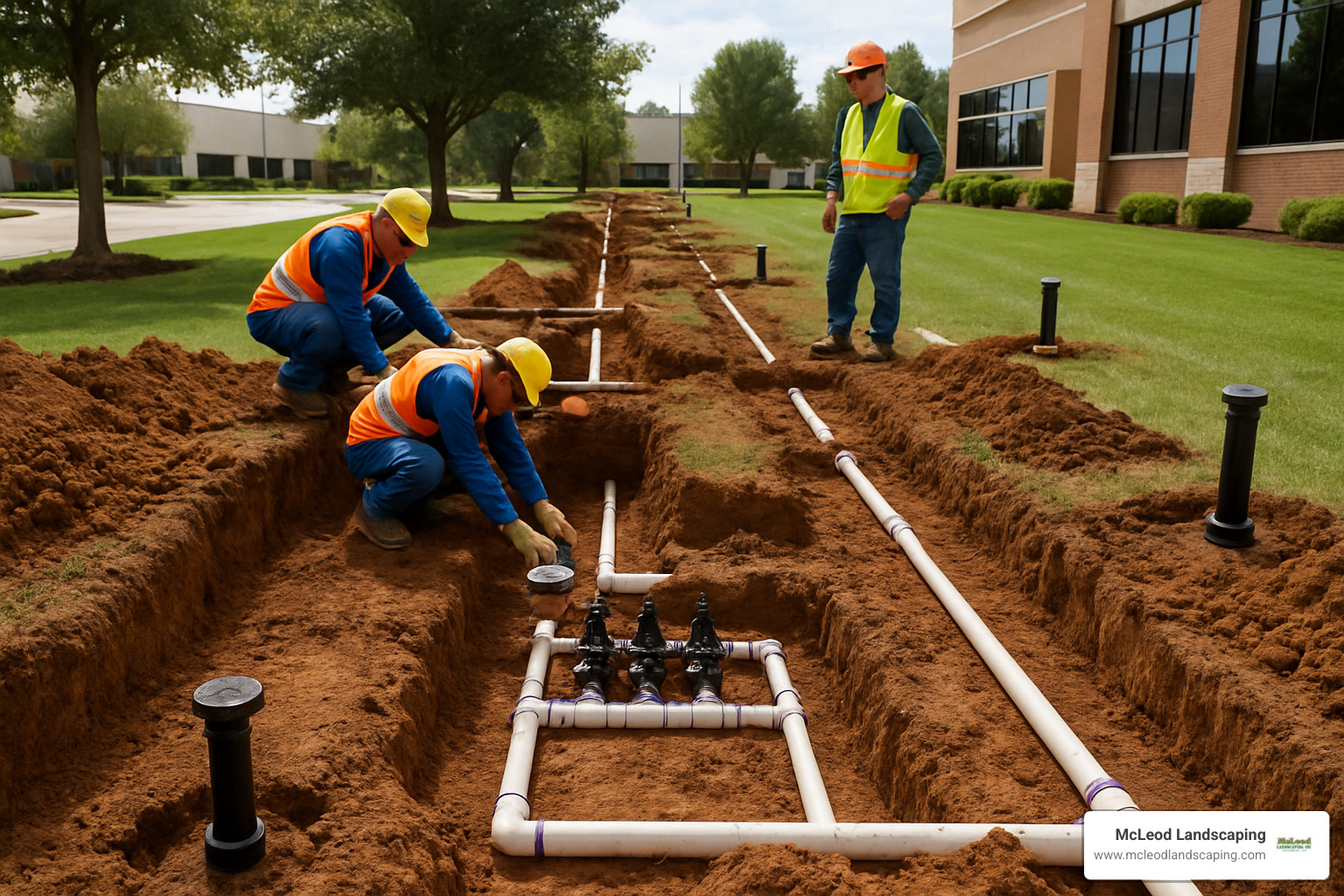
Once permits are in hand, things start moving quickly. Mobilization takes just 1-2 days as equipment and materials arrive on site. The real change begins with trenching, which can take 1-5 days depending on your property size and soil conditions. This is followed by head installation (another 1-5 days), where we place and connect all sprinkler heads according to the design specifications.
The brains of your system comes next with controller setup (1-2 days), where we install and program your irrigation controller to ensure optimal watering schedules. A thorough inspection (usually 1 day) follows, where we test every zone and make necessary adjustments.
Finally, we complete landscape restoration (1-3 days), carefully repairing any disruption to your landscape and ensuring the system is both functional and aesthetically pleasing. This attention to detail is why many commercial properties in the Merrimack Valley trust us with their irrigation needs.
When it comes to keeping your commercial landscape lush and healthy, not all irrigation systems are created equal. At McLeod Landscaping, we’ve installed countless systems across the Merrimack Valley, and we’ve seen how the right system type can make all the difference in both performance and commercial irrigation system cost.
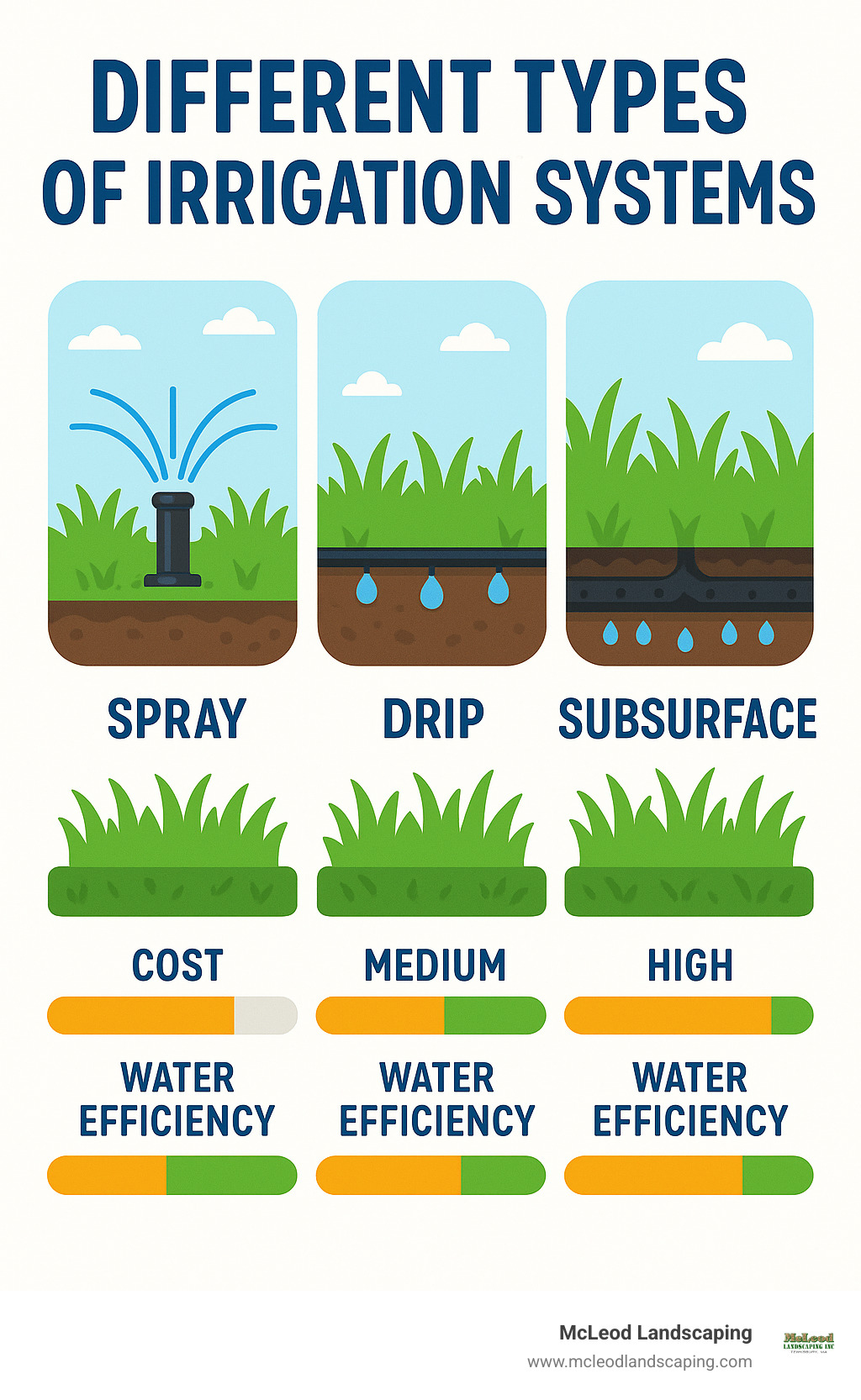
For those expansive commercial lawns and common areas, traditional spray and rotor systems remain the workhorses of the industry. These familiar pop-up sprinklers distribute water in wide patterns, efficiently covering large turf areas without breaking the bank. They typically fall in the middle range of commercial irrigation system costs and offer reliable performance that property managers have counted on for decades.
“Most of our commercial clients start with traditional systems as their foundation,” explains our irrigation specialist. “They’re proven, dependable, and parts are readily available if maintenance is needed down the road.”
If water conservation is high on your priority list (and these days, it should be!), drip irrigation delivers impressive results. These systems bring water directly to plant roots through small tubes and emitters, reducing evaporation and runoff by 30-50% compared to traditional sprinklers.
While the installation is more labor-intensive, the water savings often justify the investment, especially in planting beds and around building perimeters. Many of our clients are surprised at how quickly these systems pay for themselves through reduced water bills. Learn more about our specialized Commercial Drip Irrigation Systems and how they might benefit your property.
For the ultimate in water efficiency and aesthetics, subsurface drip systems are hard to beat. These innovative systems deliver moisture directly to the root zone from below the surface, making them virtually invisible once installed. While they typically cost 20-30% more than traditional systems due to their specialized installation requirements, they’re increasingly popular for high-profile commercial properties where appearance matters as much as function.
“Once we install a subsurface system, the property managers love that there are no sprinkler heads to trip over or damage with mowers,” notes our installation team leader. “It’s as close to irrigation perfection as you can get.”
Commercial greenhouse operations have unique irrigation needs requiring precise control and often integration with climate systems. Whether you’re growing ornamentals or food crops, these specialized systems represent a different category of commercial irrigation system cost and design. Explore our Commercial Greenhouse Watering Systems to learn how we can customize a solution for your growing operation.
When considering the investment in a quality irrigation system, the numbers tell an encouraging story. According to the National Association of Realtors’ 2023 Remodeling Impact Report, property owners typically recover about 83% of their irrigation system cost through increased property value and water savings. That’s a remarkable return compared to many other property improvements.
Maintenance costs generally run between $0.10-$0.20 per square foot annually, covering seasonal startups, winterization, and routine repairs. With proper care, a commercial system can serve your property faithfully for 20-25 years, making it a sound long-term investment rather than just an expense.
As Rick Evans of Aesthetic Gardens notes, “Sprinkler and drip systems vary in cost, but average $650-$1,000 per zone.”
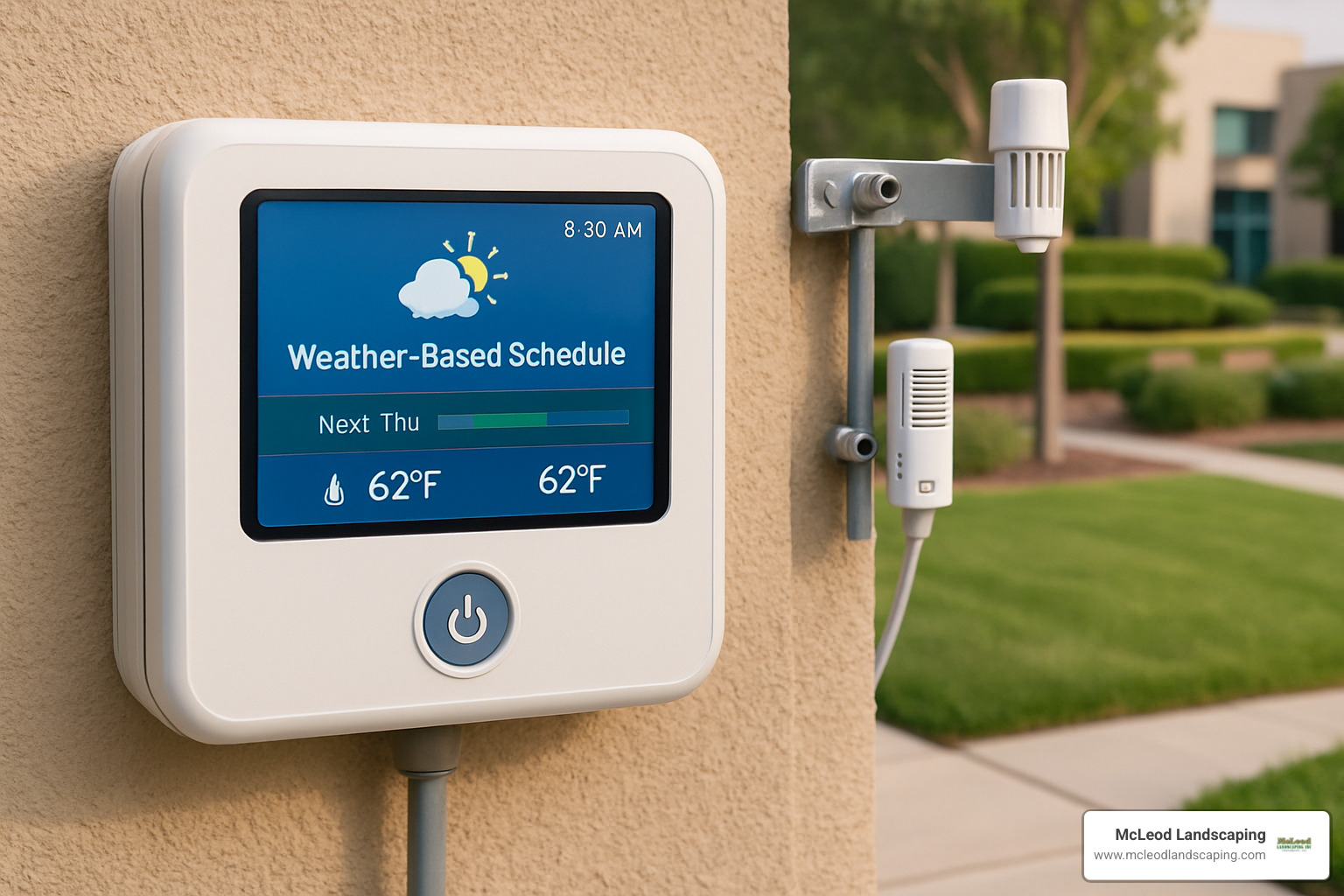
Smart irrigation technology has revolutionized the industry in recent years, and while it adds to your initial commercial irrigation system cost, the long-term savings are impressive:
WiFi-enabled controllers ($100-$300 more than standard controllers) allow you to manage your system from anywhere, making adjustments on the fly when weather changes unexpectedly. Soil moisture sensors ($150-$400 per sensor) prevent watering when the ground already has sufficient moisture. Rain sensors ($30-$100 each) automatically shut down your system during rainfall, while flow sensors ($200-$500 each) detect leaks before they become costly problems.
Together, these smart technologies can reduce water usage by 20-60% compared to traditional timers. Even better, many municipalities and water districts offer rebate programs that can significantly offset your initial investment.
One of our property manager clients in Lowell recently shared, “We upgraded to a smart controller with weather sensors last year, and our water bills have already decreased by 30%. The system paid for itself in just eight months. I wish we’d done it years ago!”
For larger commercial properties with sustainability goals or facing high water costs, using reclaimed water or water from on-site detention ponds can be a game-changer, though it does require additional infrastructure:
Pump stations ($5,000-$20,000 depending on capacity) move water from your collection point into the irrigation system. Filtration systems ($2,000-$10,000) ensure the water is clean enough for your equipment, while additional piping ($5-$15 per linear foot) connects everything together.
According to our experience, implementing a reclaimed water system can nearly double the initial commercial irrigation system cost. However, for properties with sustainability initiatives or in areas with escalating water rates, the long-term savings often justify this investment.
“Using recycled water from an on-site detention pond can double the cost of an irrigation system,” notes Martin from our design team, “but for large commercial properties with green initiatives, it’s often worth considering. Plus, it makes for excellent PR when you can showcase your water conservation efforts to clients and tenants.”
When clients ask me about installation timelines, I always remind them that every property tells its own story. The time needed depends on three main factors:
The scope of your project plays the biggest role – a modest quarter-acre commercial property might be completed in just 1-3 days, while that sprawling multi-acre campus could keep our teams busy for several weeks.
Weather conditions are the wild card in any outdoor project. A week of unexpected rain can transform our carefully planned schedule, and extreme temperatures sometimes force us to adjust our working hours for crew safety.
Our crew size typically ranges from 5-10 skilled workers on commercial projects, allowing us to work efficiently without sacrificing quality.
For most commercial properties here in the Merrimack Valley, we generally plan for 1-2 weeks of active installation time. Of course, that doesn’t include the permitting and design phases that happen beforehand, which require their own timeline.
I’ve seen the look of surprise on many property managers’ faces when certain costs appear that weren’t in their initial budget. Let me share the most common “hidden” expenses so you can plan accordingly:
As-built drawings are detailed documentation of your final system layout, often required by local authorities but frequently overlooked in initial budgeting. Think of them as the owner’s manual for your underground system.
Utility locating services are essential before any trenching begins. While sometimes included in estimates, these services occasionally come with separate fees that surprise owners.
The landscape restoration needed after installation can be more extensive than anticipated. When we trench across a property, repairing that disrupted landscaping takes time and materials that need to be factored into your budget.
Some properties require water meter upgrades to accommodate the increased flow demands of a commercial system – an expense that’s difficult to predict until the design phase is complete.
Annual backflow testing is required by most municipalities to ensure your irrigation system isn’t contaminating the public water supply. While not part of installation costs, this ongoing expense catches many owners by surprise.
At McLeod Landscaping, we pride ourselves on providing comprehensive estimates that include these potential costs, helping you avoid mid-project financial surprises.
Smart planning can significantly reduce your commercial irrigation system cost without cutting corners on quality. Here are my favorite money-saving strategies that won’t compromise system performance:
Consider off-season bidding – scheduling your project planning during fall or winter often leads to more competitive rates as irrigation contractors look to fill their upcoming schedule. This simple timing change can save 5-10% on your project.
Zone scaling is a practical approach where we focus initial irrigation on high-visibility or high-value areas first. This allows you to spread costs across multiple budget cycles while ensuring the most important areas are covered immediately.
Don’t overlook smart technology rebates offered by many local water authorities. These incentives can offset a significant portion of your investment in water-saving controllers and sensors.
Phased installation approaches let you spread costs over multiple budget cycles while still working toward a comprehensive system. We can design your entire system upfront but install it in strategic phases as your budget allows.
Be strategic with material selection by investing in high-quality components for critical elements while using standard components elsewhere. The valve that controls an entire zone deserves the premium option, while individual sprinkler heads might not.
“I always tell clients that the lowest bid is often a red flag,” Martin from our installation team often reminds customers. “It typically indicates corners being cut on materials or labor, which leads to higher long-term costs through repairs and reduced system lifespan.”
For more details about our approach to irrigation systems, visit our Irrigation System Services page, where we outline our maintenance and repair offerings.
Navigating commercial irrigation system cost isn’t just about finding the lowest price—it’s about making a smart investment that pays dividends for decades to come. Yes, the upfront costs might make you wince, but when you consider that a well-designed system will faithfully serve your property for 20-25 years while significantly cutting water waste, the value becomes clear.
Think of your irrigation system as a marathon runner, not a sprinter. The initial investment may seem substantial, but spread across two decades of service, it’s actually quite reasonable—especially when you factor in the reduced maintenance headaches and lower water bills you’ll enjoy.
When comparing proposals from different contractors, look beyond just the bottom line. What really matters is the complete picture:
Are they using reputable components that won’t fail after a few seasons? Does the contractor have a solid track record with similar commercial projects in our area? Have they designed for proper head-to-head coverage and smart zoning? What about warranty protection and ongoing service options? And perhaps most importantly—how much water (and money) will this system save you over its lifetime?
Here at McLeod Landscaping, we’ve spent over three decades designing and installing commercial irrigation systems throughout the Merrimack Valley. We’ve weathered the unique challenges of New England’s finicky climate and stubborn soil conditions, developing expertise that allows us to create irrigation solutions perfectly custom to local properties.
Our approach isn’t just about installing sprinklers—it’s about creating a comprehensive water management system that balances beautiful landscaping with resource efficiency. We understand that commercial properties have different needs than residential ones, and we design accordingly.
We invite you to learn more about our approach by visiting our Commercial Irrigation Systems page. You’ll see how our thoughtful design process and attention to detail create systems that provide exceptional performance and value for years to come.
The true cost of your commercial irrigation system isn’t measured on the day of installation—it’s calculated through years of water savings, reduced maintenance expenses, and the improved curb appeal that helps your property stand out from the competition. When viewed through that lens, a quality irrigation system isn’t an expense—it’s one of the smartest investments you can make in your commercial property.
Contact McLeod Landscaping today at (978) 640-0957 or click here to schedule a consultation for retaining wall installation. Let our experienced team design and install a functional and visually appealing retaining wall that enhances your landscape.


1881 Main St Unit 1, Tewksbury, MA 01876