
A concrete block wall is a strong, versatile structure. It’s built by stacking Concrete Masonry Units (CMUs). These walls have many uses.
Here’s what a concrete block wall is and what it’s used for:
Building a concrete block wall gives you a low-maintenance, long-lasting barrier. It offers privacy and can even reduce noise. These walls are durable, fire-resistant, and can last for many decades. They’re a practical choice for many outdoor and structural needs.
I’m Scott McLeod from McLeod Landscaping. For over 30 years, I’ve led projects involving all types of landscaping and hardscaping, including the design and construction of many concrete block wall structures. My team and I are dedicated to creating durable and beautiful outdoor spaces.
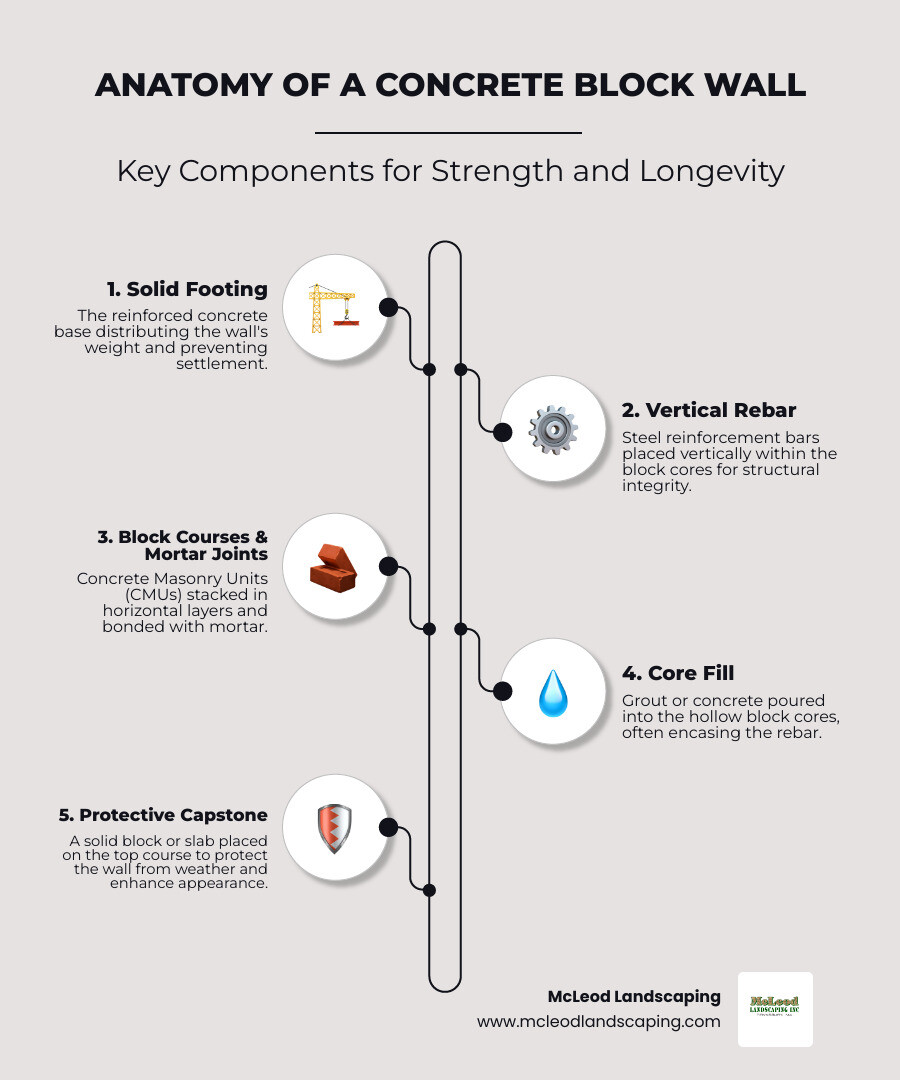
Quick concrete block wall terms:
Careful planning is the cornerstone of a successful concrete block wall project, ensuring structural integrity and adherence to local regulations. Before starting, consult your local building department in Massachusetts—whether in Andover, Billerica, or another of our service areas—for information on permits, building codes, and reinforcement requirements. Local codes often specify fence height limits (e.g., 4 feet for front yards, 6-8 feet for backyards), and ignoring them can lead to fines. Building a concrete block wall is a form of hardscaping, which includes all non-living elements in landscape design.
A non-negotiable first step is calling 811 to locate underground utilities and prevent dangerous accidents. Safety is always the priority.

Gathering the right tools and materials ensures an efficient, high-quality project. Here’s a list of essentials:
Having these items ready will streamline the process. For block ideas, see our range of landscape blocks.
The block type depends on the wall’s purpose and look. Modern blocks are Concrete Masonry Units (CMUs), made with cement, sand, and gravel—stronger than old-style cinder blocks.
Common types include:
To calculate the quantity for standard 8x8x16 blocks, divide the wall’s total square footage by 0.9 to account for mortar. Add 5-10% extra to cover breakage and cuts.
Building a concrete block wall requires precision and patience. Before starting, prioritize safety by wearing personal protective equipment (PPE)—sturdy gloves, safety glasses, and breathing protection—and always lift heavy blocks with your legs, not your back.
Proper site preparation is crucial. Clear the area, mark the wall’s layout, and excavate a trench for the footing. The trench must extend below the frost line for your region to prevent ground heave from freezing and thawing, which can cause cracks and instability.
A durable concrete block wall begins with a solid, poured concrete footing to distribute the wall’s weight and prevent settling.
First, excavate a trench at least twice the width of your blocks (e.g., a 16-inch wide trench for an 8-inch block) and deep enough to be below the frost line. Then, pour a minimum of 8 inches of high-strength concrete. Use a screed board and long level to ensure the footing is perfectly level and smooth, as any unevenness will be magnified in the wall. Finally, allow the concrete to cure for at least 24 hours, or as directed by the manufacturer, to achieve maximum strength.
For more details on foundations, see our guide on building a retaining wall.
The accuracy of the first course determines the success of the entire concrete block wall.
Start by mixing your mortar to a consistency that hangs on a trowel held at a 90-degree angle. Once the footing is cured, snap a chalk line to guide the outside edge of the blocks. Dampen the footing, apply a 1-inch thick mortar bed along the line, and create a furrow in it with your trowel tip.
Set your corner blocks first. “Butter” the inside end of the block with mortar and press it firmly into the mortar bed, aiming for a 3/8-inch joint. Use a torpedo level to check that each block is level and plumb (vertically straight), making fine adjustments with a mallet. Check for square at the corners.
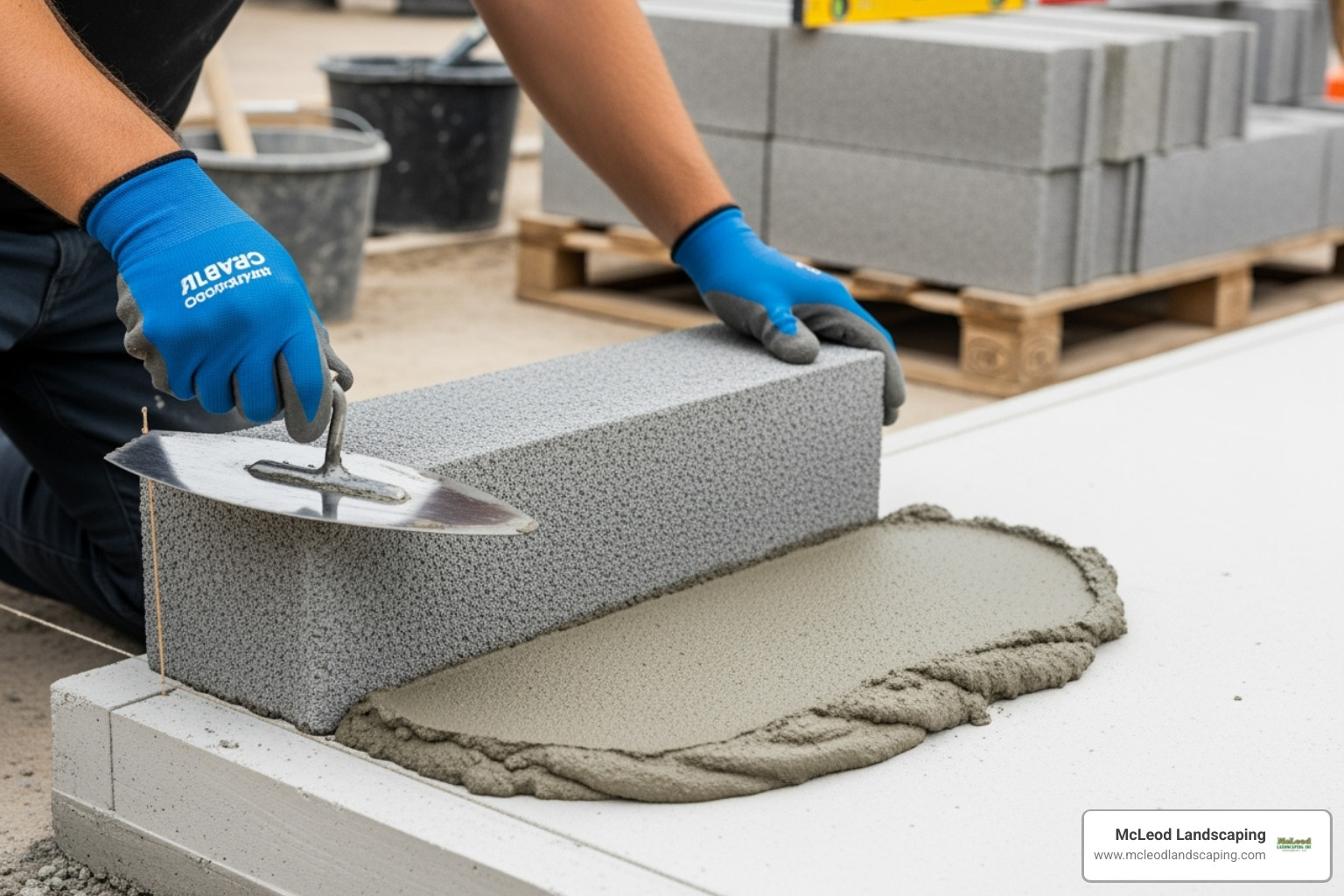
With the first course set, building up the concrete block wall becomes a rhythmic process. Lay blocks in a running bond pattern, where each block is centered over the vertical joint below it. This staggering pattern significantly increases the wall’s strength.
Apply a 1-inch thick mortar bed on the previous course and “butter” the end of each new block before setting it. Maintain consistent 3/8-inch mortar joints. Use a mason’s string line as a guide to keep courses straight and uniform. Continuously check for level and plumb with every few blocks to prevent deviations. You may need to cut blocks with a block saw or angle grinder to fit at the ends of courses; always wear eye and breathing protection when cutting.
For more on structural applications, explore our block walls services.
Final touches ensure your concrete block wall looks professional and lasts for decades.
Apply cap blocks to the top course using construction adhesive or mortar. This provides a finished look and protects the hollow cores from water. Next, tool the mortar joints with a concave jointer once the mortar is “thumbprint” hard. This compresses the mortar, creating a neat appearance and helping shed water. As you work, clean off any excess mortar while it’s still wet.
Finally, cure the wall for optimal strength. After about 8 hours, gently spray the wall with water, repeating several times a day for at least three days. This helps the mortar hydrate properly for a stronger bond.
To ensure a concrete block wall lasts a lifetime, you must incorporate reinforcement, drainage, and waterproofing. These steps are vital to prevent cracking, bowing, and failure, especially from hydrostatic pressure (water buildup) behind concrete retaining walls.
Reinforcement provides structural strength, while drainage manages water. Both are essential for a sturdy, safe wall.
Reinforcement Methods:
Drainage Solutions:
For professional standards, consult resources from the American Concrete Institute (ACI).
Concrete blocks are porous and can absorb moisture, making waterproofing essential. Mortar joints are also potential entry points for water over time.
Here’s how to protect your wall:
Note for Stucco: If you plan to apply a stucco finish, do NOT seal the wall first, as stucco requires some surface moisture to bond correctly.
Waterproofing is a critical step in any hardscape construction project, greatly extending the life of your wall.
A key decision for any concrete block wall project is whether to build it yourself or hire a professional. This choice impacts your budget, timeline, and the final quality of the wall.
| Feature | DIY Approach | Hiring a Professional |
|---|---|---|
| Cost | Potentially lower material cost, but higher equipment rental and learning curve | Higher upfront cost, but includes labor, specialized equipment, and expertise |
| Time | Can be very time-consuming, especially for complex projects or beginners | Faster completion due to experience and dedicated crew |
| Skill Level | Requires significant learning and practice; mistakes can be costly | Expert knowledge of techniques, codes, and problem-solving |
| Quality/Finish | Varies widely based on skill; potential for errors or less refined look | Professional-grade finish, structural integrity, and adherence to standards |
| Permits/Codes | Responsibility falls entirely on you to research and comply | Contractor handles permits and ensures compliance with local building codes |
| Tools | Purchase or rent all necessary specialized tools | Contractor brings all specialized tools and equipment |
| Warranty | No professional warranty on your work | Reputable contractors offer warranties on their workmanship and materials |
DIY is best suited for simple, non-structural garden walls under 3 feet tall. For taller, load-bearing walls or those requiring complex drainage, a professional is recommended.
Please note these are average costs based on internet data, not actual costs for McLeod Landscaping. For a specific quote, a detailed estimate is required.
A concrete block wall typically costs between $15 to $50+ per square foot, or $60 to $250+ per linear foot, depending on height and complexity. This wide range is due to several factors:
For more pricing details, see our guide on the cost of retaining walls.
A well-built concrete block wall can last 50-100 years with minimal care.
Maintenance involves occasional washing and inspecting for cracks or crumbling mortar. Catching issues early prevents larger problems. Repairs for minor cracks can often be handled with parging (a thin cement-based coating), but significant structural issues require a professional.
Creative finishes can transform a basic wall. Options include:
For more inspiration, browse our retaining wall ideas.
When to hire a pro comes down to project complexity. Load-bearing walls, walls over 4 feet tall, or those with extensive reinforcement demand professional expertise to avoid costly mistakes. Professionals also handle permits and inspections, ensuring compliance with local codes.
At McLeod Landscaping, our 30+ years of experience ensure we bring the right tools, techniques, and efficiency to every job, backed by a warranty. If you hire a contractor, check references, portfolios, and ensure they are licensed and insured. Look for certifications from groups like the Mason Contractors Association of America (MCAA). Always get itemized bids and never pay the full amount upfront.
For all your masonry needs, from retaining walls to stone accents, consider our comprehensive masonry services in the Merrimack Valley.
Here are answers to the most common questions we receive about building a concrete block wall.
A properly constructed and maintained concrete block wall can last 50 to 100 years or more. Longevity depends on four key factors: a solid poured concrete foundation, proper reinforcement with rebar and grout, effective drainage to prevent water buildup, and regular maintenance like sealing and repairing minor cracks.
Yes, absolutely. Every concrete block wall, regardless of size, requires a solid poured concrete footing. The footing distributes the wall’s weight, preventing it from settling or shifting. It must be at least twice the width of the wall and extend below the local frost line to prevent damage from frost heave during freeze-thaw cycles. This is non-negotiable for a stable, long-lasting wall.
While the terms are often used interchangeably, there is a historical difference. Cinder blocks were made with coal cinders, making them lightweight but less strong. True cinder blocks are rarely produced today.
What people now call “cinder blocks” are actually Concrete Masonry Units (CMUs), the same as concrete blocks. Modern CMUs are made from a strong, durable mix of cement, sand, and gravel. For any construction project today, the terms effectively refer to the same versatile building material.
Well, you’ve made it! Building a concrete block wall is truly a rewarding journey. Imagine looking at your finished wall, knowing you planned every detail, laid each block with care, and created something strong and beautiful. It’s more than just a structure; it’s a testament to your hard work and vision.
These walls are incredibly durable, versatile, and surprisingly low-maintenance once built. They add so much to any outdoor space, whether it’s a sturdy foundation, a private garden boundary, or a striking landscape feature.
We hope this guide has given you the confidence to tackle a smaller project yourself. There’s a real sense of accomplishment that comes with a DIY build. However, we also know that some projects are just too big or complex for a weekend warrior. If your vision involves significant grading, heavy loads, or intricate designs, that’s when professional expertise truly shines.
For those larger or more challenging undertakings, our team at McLeod Landscaping is always ready to step in. We have the experience, the tools, and the passion to bring your vision to life, ensuring a beautiful and long-lasting result. Consider our retaining wall installation services to build a wall that will stand strong for generations.
Contact McLeod Landscaping today at (978) 640-0957 or click here to schedule a consultation for retaining wall installation. Let our experienced team design and install a functional and visually appealing retaining wall that enhances your landscape.


1881 Main St Unit 1, Tewksbury, MA 01876