
An outdoor kitchen is one of the most impactful upgrades you can make to your home’s outdoor space. Here’s a quick overview of what to know:
| Topic | Quick Answer |
|---|---|
| Typical cost | $15,000 average (ranges from $8,000 to $75,000+; based on internet data, not McLeod pricing) |
| Most popular layout | L-shaped |
| Key zones | Prep, cooking, serving, entertainment |
| Top appliances | Built-in grill, refrigerator, sink, pizza oven |
| Resale ROI | 50–70% return at resale |
| Usage impact | Homeowners cook outside 3–4 nights/week vs. once a month |
| Build options | DIY, modular kit, or fully custom |
| Permit needed? | Usually yes — for gas, plumbing, and electrical |
Think about your last backyard cookout. You’re grilling burgers outside, but every few minutes you’re running back inside for a plate, a utensil, or something you forgot. It’s frustrating — and it’s the exact problem a well-designed outdoor kitchen solves.
Outdoor kitchens have moved well beyond a simple grill on a patio. Today, they’re fully functional cooking and entertaining spaces — with countertops, sinks, refrigerators, pizza ovens, and even sound systems — built to last through years of weather and use. And they’re no longer just for luxury homes. Modular systems have made them accessible at a wide range of budgets, while custom-built options let you create something that feels like a natural extension of your home.
Whether you’re starting from scratch or upgrading an existing patio, this guide covers everything you need to plan, build, and maintain an outdoor kitchen that works for your space, your budget, and your lifestyle.
I’m Scott McLeod, owner of McLeod Landscaping Inc., with over 30 years of experience designing and building outdoor living spaces — including outdoor kitchens — for homeowners across the Merrimack Valley. In that time, I’ve seen how the right outdoor kitchen design can completely change how a family uses their backyard.
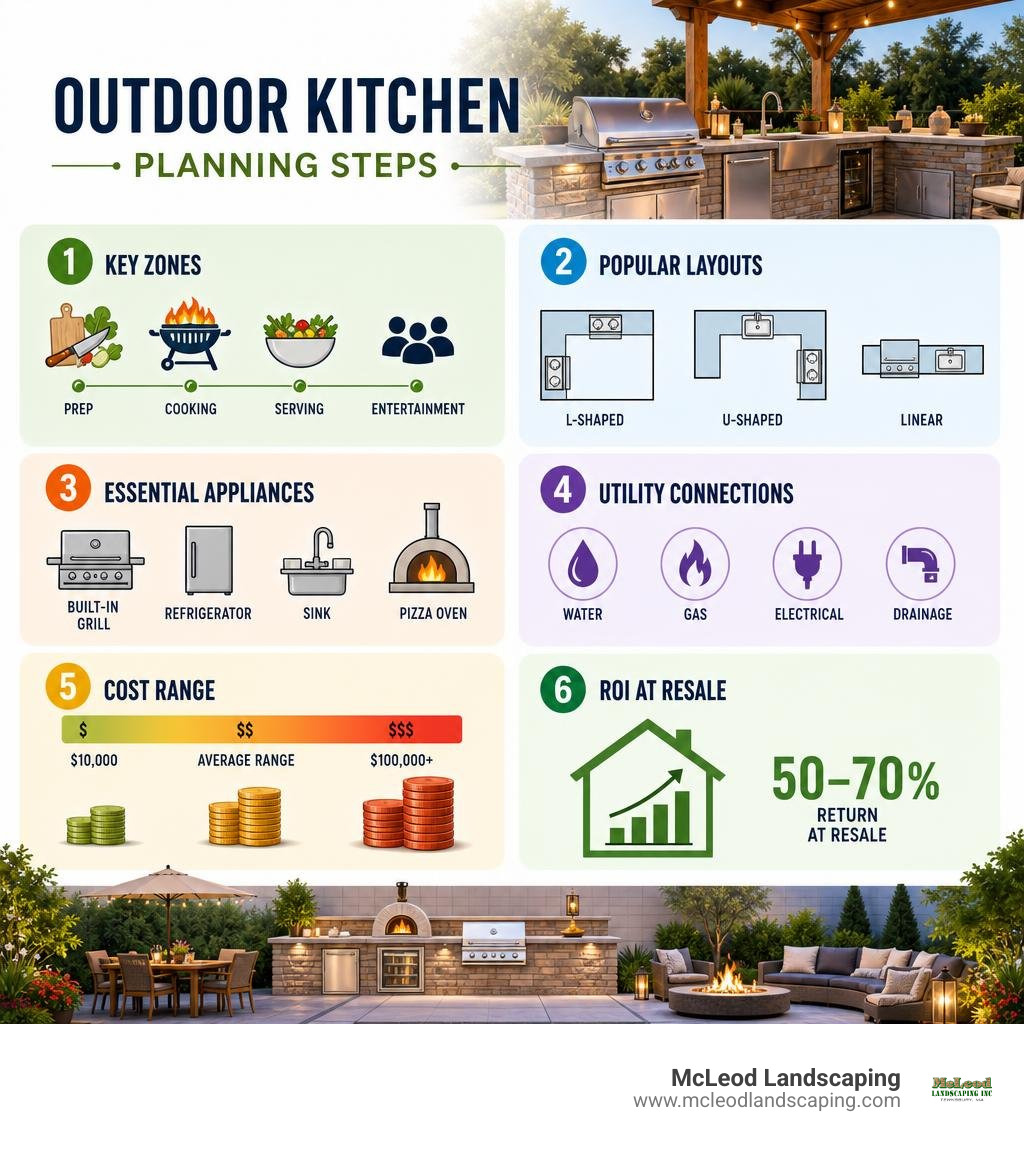

Just like your indoor kitchen, a successful outdoor kitchen relies on smart layout planning and zoning. You cannot simply line up your grill, sink, and fridge in a random row and expect a seamless cooking experience. To avoid constantly running back and forth, you need to plan for traffic flow and the classic “work triangle” (the distance between your cold storage, prep area, and hot cooking surface).
When we design these spaces for homeowners in Chelmsford, MA, or Concord, MA, we evaluate four primary layout configurations:
No matter which layout fits your yard, you must divide the footprint into four essential zones to keep the space functional:
For a real-world look at how layout planning translates to a stunning, highly functional family hub, check out Emily Henderson’s built-to-last reveal, which perfectly demonstrates how to balance cooking utilities with comfortable guest seating.
New England weather is beautiful, but it can be incredibly harsh on outdoor structures. Between freezing winters in Billerica and humid summers in Wilmington, your outdoor kitchen materials must be tough enough to withstand dramatic temperature swings, snow, rain, and UV exposure.
Standard indoor materials — like wood cabinetry or laminate countertops — will rot, warp, and fall apart within a season or two. Instead, we use highly durable, weather-resistant materials designed to last for decades.
| Material | Best Used For | Pros | Cons |
|---|---|---|---|
| Stainless Steel | Cabinets, appliances, and framing | Rust-resistant, hygienic, sleek modern look | Can get very hot in direct sunlight; shows fingerprints |
| Granite | Countertops | Extremely durable, heat-resistant, easy to clean | Needs periodic sealing; dark colors absorb sun heat |
| Concrete Panels | Kitchen bases and countertops | Industrial aesthetic, fireproof, highly customizable | Heavy; requires a stable concrete pad foundation |
| Powder-Coated Steel | Cabinets and structural frames | Adds color variety, highly weather-resistant | Scratches can expose underlying metal to rust if left untreated |
| HPL (High-Pressure Laminate) | Cabinet doors and countertops | UV-resistant, waterproof, mimics wood or stone | Premium pricing |
When selecting materials for a New England home, it is important to consider how regional design challenges—like heavy snow loads and freeze-thaw cycles—affect masonry and structural stability. Working with experienced local professionals ensures your kitchen is built on a proper foundation to prevent shifting over time.
Once the structural materials are chosen, it is time to select the appliances. The key rule here is simple: all appliances must be specifically rated for outdoor use. Indoor refrigerators and grills are not insulated or sealed to handle outdoor moisture, dust, and temperature shifts, and using them outdoors will quickly void their warranties.
If you are looking for ready-to-assemble, high-quality modular options to build out these appliance zones, systems like the IKEA BÅTSKÄR Outdoor kitchen with gas bbq and sink, the IKEA GRILLSKÄR, or the IKEA BÅTSKÄR with charcoal bbq offer fantastic modular components that combine modern style with durable stainless steel and powder-coated finishes.
As you plan, you will need to choose between three primary construction paths: DIY builds, pre-built modular kits, or fully custom stonework.
To understand how to navigate these choices and find the right building partner near you, read our guide on Finding the Best Outdoor Kitchen Near Me Without Breaking a Sweat.
An outdoor kitchen is only as functional as the utilities supporting it. Before laying a single stone, you must plan for how gas, water, and electricity will reach your cooking station.
Beyond utilities, your kitchen should integrate seamlessly with your existing backyard features. A standalone grill island can feel disconnected, but building it directly into a custom patio or positioning it next to a pool creates a cohesive outdoor living room.
Adding an overhead structure like a pergola or pavilion provides much-needed shade during hot summer afternoons and protects your appliances from direct rain. If you want to see how to elevate your layout even further, check out our guide on building an Outdoor Kitchen with Firepit, which showcases how to combine cooking and cozy fireside lounging into one incredible space.
For professional masonry inspiration, look for custom stonework that integrates seamlessly with New England yards, ensuring your outdoor kitchen matches the natural beauty of your landscape.
Let’s talk numbers. Based on average national internet data, the average cost of an outdoor kitchen is approximately $15,000, but projects typically range widely from $8,000 on the low end to $75,000+ on the high end (with the high end being at least three times the average cost) depending on the size, materials, and appliances you choose.
Please note: these are average industry cost ranges based on online research and do not represent actual project pricing for McLeod Landscaping. Every yard, utility run, and custom design is unique.
Several key factors will influence where your project lands on this pricing spectrum:
Despite the upfront investment, an outdoor kitchen is highly attractive to future homebuyers. On average, homeowners recoup 50% to 70% of their investment at resale. More importantly, it dramatically increases your daily quality of life, with most families reporting they use their backyards 3 to 4 nights a week once their kitchen is complete.
To protect this investment, simple year-round maintenance is essential. While these materials are built for the outdoors, taking care of them ensures they look pristine for decades:
To ensure you are making smart choices from the very beginning and avoiding costly construction mistakes, we highly recommend reading our guide on Don’t Get Burned Choosing Your Outdoor Kitchen Builders.
Based on average internet data, the average cost of an outdoor kitchen is around $15,000, with projects ranging widely from $8,000 to over $75,000 (where the high end is at least three times the average cost). A basic linear setup or modular kit with a grill and small counter space usually sits on the lower end ($8,000 to $15,000). A fully custom, L-shaped or U-shaped stone kitchen with premium appliances, plumbing, and electrical lines will run from $30,000 to over $75,000. Note: These are average costs based on online research and do not reflect specific pricing for McLeod Landscaping.
In almost all cases in the Merrimack Valley, yes. If you are running new utility lines (gas, water, or electricity), you will need specific plumbing and electrical permits. Additionally, local zoning laws and building codes often dictate how close an outdoor cooking structure can be to your property line or main home. A professional contractor will handle the entire permitting and inspection process for you.
Winterization is crucial in Massachusetts. First, shut off the water supply to your outdoor kitchen and drain the faucet completely (use an air compressor to blow any remaining moisture out of the lines so they don’t crack). Next, unplug your outdoor refrigerator, clean it out, and leave it turned off for the winter. Finally, clean your grill grates, apply a thin layer of cooking oil to protect them from moisture, and cover all appliances with high-quality, weatherproof covers.
An outdoor kitchen is far more than just a place to cook — it is a hub for family dinners, neighborhood block parties, and quiet weekend mornings. By carefully planning your zones, choosing durable materials that can survive New England winters, and working with experienced professionals to handle complex utilities, you can build a space that brings your family together for decades to come.
At McLeod Landscaping, we have spent over 30 years helping homeowners in Tewksbury, Andover, Burlington, and throughout the Merrimack Valley turn their backyard dreams into reality. We handle the entire process from initial design to masonry, hardscaping, and professional installation.
Ready to stop running back and forth to your indoor kitchen? Transform your backyard with a custom outdoor kitchen with firepit and let us help you build the ultimate outdoor entertainment space.
Contact McLeod Landscaping today at (978) 640-0957 or click here to schedule a consultation for retaining wall installation. Let our experienced team design and install a functional and visually appealing retaining wall that enhances your landscape.

1881 Main St Unit 1, Tewksbury, MA 01876