
Commercial retaining wall contractors are specialists you need when your property has serious grade changes, erosion risks, or unstable slopes that standard landscaping can’t fix.
Here’s a quick overview of what to look for when hiring one:
Whether you’re managing a parking lot on fill, a sloped commercial site, or a property with active erosion, the right contractor makes the difference between a wall that lasts 50+ years and one that fails under hydrostatic pressure.
I’m Scott McLeod, owner of McLeod Landscaping — a Tewksbury, MA-based hardscaping and landscaping company with over 30 years of experience working with commercial retaining wall contractors and delivering engineered wall solutions for commercial and residential properties throughout the Merrimack Valley. In the sections below, I’ll walk you through exactly how to find, evaluate, and hire the right contractor for your project.
Quick commercial retaining wall contractors terms:
When you are managing a commercial property in the Merrimack Valley—whether it’s in Andover, Billerica, or Lowell—the stakes are much higher than a simple garden border. Commercial projects often involve massive lateral earth pressure, heavy surcharges from parking lots, and strict municipal codes.
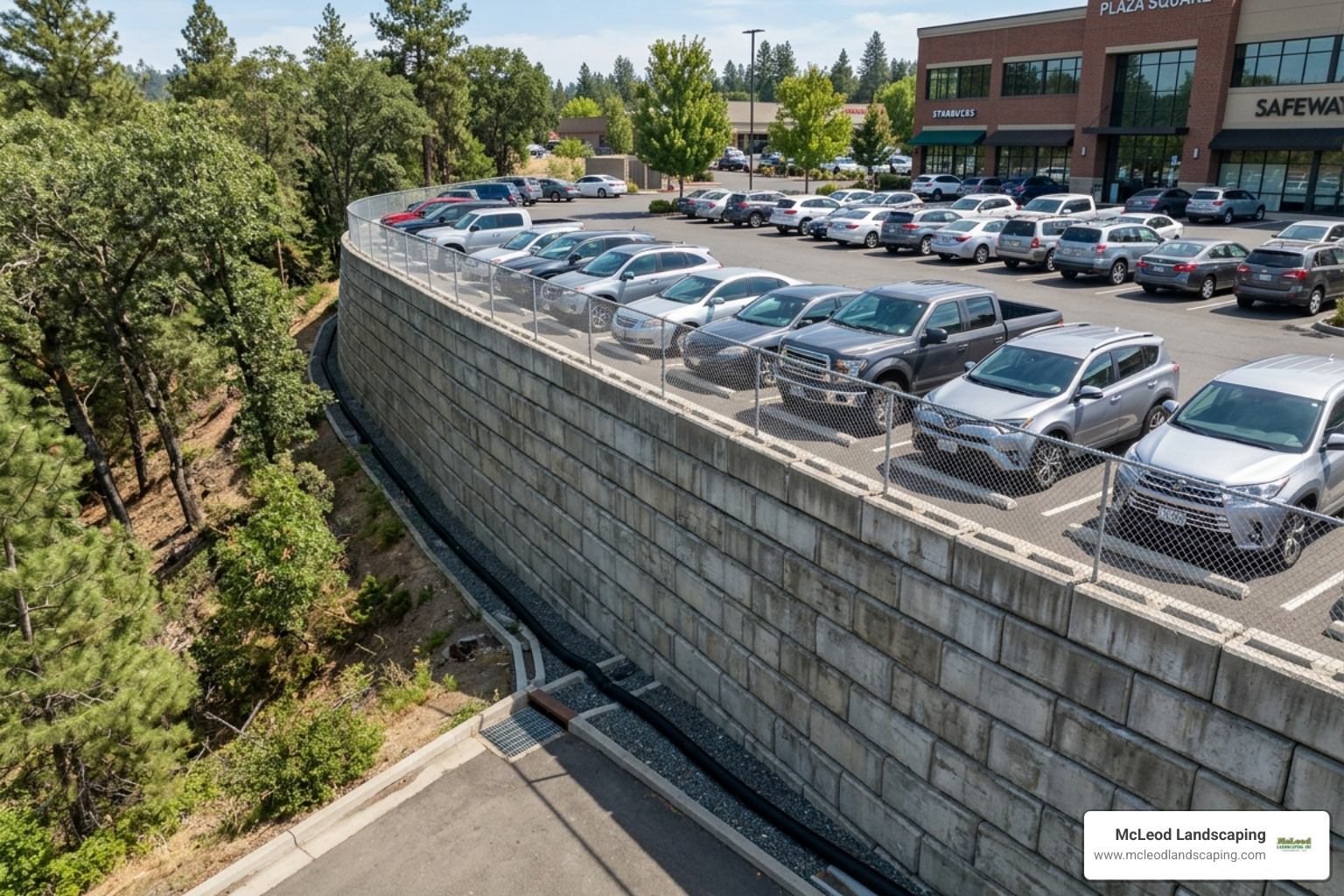
Specialized commercial retaining wall contractors are essential because they focus on:
Not every “guy with a truck” is equipped for a commercial job. When searching for the Best Hardscape Contractors Near Me, you need to dig into the details.
First, ask for a portfolio. We recommend looking for contractors who have installed millions of square feet of walls. Why? Because scale matters. A contractor who has handled 4,000,000 square feet of retaining walls across diverse terrains has seen—and solved—every problem imaginable.
Second, check their safety records and insurance. A Hardscaping Contractor working on a commercial site must carry significant liability insurance and follow OSHA guidelines strictly. If they can’t produce a COI (Certificate of Insurance) immediately, keep looking.
A true Retaining Wall Contractor provides more than just labor. They offer a “turnkey” experience, which usually includes:
In April 2026, the technology behind wall construction is more advanced than ever. Choosing the right partner means finding someone who understands the “why” behind the “how.”
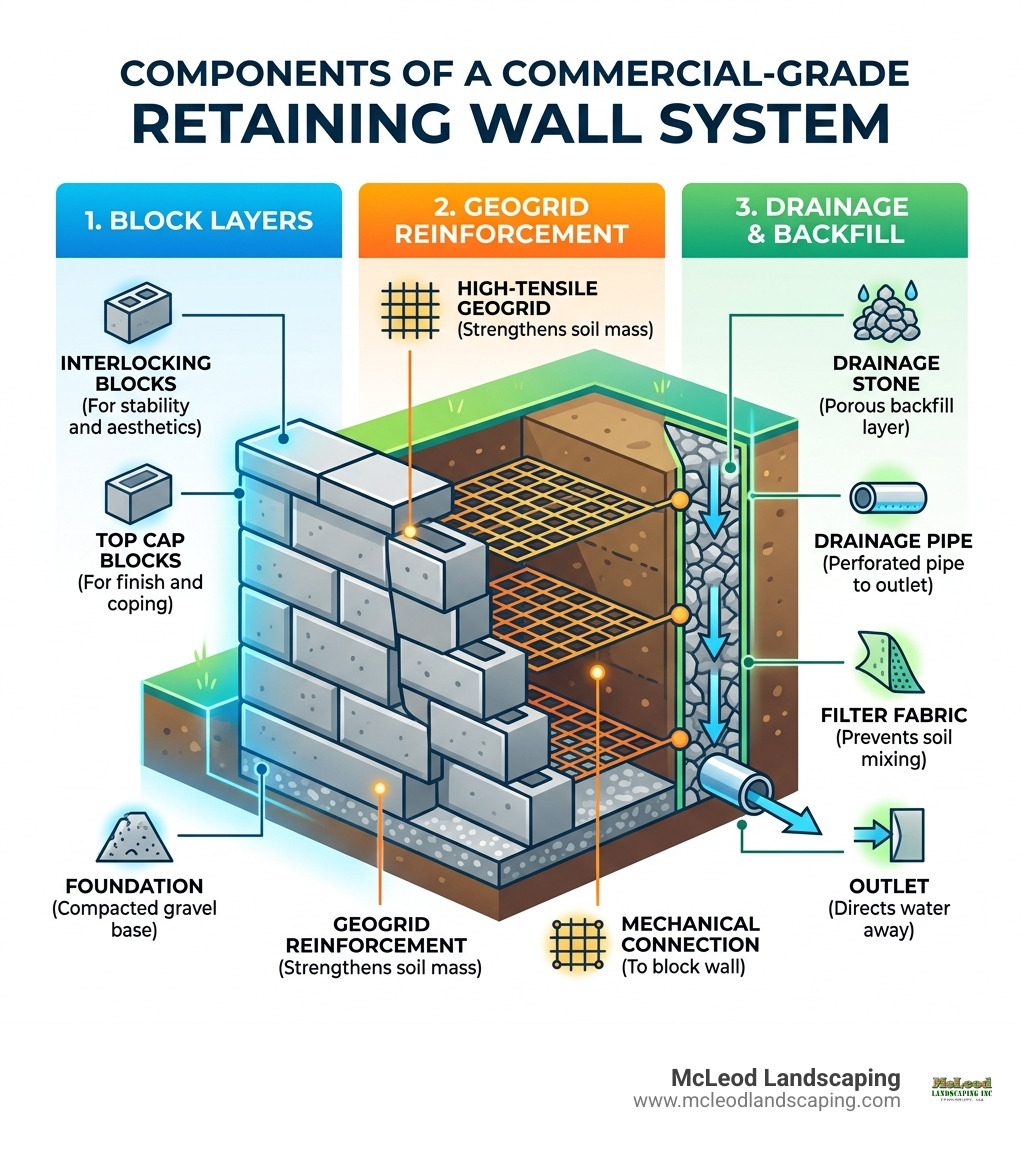
Modern walls are marvels of engineering. We no longer rely solely on the weight of the stone to hold back the earth. Instead, we use:
In the Merrimack Valley, local building codes are strict. In most jurisdictions like Wilmington or Tewksbury, any wall over 4 feet high requires a permit and a design stamped by a Licensed Professional Engineer (PE).
Professional commercial retaining wall contractors handle this coordination for you. They work with the engineer to ensure the Retaining Wall Design accounts for soil type (like the heavy clay often found in Massachusetts), hydrostatic pressure, and the specific Retaining Wall Installation requirements of the site.
A commercial property is a long-term investment. You should expect a warranty that reflects that. Most reputable contractors offer a 5-year limited warranty on workmanship and materials. However, a properly engineered and built commercial wall is designed to last 50 years or more. If a contractor hesitates to put their guarantee in writing, that’s a red flag.
Different sites require different solutions. Here’s a breakdown of the most common systems used by commercial retaining wall contractors:
| Wall Type | Best For | Key Benefit |
|---|---|---|
| Gravity Walls | Heights under 10ft | Uses its own weight; minimal excavation behind the wall. |
| MSE (Mechanically Stabilized Earth) | Tall walls (up to 50ft+) | Uses geogrid and soil for massive strength; cost-effective. |
| Cantilever Walls | Limited space | Uses a “heel” or “toe” to use the weight of the soil to stay upright. |
| Segmental Retaining Walls (SRW) | Versatility & Aesthetics | Modular blocks that “lock” together without mortar. |
Gravity walls rely on sheer mass. Systems like Redi-Rock use giant, one-ton blocks that stack like Legos. These are fantastic for sites with limited “cut” space because they don’t always require geogrid reinforcement to reach significant heights. They offer a natural stone look with the speed of precast concrete.
These are the “bread and butter” of commercial work. Using Concrete Retaining Walls made of modular blocks allows for incredible design flexibility. Features like pin systems or rear-lip locators ensure a uniform “batter” (the slight backward lean of the wall), which is critical for stability. For more inspiration on how these can look, check out our Retaining Wall Ideas.
The secret to a wall that doesn’t fail is what you can’t see.
If you are dealing with an existing structure that’s failing, you might need to consult our Retaining Wall Repair Guide 2025 to see if it can be saved or if a full replacement is necessary.
Every town in the Merrimack Valley has its own quirks. In Billerica or Burlington, the zoning requirements might differ slightly from Chelmsford. Commercial retaining wall contractors act as your liaison with the city, ensuring that all setbacks and safety codes are met so you don’t face fines or work-stoppage orders.
Budgeting for a commercial project requires looking at the “Total Cost of Ownership.”
Note: These are average costs based on internet data and not actual costs for McLeod Landscaping.
Commercial walls are priced by the “face square foot.” Depending on the complexity, material, and height, you can expect a wide range:
What influences the price?
For more detailed cost breakdowns, visit How Much Does a Retaining Wall Cost?.
Even the best wall needs a “check-up.” Our Commercial Property Maintenance teams look for:
In the Merrimack Valley, almost all commercial walls require a Licensed Professional Engineer (PE). Even if the wall is under 4 feet, if it is supporting a parking lot or a building foundation, engineering is highly recommended to protect your liability.
A wall that is properly engineered with integrated drainage and high-quality materials (like modular concrete or stone) should easily last 50 to 100 years. Timber walls, by contrast, usually only last 10-15 years before they begin to rot.
Yes, but it’s more challenging. In places like Lowell or Tewksbury, we have to deal with frozen ground. While we can excavate and set blocks in the winter, we must be extremely careful with backfill compaction to ensure ice isn’t trapped in the soil, which could lead to settling in the spring.
Hiring commercial retaining wall contractors is about more than just moving dirt—it’s about protecting your property’s value and ensuring the safety of everyone who visits your business. At McLeod Landscaping, we bring over 30 years of local experience to every project. Whether you need a massive MSE wall for a new development in Andover or a decorative but functional solution in Burlington, we have the expertise to get it done right the first time.
Ready to secure your ground? From Commercial Property Maintenance to complex engineered installations, we are here to help. Contact us today to discuss your next project.
Contact McLeod Landscaping today at (978) 640-0957 or click here to schedule a consultation for retaining wall installation. Let our experienced team design and install a functional and visually appealing retaining wall that enhances your landscape.


1881 Main St Unit 1, Tewksbury, MA 01876