
Landscape barrier walls are vertical structures that hold back soil, create level areas, define boundaries, or add visual interest. They serve both functional and aesthetic purposes, changing challenging terrain into beautiful, usable environments.
One of their primary functions is soil retention and erosion control. On a sloped yard, soil constantly shifts and washes away. Retaining walls act as robust barriers to hold back earth and keep your landscape intact. While there are ways to landscape a steep slope without retaining walls, a well-placed wall is often the most effective solution.
Beyond stability, these walls are champions of creating usable, level space. A steep, unusable slope can be transformed into terraced garden beds, a flat lawn, or an inviting patio, adding immense value and function to your property.
As Scott McLeod, owner of McLeod Landscaping, I’ve built countless landscape barrier walls throughout the Merrimack Valley. Understanding the fundamentals of wall construction makes the difference between a wall that lasts decades and one that fails within a few years.
Relevant articles related to landscape barrier wall:

Common applications include:
Landscape barrier walls are integral to maximizing property usability and aesthetics, offering a perfect blend of structural integrity and versatile design.
Not all walls are created equal. The wall that holds back a hillside requires a different approach than one that simply borders a patio. Understanding the key differences in wall types and materials is the first step to a successful project.
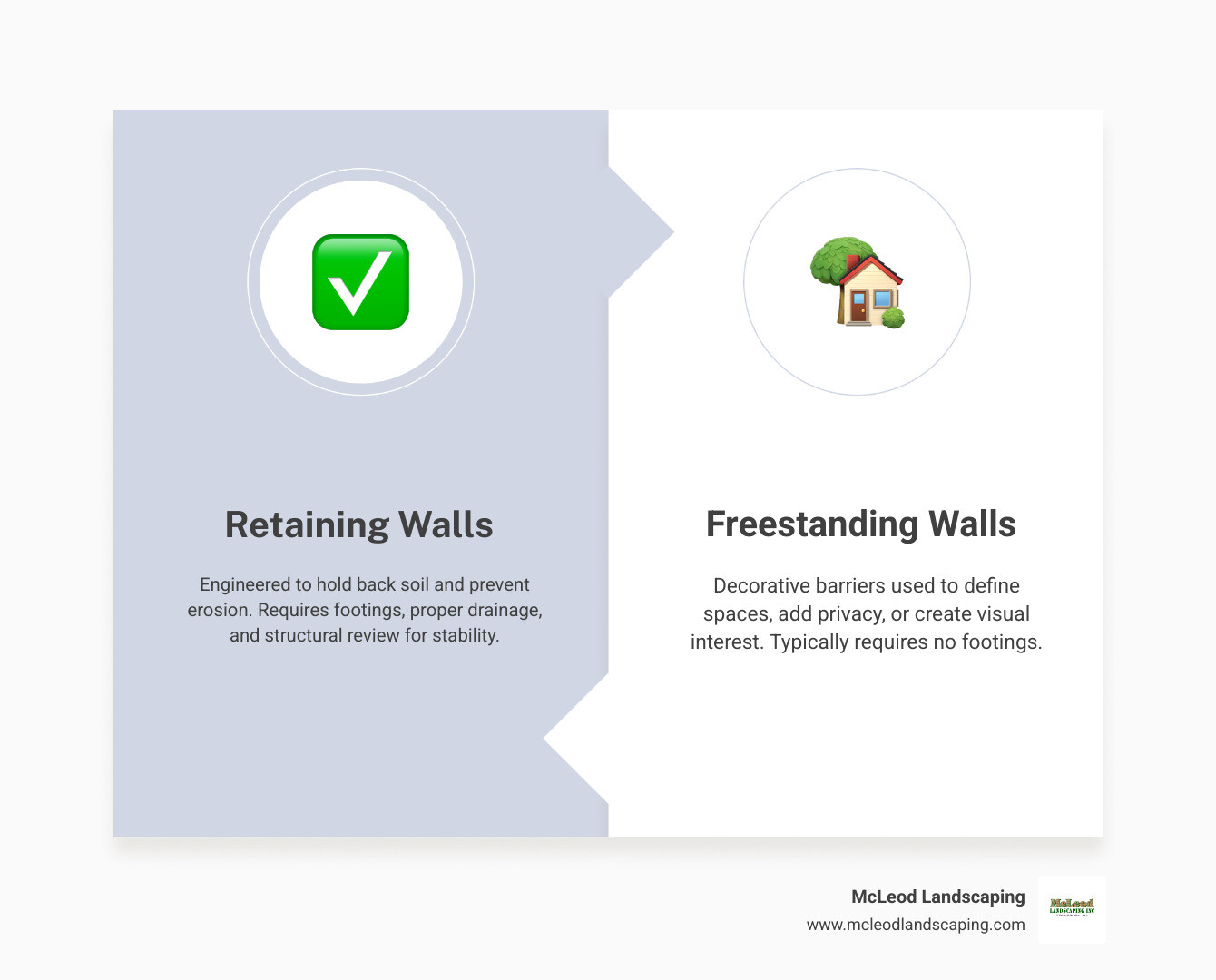
A retaining wall is an engineered structure designed to hold back soil and withstand immense pressure. If you have a slope or erosion issues, a retaining wall is your solution. They require serious engineering, including proper footings and drainage systems.
A freestanding wall, or landscape wall, is primarily decorative. These walls stand on flat ground to define garden spaces, create privacy, or provide built-in seating. They don’t bear significant structural loads and typically don’t require deep footings.
| Feature | Retaining Walls | Freestanding Walls |
|---|---|---|
| Function | Hold back soil, prevent erosion, create level areas | Decorative, define spaces, add privacy, built-in features |
| Construction | Requires robust footings, drainage, advanced engineering for taller walls | Minimal or no footings, less structural complexity |
| Common Uses | Terracing slopes, stabilizing embankments, creating raised beds | Property line markers, garden borders, outdoor kitchen bases, seating walls |
Your choice of material affects your wall’s durability, cost, and style.

Among these options, interlocking concrete blocks are our most recommended material. They offer an ideal balance of durability, efficiency, and design flexibility.
These blocks satisfy both the engineer’s demand for structural integrity and the designer’s eye for beauty.
The planning phase is where a successful landscape barrier wall is truly built. Skipping critical design steps can lead to a wall that leans, cracks, or fails within a few years.
A successful project starts with a thorough site assessment. Key factors include:
Drainage is the single most important factor in a wall’s longevity. Water saturating the soil behind a wall creates immense hydrostatic pressure, which can cause even well-built walls to bulge, crack, or fail.
The solution is an engineered drainage system. This includes a layer of free-draining gravel, a perforated drain pipe at the base, and geotextile fabric to prevent clogs. Proper retaining wall drainage is the difference between a wall that lasts decades and one that fails within years.
When a landscape barrier wall exceeds 2 to 4 feet, it requires professional engineering to ensure it can resist thousands of pounds of lateral pressure. This is a matter of safety, as a failed tall wall can cause serious damage or injury.
Engineers calculate the forces your wall will face and design solutions to counteract them. For tall walls, we often use geogrid reinforcement—synthetic mesh embedded in the soil behind the wall. This creates a reinforced soil mass that works with the wall, dramatically increasing its stability. Our gravity retaining wall complete guide explores these concepts in more depth. The underlying physics of structural integrity are universal, as seen in resources like the WSDOT Traffic Barrier Design Manual, and are just as critical in landscaping. The upfront investment in professional design ensures your wall performs safely for generations.
Building a durable landscape barrier wall involves more than just stacking blocks. Following a precise construction process is key to creating a structure that lasts.
The foundation is everything. A wall built on an improper base is destined to fail. The process of building a retaining wall starts here.
With a solid first course, you can begin building upward.
The final steps integrate the wall into your landscape.

These finishing details—proper drainage, backfill, and integration—are what separate a wall that lasts five years from one that lasts fifty.
Here are answers to the most common questions homeowners have when planning a landscape barrier wall project.
The cost of a landscape barrier wall is unique to each project. Based on general market research, you can expect average costs to range from $25 to $250+ per square foot. This wide range is necessary because a simple, low wall can be relatively inexpensive, while a tall, engineered wall on a difficult slope can cost three times the average or more. Crucially, these figures represent average costs based on internet data, not specific pricing for McLeod Landscaping. We provide custom estimates only after a site assessment.
Key factors influencing the price include:
For a more detailed look at pricing, see our guide on how much does a landscape retaining wall cost.
A well-built wall can last for generations. Lifespan depends on the material, installation quality, and maintenance.
Correct engineering, a solid foundation, and proper drainage are the true secrets to a long-lasting wall. Regular maintenance also adds years to its life.
It depends on your location and the wall’s height, but you must check with your local municipality before starting.
Most towns require a permit for any landscape barrier wall over a certain height, typically 2 to 4 feet. This is a safety measure, as taller walls exert tremendous pressure and require professional engineering.
Other factors can also trigger permit requirements, such as proximity to property lines or if the wall supports a heavy load like a driveway. Always check with your local building department and your Homeowner’s Association (HOA) before any work begins. Skipping the permit process can lead to fines, stop-work orders, or even a mandate to demolish the wall.
Throughout this guide, we’ve explored how landscape barrier walls do so much more than just look good—they solve real problems. They hold back soil on slopes, prevent erosion that washes away your investment, create usable flat spaces where there were none, and define beautiful outdoor living areas that increase your property’s value and enjoyment.
But here’s the thing: building a wall that actually works—one that won’t lean, crack, or fail after a few seasons—is more complicated than it might seem from the outside. There’s genuine engineering involved. You’re dealing with soil mechanics, hydrostatic pressure, drainage systems, proper base preparation, and local building codes. Get any of these wrong, and you could be looking at expensive repairs, lost landscaping, or even safety hazards down the road.
That’s where experience makes all the difference.
At McLeod Landscaping, we’ve been building landscape barrier walls throughout the Merrimack Valley for over 30 years. We’ve worked on properties in Andover, Billerica, Burlington, Carlisle, Chelmsford, Concord, Lowell, Tewksbury, Westford, and Wilmington, tackling everything from simple garden bed walls to complex multi-tiered retaining systems on challenging slopes. We understand New England soil conditions, freeze-thaw cycles, drainage requirements, and what it takes to build a wall that will still be standing strong decades from now.
Whether you’re dealing with erosion issues, want to create terraced garden beds, need to level out a sloped yard for a patio, or simply want to add structure and beauty to your landscape, we’re here to help. We handle everything from initial design and permitting through to final installation and planting, ensuring your project is done right the first time.
For a durable and beautiful wall built to last, consider working with a professional hardscape team for your retaining wall installation. We’d love to help you transform your outdoor space into something you’ll enjoy for years to come.
Contact McLeod Landscaping today at (978) 640-0957 or click here to schedule a consultation for retaining wall installation. Let our experienced team design and install a functional and visually appealing retaining wall that enhances your landscape.


1881 Main St Unit 1, Tewksbury, MA 01876