
Retaining wall installation is a critical landscaping project requiring careful planning and precise execution to create a structure that will last for decades. Whether you’re managing a sloped yard, preventing soil erosion, or creating usable outdoor space, understanding the fundamentals of retaining wall construction can save you thousands in repairs and ensure your investment stands strong.
Essential Steps for Retaining Wall Installation:
The key to a successful retaining wall lies in proper drainage and a solid foundation. Retaining walls under 4 feet high are usually built as gravity walls, where the weight and setback of the units provide resistance against soil pressure.
Water management is absolutely critical—poorly designed drainage is the leading cause of retaining wall failure. The performance of most retaining walls depends on keeping the area behind the wall relatively dry, which is why proper backfill and drainage systems are essential.
I’m Scott McLeod, owner of McLeod Landscaping Inc. Over the past three decades, I’ve overseen hundreds of retaining wall installation projects in the Merrimack Valley. My team has learned that the difference between a wall lasting 10 years versus 50+ years comes down to getting the fundamentals right from day one.
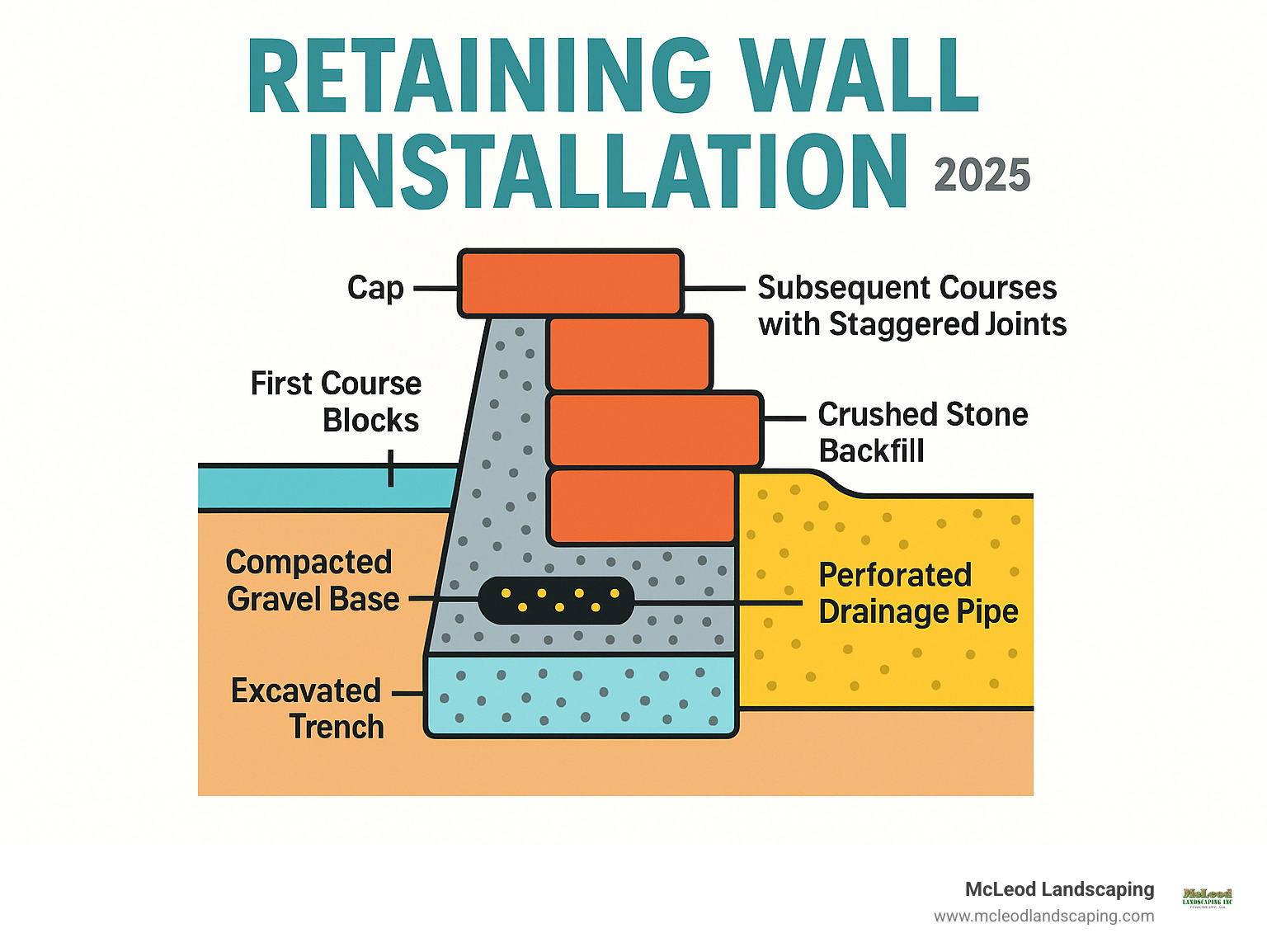
Key terms for retaining wall installation:
The success of any retaining wall installation hinges on what happens before you pick up a shovel. After three decades in landscaping, I’ve seen too many walls fail from skipped planning. We always start with a thorough site assessment to understand the property’s unique characteristics before building.
Soil types dictate how your wall will perform. Clay soils retain water and put serious pressure on a wall. Sandy soils drain well, making the job simpler. Organic soils lack structural support and are only suitable for the top few inches of landscaping.
Pro tip: always build after a dry spell. Working with wet, sticky soil is messy, frustrating, and slows down the project.
For calculating materials, we follow the 10% extra material rule. This smart planning accounts for cutting mistakes, errors, and provides spare blocks for future repairs, saving you the headache of finding matching blocks later.
To figure out how many blocks you need, measure your wall’s total length and finished height. Divide the wall length by your block length to get blocks per course, then divide total height by block thickness for the number of courses. Multiply these together, add your 10% buffer, and you’re set.
Let’s discuss permit requirements, which often trip up DIYers. While the 4-foot height rule is a common guideline, don’t rely on it. Some municipalities require permits for walls as short as 2 feet, especially near property lines or utilities. Walls over 4 feet almost always need permits and an engineer’s stamp. Always check with your local building department first.
Calling 811 is essential. This free service marks underground utilities so you don’t accidentally dig into a gas line or electrical cable. It’s a call that can save your life and wallet.
Don’t forget property lines. A quick conversation with neighbors can prevent future disputes and headaches.
Drainage planning is what separates pros from amateurs. Poor drainage is the number one killer of retaining walls, as water pressure builds up and eventually causes failure. We always plan for comprehensive water management from day one. For more details, see our guide on Retaining Wall Drainage.
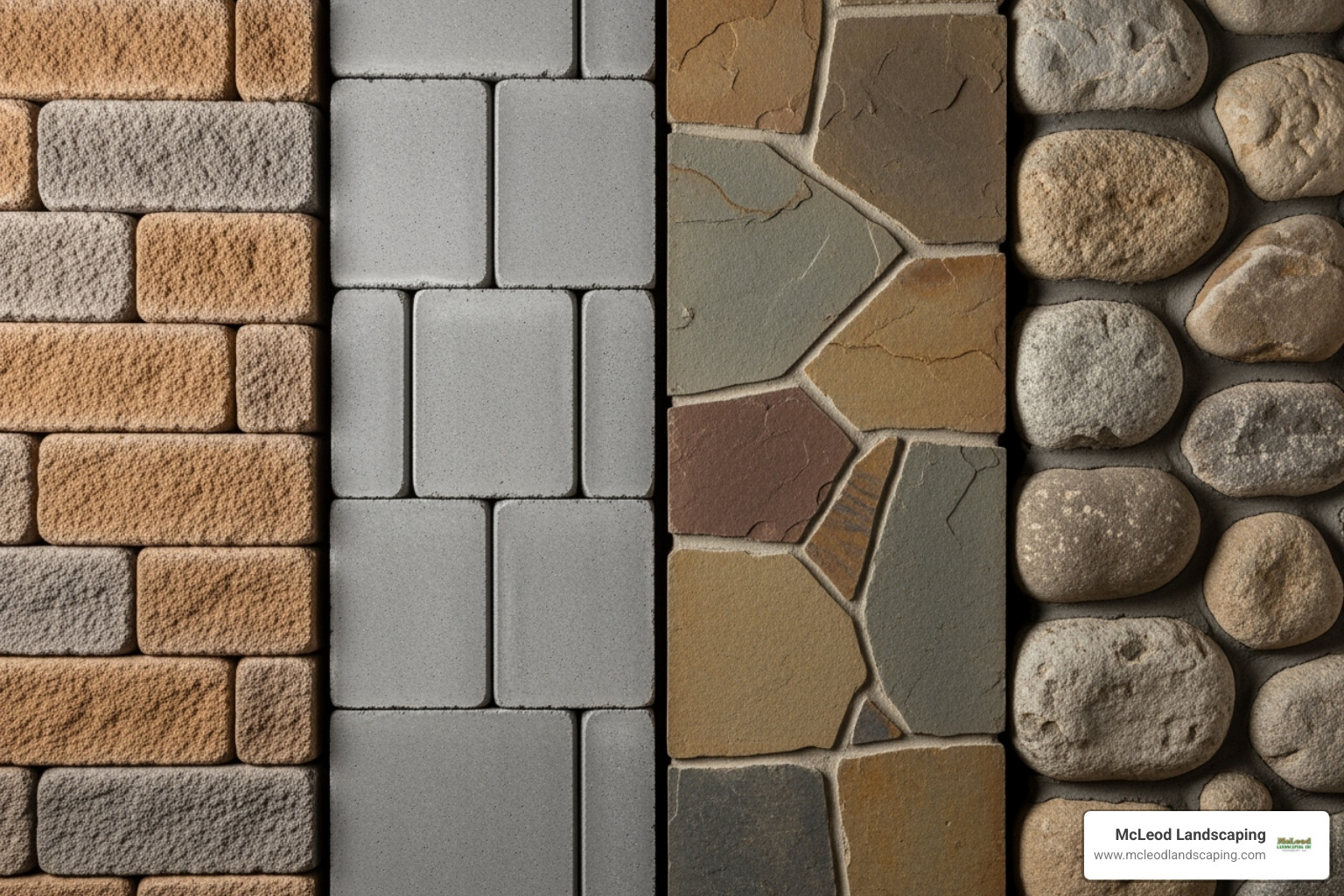
Choosing materials affects your wall’s appearance and installation time. Concrete blocks are popular because they’re user-friendly, versatile, and come in many styles. Their interlocking design simplifies installation, even for DIYers. Learn more at Concrete Block Retaining Wall.
Natural stone offers a timeless, organic look but requires more skill to install. Timber walls are another option, but they typically last only 10-15 years, far less than the 50+ years for concrete or stone. If considering timber, see our guide on How to Build a Retaining Wall with Landscape Timbers.
For those seeking a more natural approach, Boulder Walls Landscaping offers a beautiful alternative that uses the sheer mass of large rocks for stability.
Understanding the difference between gravity and reinforced walls can prevent over-engineering a simple project or under-building a complex one.
| Feature | Gravity Wall | Reinforced Wall |
|---|---|---|
| Key Characteristics | Relies on its own weight and setback for stability | Uses geogrid reinforcement extending back into soil |
| When to Use | Walls under 4 feet, simple applications | Walls over 4 feet, areas with heavy loads above |
| Typical Height Limits | Up to 4 feet for most residential projects | Can exceed 6 feet with proper engineering |
| Pros | Simpler installation, lower cost, no geogrid needed | Greater height capability, handles surcharge loads |
| Cons | Height limitations, less resistant to heavy loads | More complex installation, higher material costs |
Geogrid reinforcement is a synthetic mesh that extends into the soil, creating a reinforced mass with the blocks. It’s essential for taller walls or those with surcharge loads like driveways or slopes above them.
Any reinforced wall exceeding typical residential heights should be designed by a licensed Professional Engineer. This is often required by code and is necessary for safety.
Essential Tools and Materials:
The key to successful retaining wall installation lies in respecting each of these planning steps. Skip them at your own risk.
Now it’s time to build. But first, let’s talk safety. Personal Protective Equipment (PPE) is not optional for retaining wall installation. You’ll need safety glasses, sturdy work gloves, steel-toed boots, and hearing protection for power tools. When cutting blocks, add a respirator or dust mask to protect your lungs.
811 call? Double-check the utility markings before digging to avoid hitting a gas line. Following a logical process separates walls that last for decades from those that fail. Each step builds on the last; cutting corners now means headaches later. The goal is a structure that endures. For additional guidance, you can reference resources like Learn how to install beautiful retaining walls.
This is where the real work begins. It’s not glamorous, but it’s the most important part.
Marking the layout is first. Use stakes and a mason’s line for straight sections. For curves, a garden hose is great for adjustments; mark the final shape with spray paint. Pro tip: view your layout from different angles to ensure it looks right from a distance.
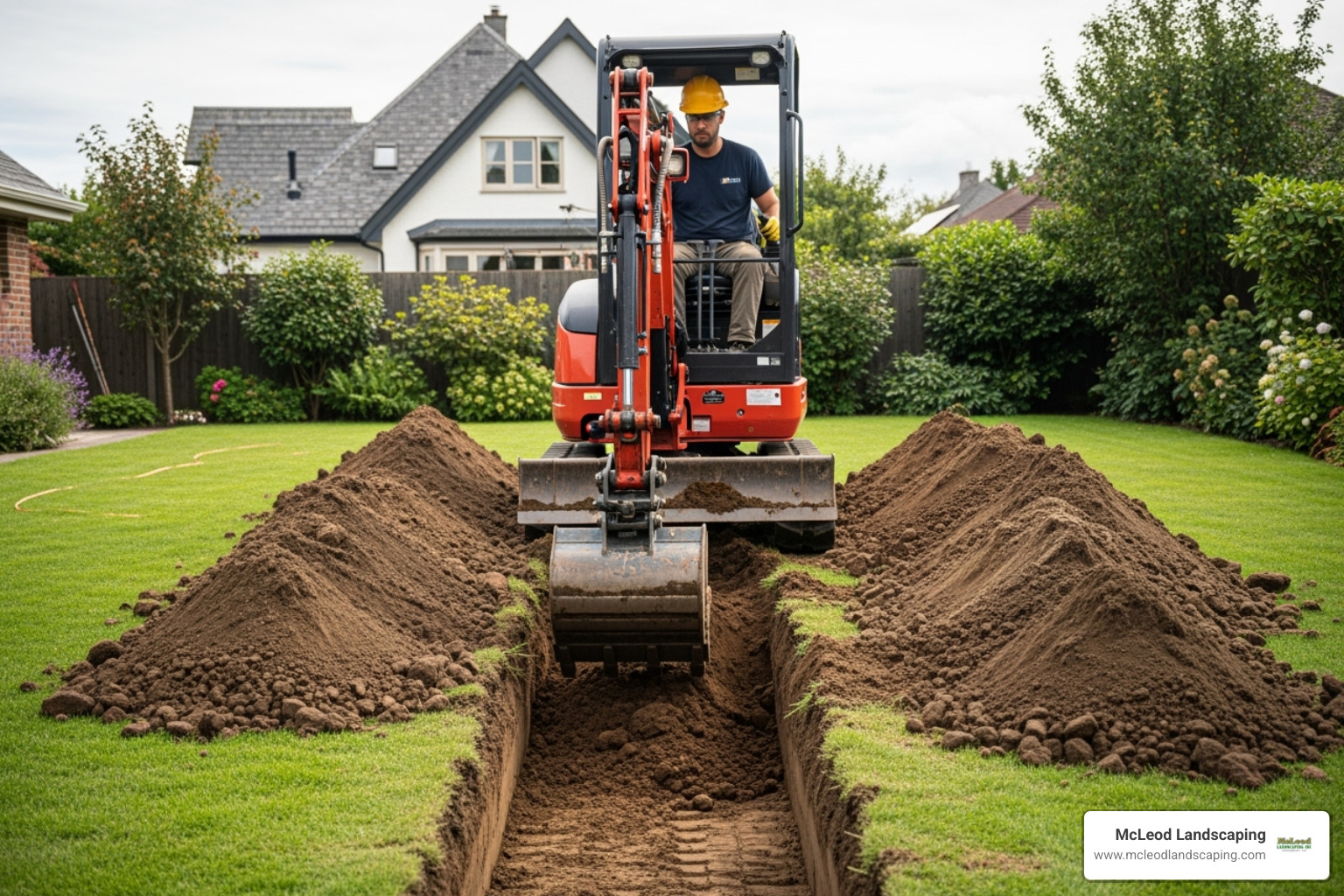
Excavating the trench requires simple math. Your trench needs to be deep enough to bury at least half the height of your first block, plus 6 inches for the compacted gravel base. For walls over 3 feet, bury a full block for maximum stability. The trench dimensions should be about twice as wide as your block to accommodate the block and drainage material behind it.
Compacting the subgrade soil is not overkill. Use a hand tamper for small areas or a plate compactor for larger ones. This creates the solid foundation your wall depends on.
Next, install landscape fabric in the excavated area. It acts as a filter, preventing soil from clogging your drainage system and ensuring your wall’s longevity.
Install the gravel base using at least 6 inches of 3/4-inch crushed stone. The key is compacting in lifts: add no more than 4 inches at a time, compacting thoroughly before adding the next layer. This prevents settlement.
This step will make or break your retaining wall installation. The importance of the first course cannot be overstated, as many DIY walls fail due to a rushed base.
Leveling the gravel base requires patience. Use a long level (a 4-foot level is best for long runs) and consider using 1-inch pipes as guides to screed the surface smooth.
Placing the first block requires attention to detail. Center the block in the trench. If your blocks have a lip or flange, it typically faces up and forward, but some require removing it for the base course. Always check the manufacturer’s instructions.
Constantly check for level front-to-back and side-to-side on each block and relative to its neighbors. Use a dead blow hammer for adjustments to avoid chipping the blocks.
Fill block cores with wall rock as you go. The hollow cores and the space about 12 inches behind the blocks get filled with crushed stone up to block height. This adds weight and starts your drainage system.
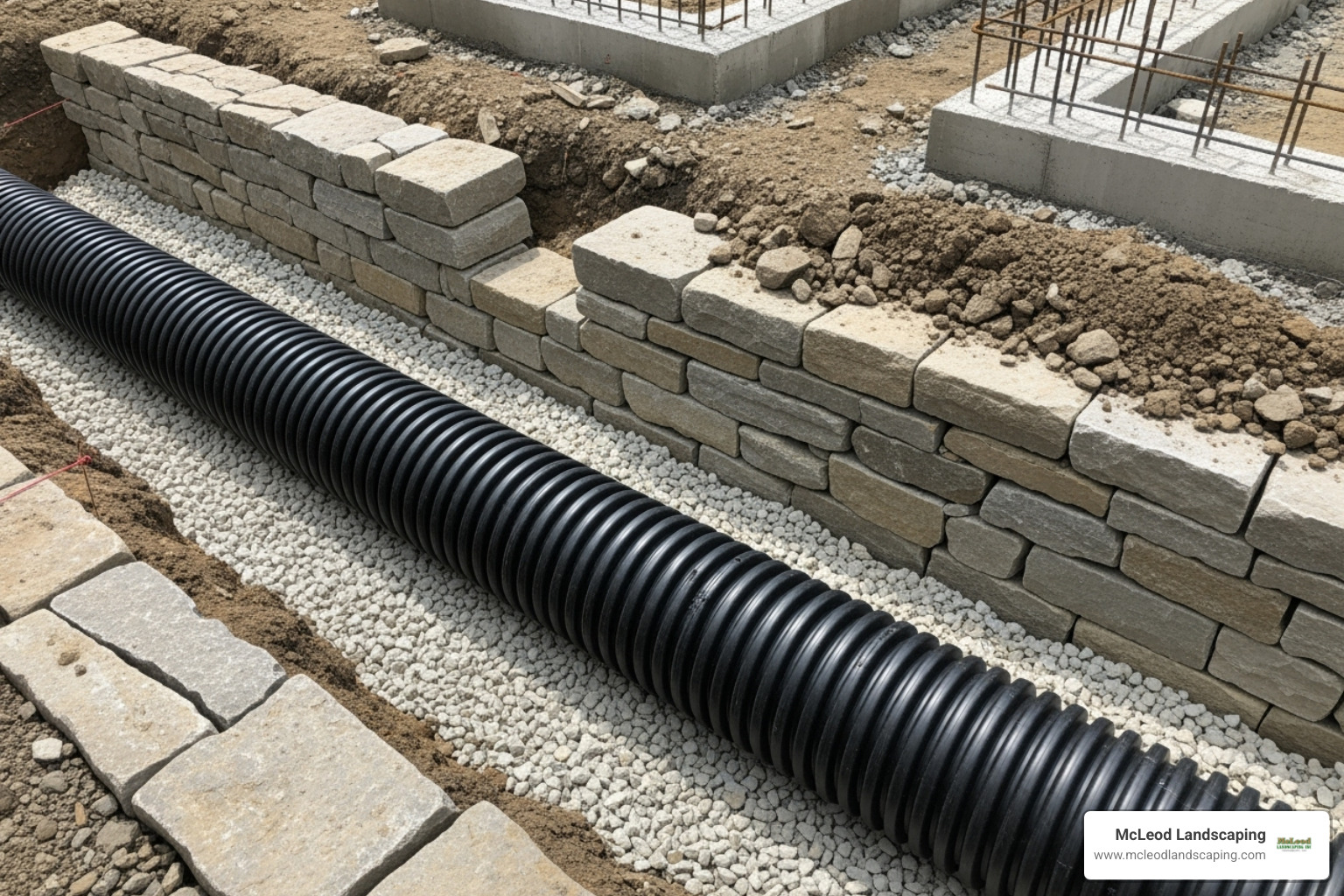
Water is your wall’s biggest enemy. Poor drainage is the leading cause of wall failure. Get this step right, and your wall will last for decades. Drainage is required almost always, but it’s critical with poorly draining soils like clay and for walls over 4 feet.
Perforated pipe installation happens after your first course or two are in place. Use a 4-inch corrugated pipe with a drain sleeve to prevent clogging. The pipe sits at the lowest point behind your wall and must slope about 1/8 inch per foot toward an exit point. A common mistake is not planning an exit for the drain pipe. Ensure water can escape, either by daylighting to a lower area or connecting to a storm drain.
Wall rock (crushed stone) creates a path for water to reach your drain pipe. Use clean 3/4-inch crushed stone in a layer at least 12 inches wide behind the blocks. For more detailed information, check out Retaining Wall Drainage.
Now your wall starts taking shape. Staggering joints is like laying bricks; you never want vertical seams to line up. Starting courses with half-blocks on alternating rows achieves this pattern.
Backfilling in lifts requires patience. Add no more than 8 inches of material at a time. Compacting backfill after each lift is non-negotiable. Make at least two passes with a plate compactor, starting on the blocks and working backward. This prevents settlement and ensures the backfill supports the wall.
Keep heavy equipment away from the wall while it’s new. Stay at least 3 feet back with anything heavier than a wheelbarrow to prevent pushing the wall out of alignment. For deeper technical details, resources like The Redi-Rock Installation Guide provide excellent preconstruction and construction specifics.
This is where your retaining wall installation becomes a beautiful landscape feature. Cutting blocks is inevitable. Use a masonry saw or chisel depending on the number of cuts. Rent a masonry saw with a diamond blade for many cuts; a hammer and chisel works for a few but is more labor-intensive.
Installing capstones provides a finished, professional look and protects the top course. Use construction adhesive, applying two 1/4-inch beads to the top of the last course before setting the caps.
Overhanging capstones by 1 to 1.5 inches creates a drip edge that sheds water away from the wall face. Final grading involves sloping the ground about 2-5% away from the wall on both sides to direct surface water away.
Integrating landscaping is where creativity meets function. Consider drought-tolerant plants above the wall or use the space to create defined garden beds.
After three decades of retaining wall installation projects throughout the Merrimack Valley, I’ve heard just about every question you can imagine! Here are the answers to the most common ones.
This can be tricky. The general rule of thumb is 4 feet, but it’s not universal. Every municipality has its own regulations, and permit requirements can vary from one town to the next. Some cities might prohibit walls near property lines or require permits for any wall over 3 feet.
Checking local building codes is essential before you start any project. Don’t assume the 4-foot rule applies everywhere. Many homeowners don’t realize that taller walls often require an engineer to stamp the plans, adding time and cost to the project.
If you’re feeling overwhelmed by the permit process, working with experienced Retaining Wall Contractors can help you steer these regulations smoothly. We’ve dealt with building departments across the Merrimack Valley for decades, so we know what each town requires.
The cost of a retaining wall installation can vary dramatically based on several key factors.
Based on internet data, average cost ranges are wide, from $25 to over $80 per square foot. For complex projects with premium materials, costs can be much higher. Please note that these figures are based on national averages and are not a quote from McLeod Landscaping.
For a detailed breakdown, check out our guide on How Much Does a Retaining Wall Cost?.
The most common cause is water pressure—specifically, hydrostatic pressure building up behind the wall. I’ve seen many walls that looked fine but were being destroyed by unmanaged water.
When water accumulates behind a wall with nowhere to go, it creates tremendous force. Eventually, that pressure causes the wall to bulge, crack, or collapse. Hydrostatic pressure develops when drainage systems fail or were never properly installed.
The importance of proper drainage cannot be overstated. A well-drained wall can last 50+ years, while a poorly drained one might show problems within a few seasons.
Other contributing factors include a poor foundation, lack of reinforcement for taller walls, and freeze-thaw cycles, which are particularly brutal here in New England. When water-saturated soil freezes and expands, it can exert incredible pressure on improperly built walls.
Fortunately, all of these issues are preventable with proper retaining wall installation techniques and attention to drainage from day one.

Building a durable retaining wall installation is about mastering every critical step. From planning and permits to excavation, foundation prep, and laying a level base course, every detail matters.
A perfect drainage system is crucial. I’ve seen many failed walls where drainage was skipped or done improperly. Water is relentless, but with proper drainage, staggered joints, and careful compacting, you’re building a structure that will last for decades.
Long-term maintenance is simple when the installation is solid. Inspect your wall a couple of times a year, especially after harsh weather, looking for cracks, bulges, or leaning. Most importantly, keep the drainage system clear. Check the pipe outlet and ensure leaves or debris haven’t blocked water’s escape route. This small task can prevent costly future repairs.
This isn’t a simple weekend project for everyone. Retaining wall installation demands the right tools, physical stamina, and attention to detail. There’s no shame in recognizing when a job requires professional expertise.
For complex sites, walls over 4 feet high, or when you want the peace of mind that comes with guaranteed results, hiring experienced professionals is the smartest investment. We’ve seen many DIY attempts that ended up costing more to fix than professional installation would have from the start.
At McLeod Landscaping, we’ve spent over three decades perfecting our craft throughout the Merrimack Valley. We know the local soil quirks, building codes, and how to handle the unique drainage challenges of each site, whether you’re in Andover, Westford, or any of the surrounding towns.
For expert retaining wall installation in the Merrimack Valley, contact us today! Let’s turn your sloping yard challenges into a beautiful, functional outdoor space that you’ll enjoy for decades to come.
Contact McLeod Landscaping today at (978) 640-0957 or click here to schedule a consultation for retaining wall installation. Let our experienced team design and install a functional and visually appealing retaining wall that enhances your landscape.


1881 Main St Unit 1, Tewksbury, MA 01876