
A commercial fertilizer injector for irrigation system is a transformative technology for any business aiming to maintain a pristine and healthy landscape. This method, known as fertigation, involves the precise application of liquid fertilizers and other soluble nutrients directly through an irrigation system.
It represents a significant leap forward from traditional fertilizing techniques, which are often wasteful, labor-intensive, and environmentally taxing. Broadcasting granular fertilizer, for example, frequently leads to uneven nutrient distribution, soil compaction from heavy machinery, and significant nutrient runoff into local water sources. For a general overview of the concept, see fertigation.
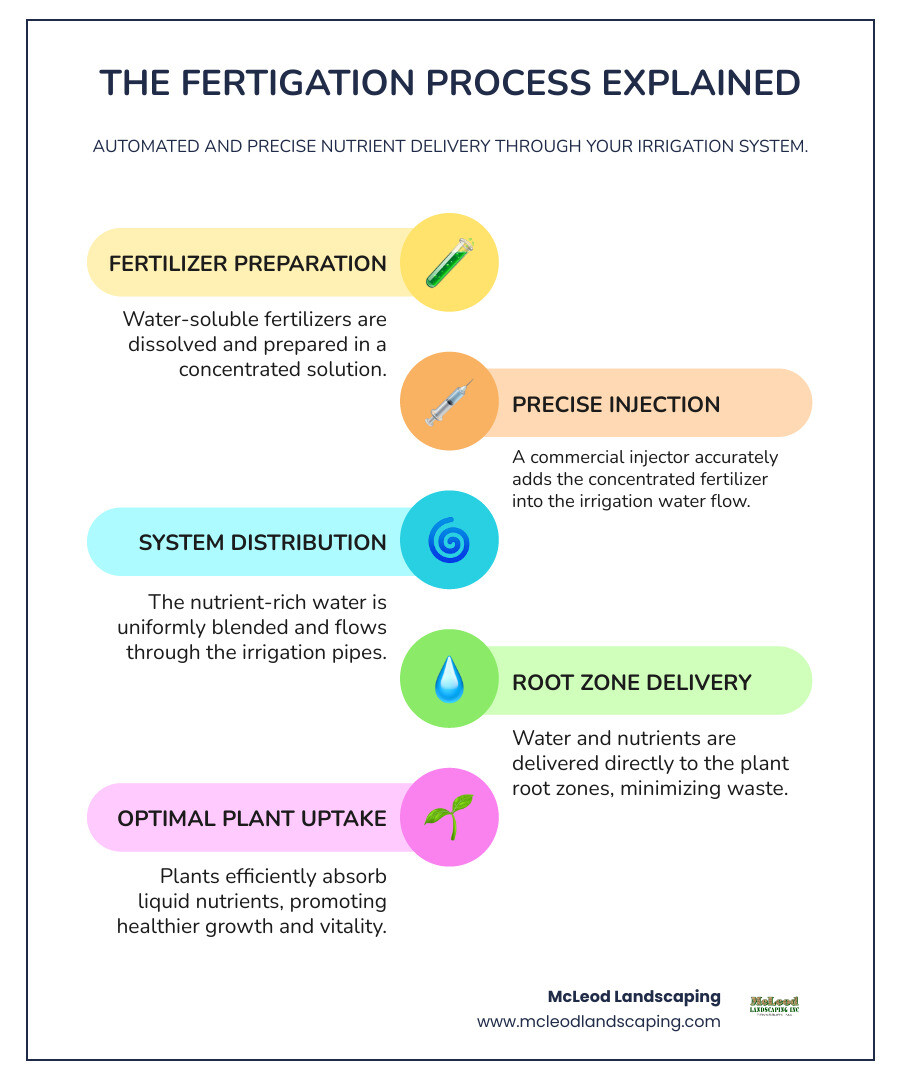
Fertigation solves these problems by delivering nutrients in the most effective way possible. Plants absorb nutrients in solution at the root zone; injectors deliver measured amounts of soluble fertilizer with the irrigation water so nutrients are consistently available where roots can use them.
By injecting a controlled dose of liquid nutrients into the water flow, plants receive a consistent, steady diet directly at their root zone. This “spoon-feeding” approach maximizes absorption, minimizes waste, and promotes robust, resilient growth. The result is a visibly healthier landscape, reduced labor and material costs, and a more sustainable maintenance strategy.
There are several types of injectors available, each suited for different scales and applications:
Note: These are average costs based on internet data and not actual costs for McLeod Landscaping.
Commercial properties, from corporate campuses in Burlington and Andover to municipal parks in Lowell and Chelmsford, are increasingly adopting automated fertilizer injection systems. The benefits are clear: greener turf, more vibrant plants, lower maintenance budgets, and compliance with environmental stewardship goals.
A properly designed assembly typically includes:
I’m Scott McLeod, and for over 30 years, my team at McLeod Landscaping has been at the forefront of implementing these advanced irrigation solutions. We have designed, installed, and maintained fertigation systems on over 200 commercial properties throughout the Merrimack Valley. We’ve witnessed how a properly specified commercial fertilizer injector for irrigation system can revolutionize property care, delivering superior results while saving our clients time and money.
Learn more about commercial fertilizer injector for irrigation system:
When selecting a commercial fertilizer injector for irrigation system, understanding the three primary types is crucial for making an informed decision. Each operates on a different mechanical principle and comes with its own set of pros, cons, and ideal use cases. Your choice will depend on factors like the size of your property, your budget, the required precision, and your existing irrigation system’s specifications. At McLeod Landscaping, we have extensive experience with all types and can help you select the perfect fit for your property’s unique needs.
Here is a comparative overview of the main injector types:
| Injector Type | Mechanism | Pros | Cons | Best Applications |
|---|---|---|---|---|
| Suction-Style (Venturi) Injector | Operates on a pressure differential created by a constriction (the venturi). As water flows faster through the narrow section, pressure drops, creating a vacuum that siphons fertilizer from a tank into the water line. | – Very affordable – Simple design with no moving parts – Low maintenance – Easy to install |
– Causes a significant pressure drop in the irrigation line – Injection rate can be inconsistent and varies with water pressure and flow – Less precise than other types |
Small residential gardens, hobby greenhouses, or small commercial zones where precision is not critical. |
| Positive Displacement (Water-Powered Piston) Pump | Uses the flow of irrigation water to power a piston or diaphragm that pumps a precise, proportional amount of fertilizer into the system. The injection rate is directly tied to the water flow. | – Extremely accurate and consistent injection – Proportional feeding ensures a constant fertilizer ratio regardless of flow changes – No external electricity required – Minimal pressure loss |
– Highest initial cost – More complex with moving parts that require periodic maintenance (seals, O-rings) – Can be sensitive to debris in water |
Commercial landscaping, golf courses, large-scale agriculture, nurseries, and any application where precise nutrient management is essential. This is the industry gold standard. |
| Differential Pressure (Tank-Style) Injector | A portion of the irrigation water is diverted through a pressurized tank containing soluble fertilizer. The pressure difference between the inlet and outlet of the tank forces the water to mix with the fertilizer and gradually re-enter the main line. | – Simple to operate – No moving parts – Can handle both liquid and water-soluble granular fertilizers – Relatively low cost |
– Injection rate is not precise and changes over time as the fertilizer in the tank becomes more diluted – Best for batch feeding, not continuous injection – Can be bulky |
Applications where a slow-release, non-uniform application is acceptable, such as deep root feeding for trees or applying soil conditioners over a long irrigation cycle. |
1. Suction-Style (Venturi) Injectors
Venturi injectors are the simplest and most economical option. Their design is neat: a cone-shaped body that narrows in the middle. As water is forced through this constriction, its velocity increases and its pressure drops, creating a suction effect at an intake port. This vacuum pulls liquid fertilizer from a connected container directly into the irrigation stream.
Because they have no moving parts, Venturi injectors are incredibly reliable and require almost no maintenance. However, their main drawback is the significant pressure loss (often 30-50%) they introduce into the system, which must be accounted for in the irrigation design. Their injection rate is also highly dependent on stable water pressure and flow, making them less precise for applications demanding consistent nutrient ratios.
2. Positive Displacement (Water-Powered Piston) Pumps
Often hailed as the gold standard for commercial applications, water-powered piston pumps offer unparalleled accuracy and reliability. These devices use the energy from the water flowing through them to drive a piston or diaphragm. This action pumps a precise volume of fertilizer into the irrigation line with each stroke. The key advantage is that the injection is proportional to the water flow; if the water flow doubles, the injection rate also doubles, maintaining a constant fertilizer-to-water ratio.
This ensures that every part of your landscape receives the exact same concentration of nutrients, regardless of variations in system pressure. While they have a higher upfront cost and require some routine maintenance on their moving parts, their precision and efficiency deliver a strong return on investment for serious commercial operations.
3. Differential Pressure (Tank-Style) Injectors
These systems, also known as batch tanks, work by creating a pressure differential across a sealed tank filled with fertilizer. A small amount of water from the mainline is diverted into the top of the tank, while water mixed with fertilizer exits from the bottom and returns to the mainline. The concentration of the fertilizer solution exiting the tank is highest at the beginning of the cycle and gradually decreases as the tank fills with fresh water.
This makes them unsuitable for applications requiring a precise, constant feed rate. However, they are very simple to use, can handle water-soluble granular products without pre-mixing, and are effective for “batch” applications where the goal is to apply a set amount of product over an entire irrigation cycle, such as for soil wetting agents or certain organic amendments.
When we specify an injector for a commercial property in the Merrimack Valley, we compare:
By aligning injector type with your operating conditions and maintenance bandwidth, you ensure accurate, efficient nutrient delivery season after season.
Contact McLeod Landscaping today at (978) 640-0957 or click here to schedule a consultation for retaining wall installation. Let our experienced team design and install a functional and visually appealing retaining wall that enhances your landscape.


1881 Main St Unit 1, Tewksbury, MA 01876