

Brick steps design encompasses more than just choosing a material—it’s about creating a welcoming entrance that combines timeless beauty with practical durability. Here’s what you need to know:
Key Elements of Effective Brick Steps Design:
Every homeowner knows that first impressions matter. Your entry stairs are often the first thing visitors see, and brick steps offer something concrete or wood simply can’t match: a combination of durability that lasts generations and a timeless aesthetic that never goes out of style.
The research is clear—brick entry stairs can last 50+ years with proper installation, resist freeze-thaw cycles better than most alternatives, and actually increase your property value. They provide excellent traction in wet conditions and require minimal maintenance compared to wood or painted concrete. Whether you’re drawn to the warm heritage of classic red brick, the sleek lines of modern designs with stone accents, or the graceful flow of curved entrances, brick steps adapt to virtually any architectural style.
But here’s the catch: the foundation matters more than the bricks you see. A beautiful brick staircase built on inadequate groundwork will fail within years, while one properly constructed can outlast your home’s mortgage. That’s why understanding the full scope of brick steps design—from calculating comfortable rise-to-run ratios to selecting appropriate mortar types for your climate—makes all the difference.
I’m Scott McLeod, owner of McLeod Landscaping, and over the past 30+ years serving the Merrimack Valley, I’ve designed and installed countless brick step projects that balance aesthetic vision with the structural realities of New England weather. A well-executed brick steps design isn’t just about curb appeal—it’s about creating an entrance that welcomes you home for decades to come.

Basic brick steps design vocab:
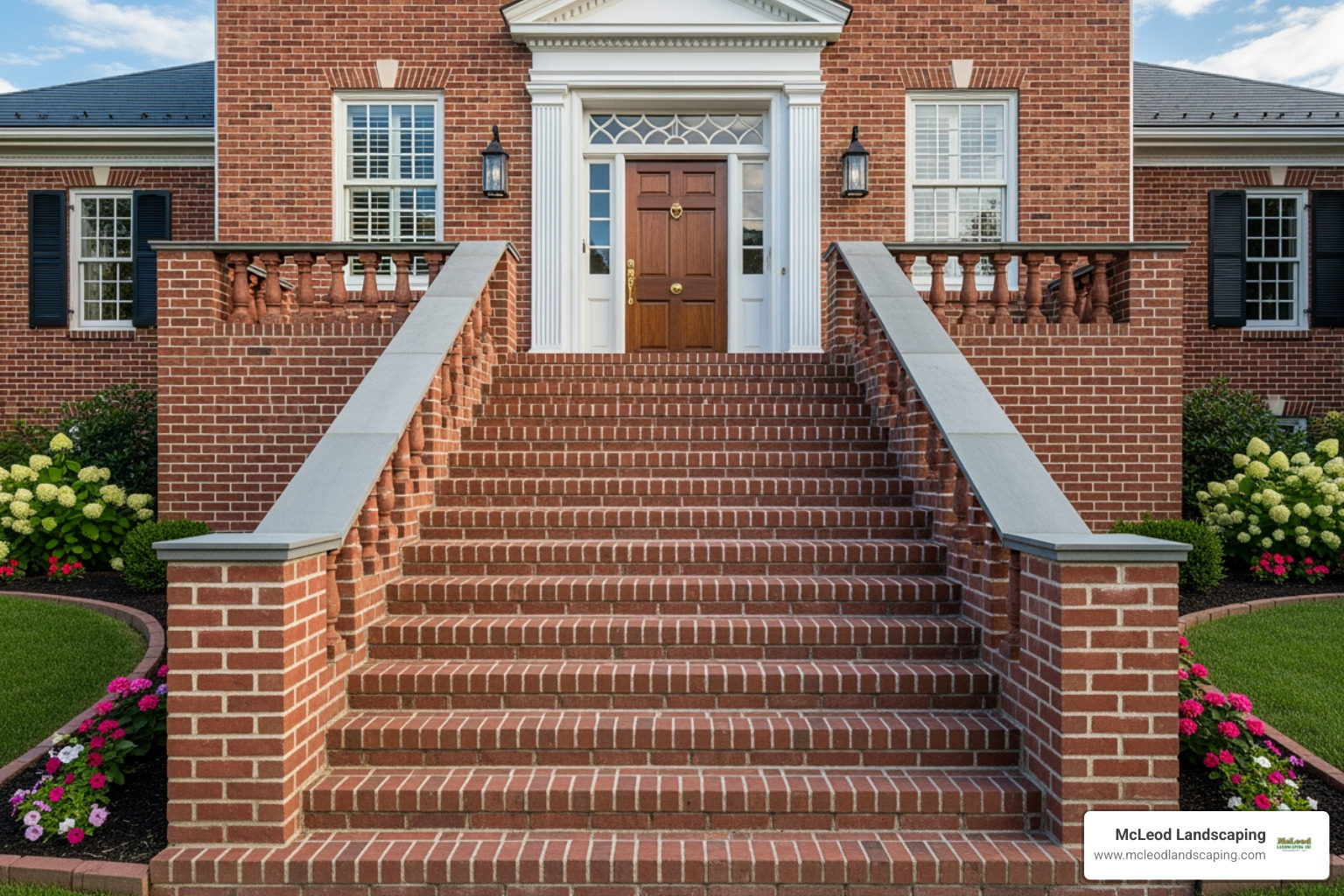
Picture a classic Colonial home with warm red brick stairs leading to the front door. There’s something about that combination that just works—and it’s worked for centuries. When most people think about brick steps design, this is exactly what comes to mind, and there’s good reason these traditional styles remain so popular.
Classic red brick stairs bring a sense of warmth and heritage that’s nearly impossible to replicate with other materials. Whether you’re working with a Colonial, Cape Cod, or Craftsman home, these timeless stairs seem to naturally belong. I’ve installed countless brick stairways throughout the Merrimack Valley, and the traditional red brick approach never goes out of style—it simply becomes part of the home’s character.
The beauty of traditional brick steps goes beyond aesthetics. They’re built to last generations, handle our New England weather without complaint, and require surprisingly little maintenance. Add in the fact that they genuinely increase your property value, and you’ve got an entrance that’s as smart an investment as it is attractive. For more ideas on how we approach these projects, check out our masonry services.
Classic red brick has a quality that’s hard to put into words until you see it in person. The color isn’t just “red”—it shifts from bright terracotta to deep burgundy depending on the light, creating a dynamic, living quality that painted concrete or manufactured materials simply can’t match. This natural color variation adds depth and character to your entrance.
But here’s what really matters: longevity. We’re not talking about a material that looks good for a decade—properly installed brick steps can last 50 years or more, often outliving the mortgage on your home. I’ve repaired brick stairs that were laid down before my grandfather was born, and with some fresh mortar, they were good for another generation.
The weather resistance of brick is particularly important here in the Merrimack Valley. Our freeze-thaw cycles can be brutal on exterior materials, but brick tolerates these temperature swings remarkably well when the foundation is done right. While other materials crack, spall, or deteriorate, brick just keeps doing its job year after year.
There’s also something to be said for how classic red brick pairs with traditional landscaping. Whether you’re framing your stairs with boxwood hedges, hostas, or flowering perennials, that warm brick tone provides the perfect backdrop. It grounds everything together in a way that feels intentional and polished. If you’re looking for more inspiration, see more traditional designs that showcase this timeless combination.
Here’s where brick steps design gets interesting—the pattern you choose affects both how your stairs look and how long they’ll last. It’s not just decoration; it’s engineering that happens to look beautiful.
The running bond pattern is what you see most often, and there’s solid reasoning behind its popularity. Each course of brick overlaps the one below it, preventing vertical cracks from forming and distributing weight evenly across the entire structure. It creates clean, orderly lines that feel both traditional and timeless. We often finish running bond stairs with soldier course edging—bricks stood upright along the edges—which gives crisp, defined borders that really make the stairs pop. And yes, those wrought iron railings you’re picturing? They’re the perfect complement.
Now, if you want to make more of a statement, the herringbone pattern is where traditional brick steps design becomes art. This zig-zag arrangement takes more time and skill to install, but the result is genuinely stunning. Beyond the sophisticated appearance, the interlocking nature of herringbone actually helps distribute weight more effectively than simpler patterns. As this design guide on entry stairways points out, your stairway should be a conscious and creative statement—and herringbone delivers on that promise.
I’ve installed herringbone patterns for historic homes throughout Concord and Andover, where homeowners wanted something special that honored their home’s architectural heritage. The extra craftsmanship required is worth it when you step back and see how the pattern catches the eye and draws visitors toward your entrance. It transforms brick entry stairs from a simple necessity into a focal point that adds genuine character to your property.

Here’s something that surprises many homeowners: brick isn’t just for traditional homes. Modern brick steps design has evolved far beyond the classic red brick look, embracing clean lines and minimalist beauty that perfectly complement contemporary architecture throughout the Merrimack Valley.
The key to contemporary brick stairs lies in thinking beyond tradition. We’re seeing more grey bricks, whitewashed finishes, and—most exciting of all—strategic combinations of brick with natural stone that create stunning visual contrasts. The texture of brick paired with smooth stone treads creates a sophisticated entrance that feels both grounded and refined. It’s this interplay of materials that transforms a simple staircase into a design statement worthy of any modern home in Chelmsford, Westford, or beyond.
If you’re drawn to contemporary design, you’ll want to explore the full range of possibilities available with stone and brick stairs. The combination offers not just aesthetic appeal but practical benefits that make your entrance both beautiful and built to last.
There’s a reason combining brick with stone has become one of our favorite approaches for modern entrances: it simply works. While brick provides excellent structural support as riser material, stone brings best durability to the horizontal surfaces where you’ll actually be walking. This isn’t just about looks—though the contrast between textured brick and smooth stone is undeniably striking—it’s about using each material where it performs best.
Granite stands out as the most durable option, with its extreme hardness resisting wear even in high-traffic areas. Its subtle speckled appearance adds texture without overwhelming the clean lines of a modern design. Bluestone offers those beautiful blue-grey tones that feel both contemporary and timeless, with a naturally cleft surface that provides excellent traction in wet conditions. For a softer, more refined look, limestone can be cut and shaped easily, creating smooth treads that feel almost sculptural.
The real challenge—and where professional expertise becomes essential—is that different materials expand and contract at different rates. We’ve seen DIY projects fail within a single winter because the builder didn’t account for how brick and stone move differently through freeze-thaw cycles. Our masonry team ensures these materials are properly integrated, with appropriate expansion joints and mortar selection, creating an entrance that looks seamless and stays that way for decades.
The finishing touches make all the difference in modern design. Sleek metal railings in brushed steel or powder-coated black provide the necessary safety features without competing with the material interplay. Contrasting mortar colors—perhaps a light grey mortar against darker brick—can highlight the clean geometry of your design, drawing the eye to the careful craftsmanship rather than hiding it.
Walk up to a beautifully lit brick staircase on a dark evening, and you’ll understand why integrated lighting has become a cornerstone of modern brick steps design. It’s not just about creating atmosphere (though it certainly does that)—it’s about practical safety that protects your family and guests during those long New England nights.
Properly illuminated stairs prevent trips and falls by clearly defining each step’s edge, which is especially critical when weather conditions make surfaces less visible. We always reference the Americans with Disabilities Act guidelines for illumination levels, ensuring your entrance welcomes everyone safely regardless of age or ability. It’s simply the right thing to do.
But here’s where it gets fun: lighting can transform your entrance from merely functional to genuinely stunning. Recessed step lights built directly into brick risers cast a subtle downward glow that highlights each tread without creating glare. Under-cap lighting—those small LED strips tucked beneath the overhang of stone treads—creates a floating effect that’s particularly dramatic against textured brick risers. The warm glow emphasizes the contrast between materials while adding depth and dimension to your entrance.
We typically recommend low-voltage LED systems for their energy efficiency and remarkable lifespan—often 50,000 hours or more. That translates to years of maintenance-free operation, which matters when the wiring is concealed within your masonry work. The key is planning for lighting during the initial design phase, not as an afterthought. This allows us to route wiring and hide junction boxes within the structure itself, maintaining those clean lines that define modern design while ensuring everything meets code requirements.
The result? An entrance that’s as safe as it is beautiful, welcoming you home with a warm glow that makes even the darkest winter evening feel inviting.
There’s something magical about the first time you see a sweeping curved staircase leading to a home’s entrance. Unlike their straight counterparts, curved brick entry stairs create a graceful, flowing design that feels less like a simple path and more like an invitation. This type of brick steps design transforms your entrance into a true focal point, immediately elevating your home’s curb appeal in a way that neighbors notice.
But here’s what makes curved stairs particularly smart: they’re not just about looking impressive. When you’re dealing with tricky elevation challenges—and we see plenty of those on properties throughout Burlington, Lowell, and the surrounding Merrimack Valley—curved stairs can actually solve problems that straight designs can’t. They make better use of available space, allowing you to work with the natural contours of your landscape rather than fighting against them. Instead of forcing a rigid, linear climb up a steep slope, a gentle curve can distribute the elevation change more comfortably and naturally.
We’ve designed curved entries that completely transformed how homeowners felt about coming home. If you’re ready to create that kind of statement entrance, our team specializes in front stair installation that turns architectural challenges into stunning focal points.
The aesthetic impact of curved brick stairs is immediate and lasting. They add a sense of grandeur and sophistication that makes your home feel more welcoming before anyone even reaches the door. The gentle arc naturally softens the often-harsh linear edges of residential architecture, creating visual harmony between your home and its landscape. Picture this: wide, sweeping curves with integrated planters on either side, overflowing with seasonal flowers—it’s the kind of entrance that makes coming home feel like an event rather than a routine.
Beyond beauty, the practical advantages are considerable. Curved stairs create a natural pathway that feels intuitive to steer, guiding visitors effortlessly toward your front door. They can gracefully handle changes in grade, offering a more comfortable and gradual ascent than steep straight flights. For properties with unusual topography—something we encounter frequently in the Merrimack Valley—curved designs provide solutions that straight stairs simply can’t match.
The catch? Creating beautiful curved brick stairs demands specialized masonry expertise. Unlike straight stairs where bricks can be laid in standard patterns, curved designs require cutting custom-shaped bricks and calculating precise mortar joints to maintain both structural integrity and that flawless, flowing appearance. Our masons take pride in this exacting work, ensuring that every step maintains consistent rise and run dimensions—critical for both safety and the comfortable feel that makes curved stairs so appealing. It’s detailed craftsmanship that requires experience, but the result is an entrance that truly stands apart.
When starting on a brick steps design project, several key considerations come into play—from the foundation that ensures decades of performance to the budget that makes your vision a reality. After 30+ years building stairs throughout the Merrimack Valley, I can tell you that understanding these factors upfront saves both headaches and money down the road.
The foundation is absolutely critical. In New England, we face brutal freeze-thaw cycles that can destroy poorly built stairs within just a few years. That’s why we always start with a properly compacted gravel base and concrete footing—it’s not glamorous work, but it’s what separates stairs that last 50+ years from ones that crack and settle after the first hard winter.
Durability extends beyond just the foundation. The type of mortar matters enormously. We typically use Type M mortar for exterior brick stairs because it offers superior strength and weather resistance. Proper drainage is equally important—water is the enemy of masonry, and we design every project to shed moisture away from the structure rather than letting it pool and penetrate.
Maintenance requirements for brick stairs are refreshingly minimal compared to wood or painted surfaces. You’ll need to sweep them regularly, wash them gently once or twice a year, and check mortar joints periodically for any needed repairs. Sealing every few years helps protect against moisture and staining. If you notice any issues developing, our brick stair repair services can address problems before they become major headaches.
Cost is naturally a significant consideration. Based on internet data for materials and labor—and not an actual quote from McLeod Landscaping—brick stair projects typically range from $20 to over $90 per square foot. The final price depends on complexity, materials, and site conditions, with high-end custom work sometimes costing three times the average or more. A simple straight flight might fall toward the lower end, while curved stairs with integrated stone treads and lighting systems will be considerably more expensive. The good news? Brick stairs are a genuine long-term investment that adds property value and eliminates the recurring costs of replacing or refinishing wood stairs every few years. For projects that might require permits, it’s worth checking if your project needs a permit before breaking ground.
Let’s look at how brick compares to another common outdoor stair material:
| Feature | Brick Steps | Poured Concrete Steps |
|---|---|---|
| Durability | Exceptional—lasts 50+ years with proper installation and foundation; individual bricks can be replaced if damaged | Very durable when properly installed, but prone to cracking over time; repairs often require matching the entire surface |
| Maintenance | Low—periodic sweeping, occasional sealing every 3-5 years, simple mortar joint repairs as needed | Moderate—requires sealing every 2-3 years; cracks need immediate attention to prevent water infiltration and further damage |
| Cost | Moderate to high initial investment ($20-$90+ per sq ft based on internet data, with custom projects costing significantly more); minimal ongoing costs | Lower initial cost ($15-$40 per sq ft based on internet data); potential repair costs if cracking occurs |
| Aesthetics | Timeless, warm appearance with natural color variation; multiple pattern options (running bond, herringbone); complements traditional and modern homes | Clean, contemporary look when new; can be stamped or colored, but appearance may fade or become dated; harder to match architectural styles |
The comparison makes one thing clear: while concrete might save a few dollars upfront, brick offers superior longevity, easier repairs, and a timeless aesthetic that actually increases property value. When you’re making a decision about your home’s entrance—something you’ll see and use every single day—choosing the material that performs best over decades makes sense.
I can’t emphasize enough how critical the foundation is to your brick steps design. In my three decades in this business, I’ve torn out and rebuilt more poorly constructed stairs than I care to count—almost always because someone skimped on the foundation work.
Here’s what a proper foundation looks like: We start by excavating below the frost line (about 4 feet deep in Massachusetts) and creating a solid base with compacted gravel. This allows for drainage and prevents frost heave—that destructive force when frozen ground expands and lifts your stairs right out of place. On top of that gravel base, we pour a concrete footing that provides a stable, level platform for the brick structure.
The materials themselves matter just as much. We use Type M mortar for exterior stairs because it offers the highest compressive strength and best weather resistance. It’s specifically formulated to handle the moisture and temperature extremes we experience in the Merrimack Valley. Regular Type N mortar, which works fine for walls, simply doesn’t hold up to the mechanical stress and weather exposure that stairs endure.
Drainage deserves its own mention because water infiltration causes more masonry failures than anything else. Every stair project we design includes proper grading to direct water away from the structure, weep holes where needed, and careful attention to how water will flow during rainstorms and spring thaws. If you’re interested in the technical details of proper construction, you can learn more about how to build brick stairs on our site.
The brick itself should be rated for exterior use—specifically, SW (severe weathering) grade brick that can handle our freeze-thaw cycles without spalling or cracking. Using interior-grade brick outside is a recipe for disaster, even if it looks identical and costs less.
When all these elements come together—proper foundation, quality materials, expert installation—you get stairs that don’t just look beautiful on day one, but continue performing flawlessly for generations. That’s the difference between a project done right and one that becomes a costly problem down the road.
Let’s talk numbers, because understanding the investment helps you plan appropriately. Brick stair projects vary widely in cost based on several key factors: the size and height of the stairs, the complexity of the design, the materials you select, and site-specific challenges like access or existing conditions.
Please note that the following figures are based on average costs from internet data for materials and professional labor and are not actual quotes from McLeod Landscaping. Based on these sources, you can expect costs ranging from around $20 per square foot for basic straight stairs to over $90 per square foot for elaborate curved designs with premium materials and integrated features like lighting or stone accents. For the most complex, high-end projects, the final cost can easily be three times the average price or more. A typical residential front entrance with 5-7 steps might fall in the $3,000 to $8,000 range for straightforward designs, while grand curved entrances with custom features can easily exceed $15,000.
What drives costs up? Curved stairs require significantly more labor and expertise than straight flights. Combining materials—like brick risers with bluestone treads—adds both material and installation costs. Integrated lighting requires electrical work. Site challenges like limited access, removal of old stairs, or dealing with difficult soil conditions all add to the project scope.
Here’s what I always tell homeowners: while the upfront investment might seem substantial, brick stairs deliver exceptional long-term value. Unlike wood stairs that need refinishing or replacement every 10-15 years, properly built brick stairs can last 50+ years with minimal maintenance. They add genuine curb appeal and property value—real estate agents consistently note that quality masonry work is among the home improvements that offer the best return on investment.
It’s also worth noting that permits may be required depending on your location and project scope. Checking if your project needs a permit before starting work saves potential headaches with local building departments.
When we provide estimates, we break down all costs clearly so you understand exactly what you’re getting. We never cut corners on foundation work or materials to hit a lower price point—that approach creates problems that cost far more to fix later. Our goal is to build stairs that perform beautifully for decades, providing value that far exceeds the initial investment.
Contact McLeod Landscaping today at (978) 640-0957 or click here to schedule a consultation for retaining wall installation. Let our experienced team design and install a functional and visually appealing retaining wall that enhances your landscape.


1881 Main St Unit 1, Tewksbury, MA 01876