
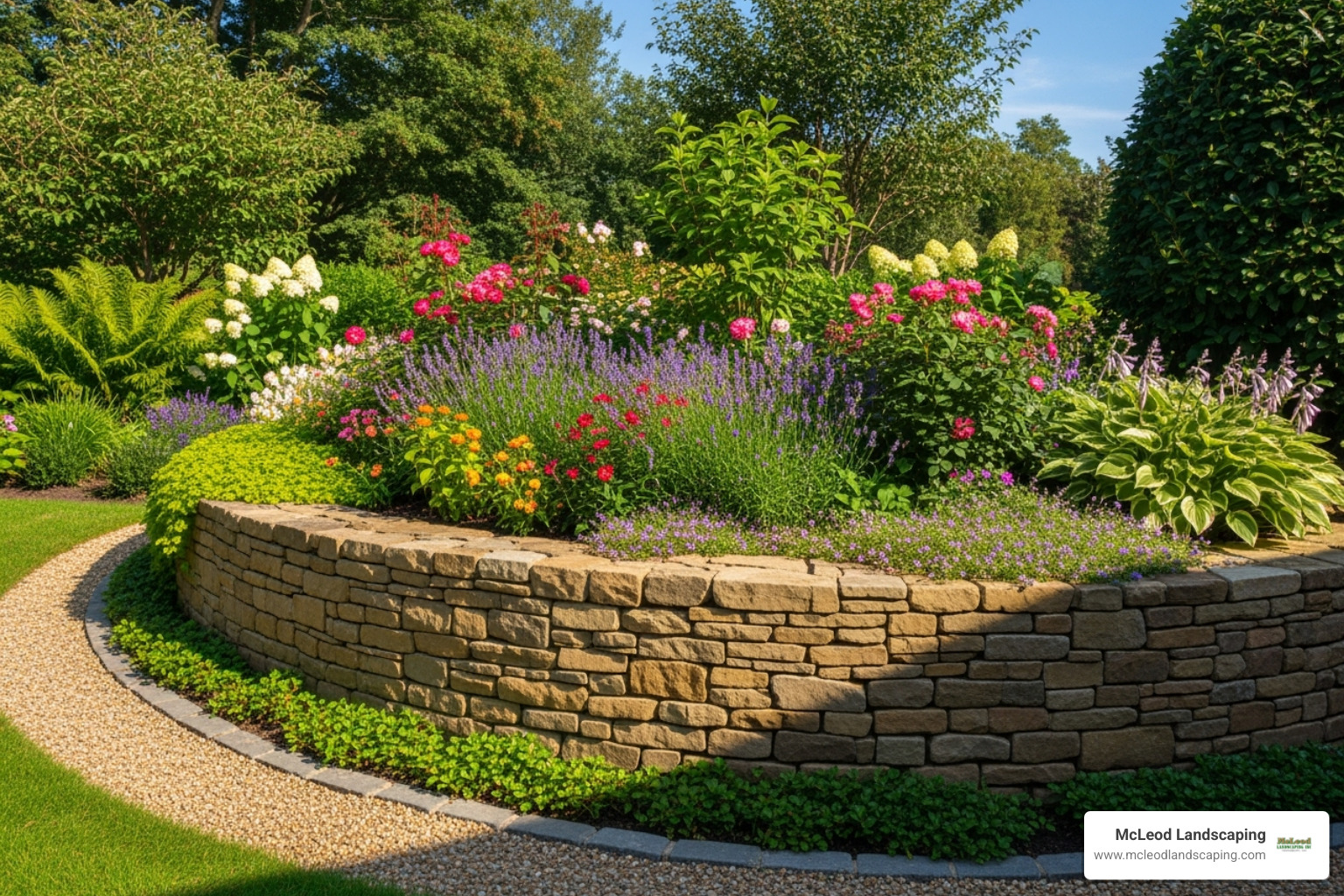
A curved retaining wall is a structure that retains soil along a flowing, non-linear path. It combines functional earth support with aesthetic design, creating natural-looking landscape features that often outperform straight walls in both looks and structural integrity.
Key Benefits of Curved Retaining Walls:
Quick Comparison:
| Feature | Straight Wall | Curved Wall |
|---|---|---|
| Structural Strength | Standard | Stronger due to arch effect |
| Visual Impact | Utilitarian | Dynamic and flowing |
| Installation Complexity | Simpler | Requires planning and technique |
| Material Flexibility | All types | Best with tapered blocks or stone |
Most curved walls use specially designed blocks with angled sides, minimizing the need for cutting. The tightest radius is typically 4 feet (1.2 m) for full-size blocks and 2.5 feet (0.8 m) for half-width blocks.
I’m Scott McLeod, owner of McLeod Landscaping. With over three decades of experience in the Merrimack Valley, my team and I have seen how curved retaining wall projects transform challenging slopes into stunning outdoor living spaces, delivering both structural performance and aesthetic appeal.
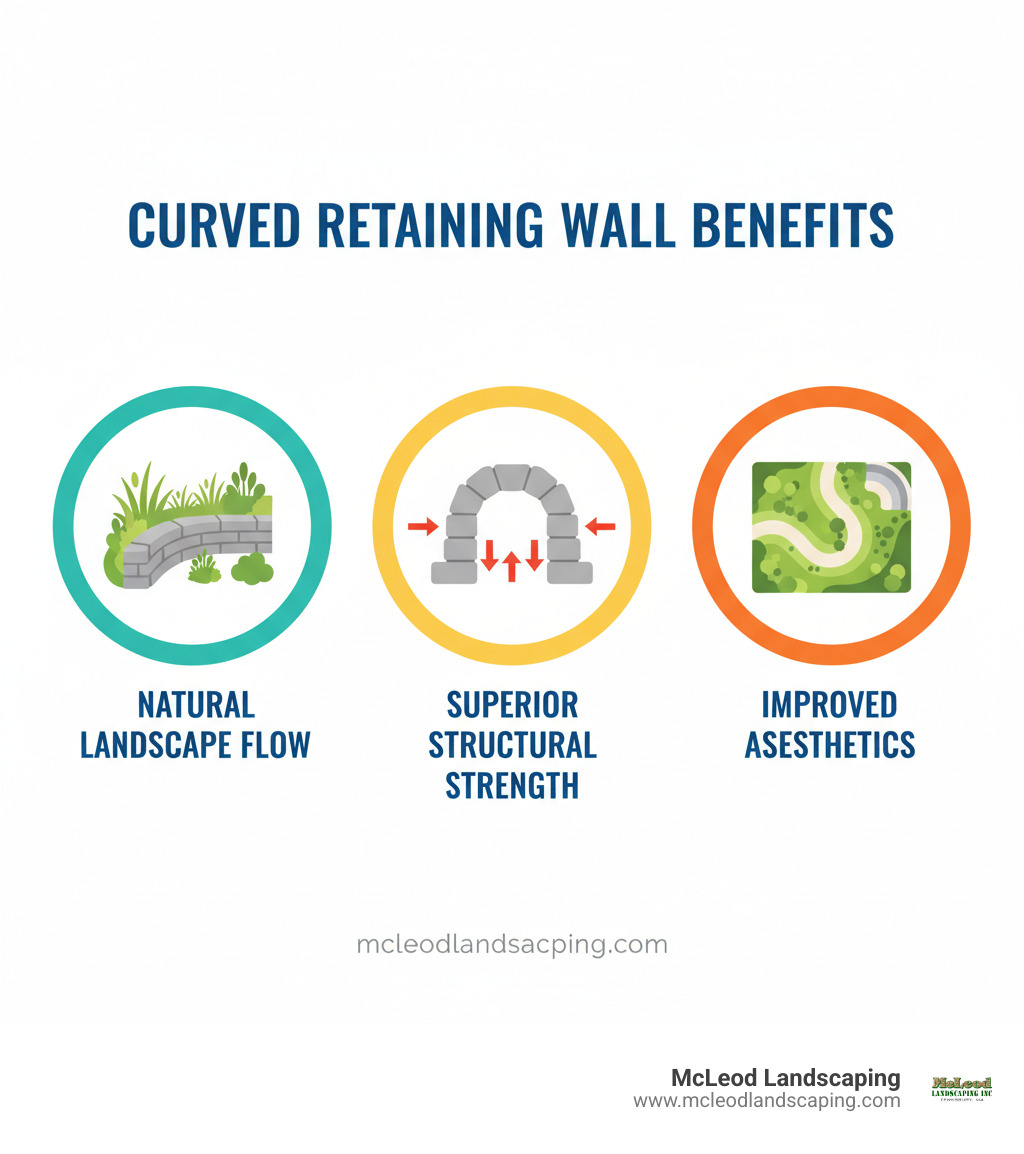
Curved retaining wall terms to remember:
While most people picture straight retaining walls, curved retaining walls offer surprising advantages. They don’t just hold back soil—they transform your outdoor space by blending form and function in a way straight lines cannot. A curve can define beautiful garden beds, create inviting raised patios, or highlight your property’s natural flow. It’s the difference between a landscape that feels engineered and one that feels organically designed.
Instead of fighting the natural contours of the land, curves work with them, guiding the eye and adding a sense of movement. If you’re looking for inspiration, check out these curved retaining wall projects to see what’s possible. You can also explore more retaining wall ideas to spark your creativity.
A landscape with only straight lines and 90-degree angles can feel rigid. A curved retaining wall changes everything by bringing softness to hardscaping. It creates a dynamic, organic look that feels like it belongs in nature.
We use curved walls to guide visitors through garden spaces, drawing attention to key features. They are perfect for defining distinct outdoor rooms, such as a raised patio, a flowing garden bed, or a cozy fire pit area. On sloped properties, a curved retaining wall can maximize your usable space by creating level terraces where only a steep incline existed before. This is what makes them such powerful landscape retaining walls—they solve problems while looking beautiful.
A curved retaining wall isn’t just prettier than a straight wall—it’s often significantly stronger. This is due to basic physics, making curves ideal for challenging sites.
Think of ancient Roman arches. The curved shape is structural genius, distributing weight and pressure along its entire length rather than concentrating stress at weak points. Your curved retaining wall works the same way. When soil pushes against the curve, the pressure is dispersed along the arc. This arch effect means the wall naturally handles loads better than a comparable straight wall.
This inherent structural integrity can mean you’ll need less reinforcement than for a straight wall of the same height. Of course, proper engineering and installation are still critical—no curve can compensate for a poor foundation. But when you start with good practices, like those in our gravity retaining wall complete guide, the curve provides an extra margin of stability.
A successful curved retaining wall begins with meticulous planning. Before moving any soil, we map out every detail to ensure the wall is both beautiful and structurally sound for decades. This phase involves assessing how the curve will flow with your property, selecting the right materials, and ensuring structural integrity. Good planning saves time, money, and headaches. Our approach to retaining wall design focuses on getting these details right from the start.

Choosing the right material is crucial for building curves. Some materials are better suited for creating flowing arcs than others.
Crucially, every block system has a minimum radius. You cannot force materials into a tighter curve than they are designed for. Full-size blocks typically require at least a 4-foot radius, while half-width blocks can handle tighter 2.5-foot curves. Pushing these limits risks an unstable wall.
We also account for the coning effect. Because retaining walls lean back (setback) with each course, a curve naturally tightens as it gets taller. The base radius must be larger than the top radius. Failing to plan for this can result in a top course that is too tight or looks awkward. The wall’s height determines how much larger the base radius needs to be.
This is where the design is marked on the ground. A simple garden hose or rope is a great tool to experiment with different curves. Once a pleasing shape is found, we mark it with spray paint for a full-scale preview.
For more precision, we use the stake and string method. A stake is placed at the curve’s center point, and a string cut to the desired radius is used like a giant compass to mark a perfect arc.
From our experience, gentle, sweeping curves almost always look better and feel more natural than tight ones. They are also easier to build and more structurally sound. Before committing, we always double-check the minimum radius for the chosen blocks. If a tighter curve is desired, we can switch to half-width blocks.
Remembering the coning effect, we use radius charts to ensure the base radius is large enough so the top course maintains a graceful, buildable curve. This detail is especially important when you build a retaining wall on a slope, where terrain adds complexity.
Building a curved retaining wall requires more finesse than a straight one. While the fundamentals of a solid foundation, proper drainage, and sturdy block placement are the same, the curve introduces unique challenges. Our comprehensive building a retaining wall guide covers many basics.
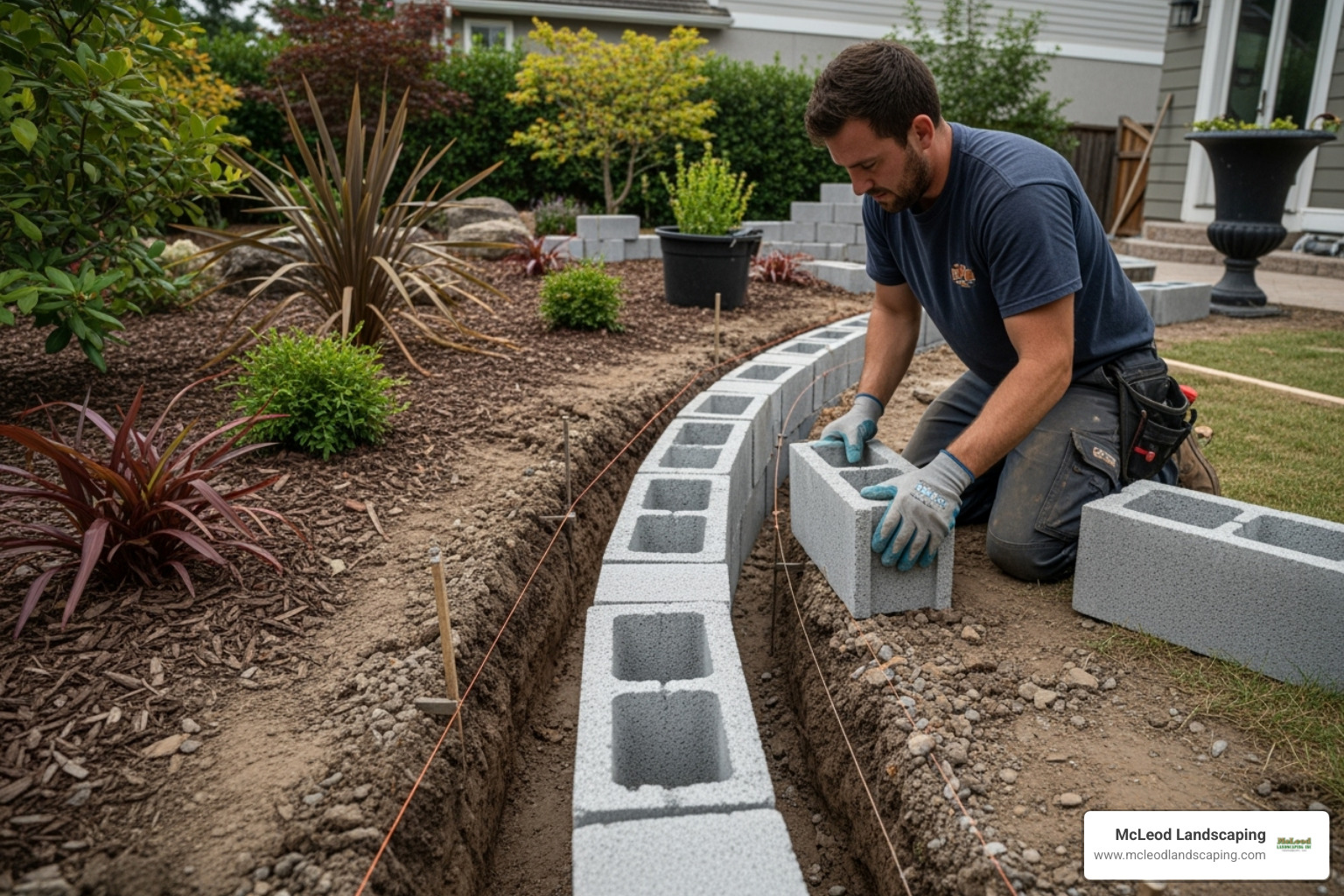
The foundation is critical for a curved wall, as any unevenness is magnified as the wall rises.
This meticulous approach is a hallmark of quality retaining wall installation.
Building curves requires specific techniques for convex (outside) and concave (inside) curves to maintain the arc and structural integrity.
| Feature | Convex (Outside) Curve | Concave (Inside) Curve |
|---|---|---|
| Block Placement | Backs of blocks are tighter together. | Fronts of blocks are tighter together. |
| Gaps | Small gaps form at the front. | Small gaps form at the back. |
| Block Mod. | Remove “wings” from the back of blocks. | Keep fronts tight; fan out the backs. |
For convex (outside) curves, we often remove the rear “wings” or flanges from blocks to allow their backs to sit closer together, creating a smooth outer arc. You can see this in a video on building outside curves. For concave (inside) curves, we keep the block fronts tight and allow the backs to fan out with consistent spacing. For both types, we stagger joints like brickwork for stability.
Even a strong curved retaining wall will fail without proper drainage to prevent hydrostatic pressure.
Our guide on retaining wall drainage provides more detail.

Capstones provide a finished look and protect the wall. On a curved retaining wall, this step requires the most precision, as each capstone typically needs two angled cuts with a masonry saw to follow the arc smoothly. Once cut, caps are secured with high-strength construction adhesive. This detail transforms the structure into a true landscape feature. For more on materials, see our guide on concrete block retaining wall.
Building a curved retaining wall can be tricky. Avoiding a few common, preventable mistakes is key to ensuring your wall is attractive, durable, and safe.

Avoiding these pitfalls ensures your investment results in a durable, attractive landscape feature. For complex projects, professional guidance is invaluable. Our retaining wall installation guide offers more best practices.
Here are answers to the most common questions we get about curved retaining walls.
Yes, a curved retaining wall typically costs more per linear foot. The materials are the same, but the cost increase comes from the additional labor and skill required. The installation is more intricate, from layout to block placement. The most time-consuming part is often cutting capstones, as each cap on a curve may need two precise cuts to fit the arc.
About pricing: Based on our research of industry averages, curved retaining walls typically run between $40 to $150+ per square foot, while straight walls might range from $30 to $100+ per square foot. These are average costs based on internet data and not actual costs for McLeod Landscaping. Project-specific factors like height, site access, and material choice will influence the final price.
While a straight wall may suffice for a hidden utility area, the added beauty and strength of a curve often justify the investment for prominent features like patios or entryways. Explore these retaining wall ideas for inspiration.
Every block system has physical limits. For most full-size segmental blocks, the tightest recommended radius is around 4 feet (1.2 meters). For tighter curves, such as for a fire pit area, half-width blocks are the solution, typically allowing a minimum radius of about 2.5 feet (0.8 meters).
Remember the coning effect: a taller wall needs a larger radius at its base to ensure the top course remains stable and doesn’t get too tight. Always consult the manufacturer’s specifications. For more, review these instructions for building curves.
For a small, low garden wall (under 2 feet), a skilled DIYer might succeed. However, for most projects, we strongly recommend a professional.
Building a curved retaining wall is more complex than a straight one. For walls over 3-4 feet high, professional installation is essential for safety. These walls involve significant soil loads, requiring proper engineering, drainage solutions, geogrid reinforcement, and compliance with local building codes.
The same applies if the wall supports a driveway, structure, or steep slope. Mistakes are expensive to fix and can cause property damage. Hiring an experienced retaining wall contractor provides expertise, proper equipment, and peace of mind that your wall is built to last.
For homeowners in the Merrimack Valley, we’re happy to provide a consultation to help you make an informed decision.
Curved retaining walls are more than just bent structures; they are landscape features that blend the strength of an arch with the beauty of natural lines. A curved retaining wall offers superior structural strength, creates visual magic by softening hard edges, and transforms a functional necessity into an aesthetic opportunity.
While they require more planning and skill, the result is extraordinary. A gentle sweep defining a patio or a flowing garden bed carved into a hillside does more than hold back earth—it sculpts your landscape.
We encourage you to plan thoughtfully, considering the minimum radius, the coning effect, and the critical need for proper drainage. For walls over 3-4 feet, complex curves, or structures supporting critical loads, professional expertise is essential for safety and longevity.
At McLeod Landscaping, we’ve spent over three decades designing and installing hardscaping features throughout the Merrimack Valley, and curved retaining walls are among our favorite projects. We love changing a challenging slope into a stunning, functional outdoor space.
If you’re a homeowner in Andover, Billerica, Burlington, Carlisle, Chelmsford, Concord, Lowell, Tewksbury, Westford, or Wilmington, MA, and envision a curved retaining wall on your property, we’d love to talk. Our team has the technical expertise and artistic eye to create a landscape that is organic, inviting, and built to last.
Ready to create something beautiful? Contact us for your retaining wall installation project, and let’s transform your outdoor space.
Contact McLeod Landscaping today at (978) 640-0957 or click here to schedule a consultation for retaining wall installation. Let our experienced team design and install a functional and visually appealing retaining wall that enhances your landscape.


1881 Main St Unit 1, Tewksbury, MA 01876