
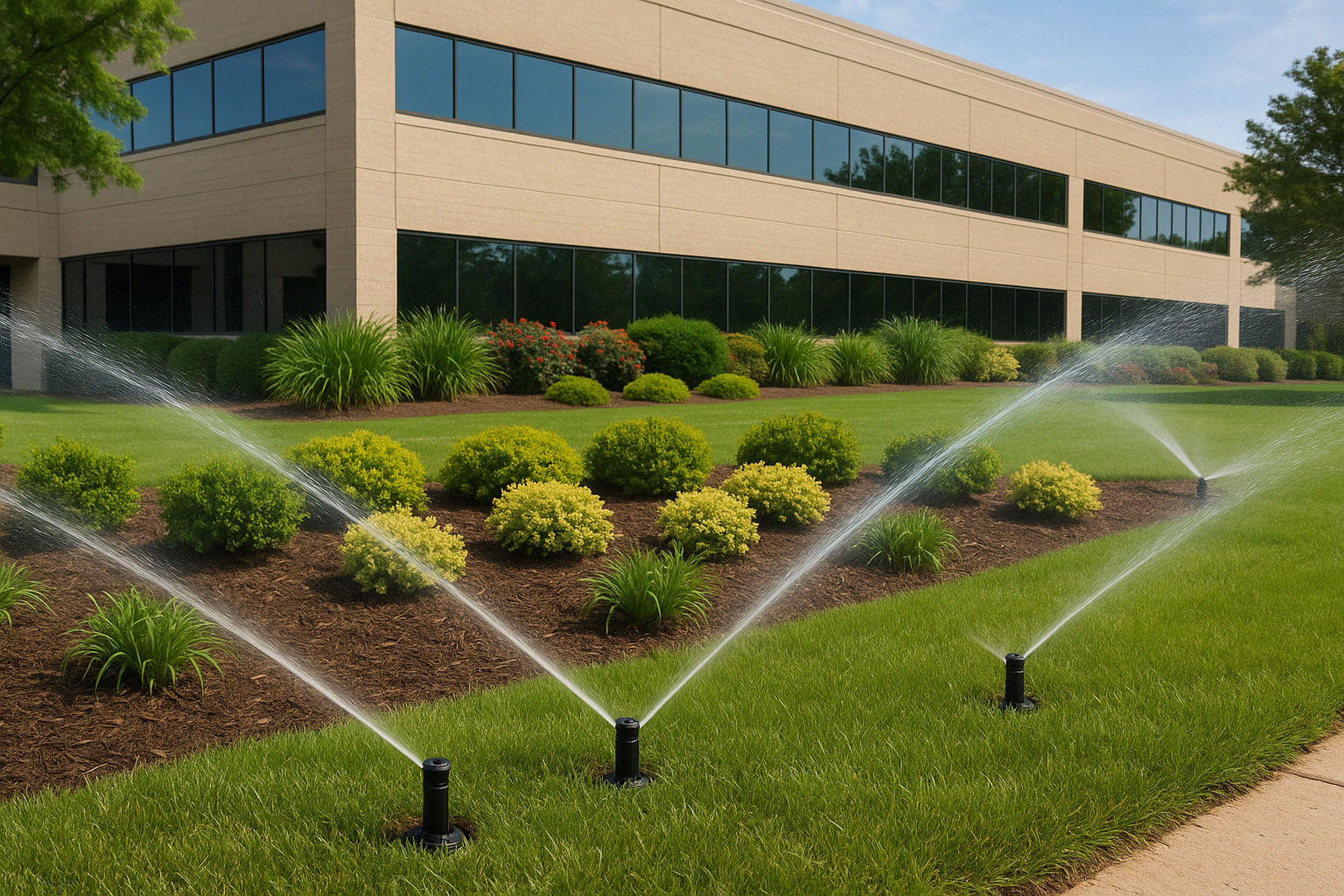
Commercial irrigation system design is the strategic planning and implementation of water delivery systems for business properties, ensuring optimal plant health while conserving water resources. When properly executed, these systems can significantly reduce maintenance costs and environmental impact.
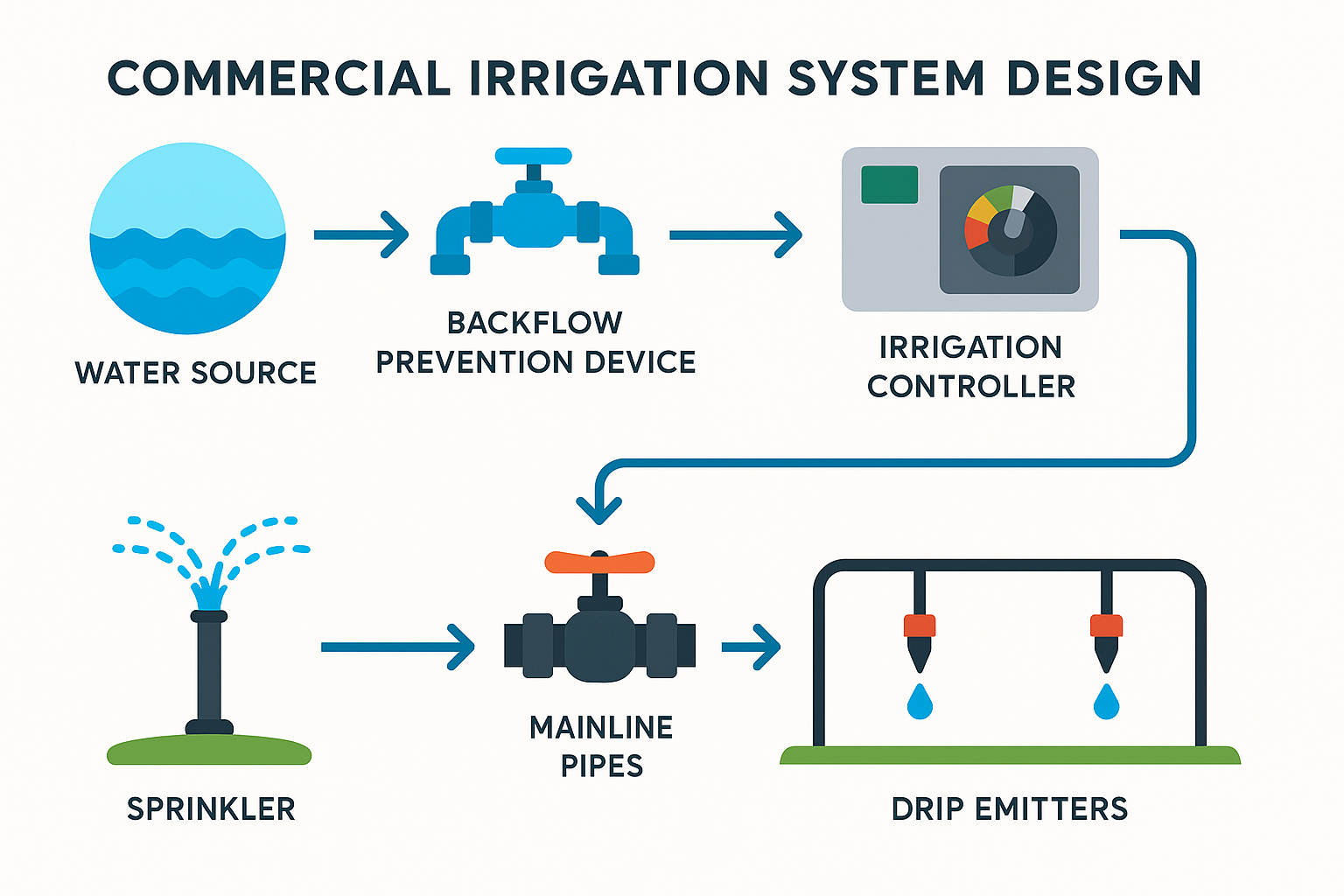
For those seeking to understand the basics, here are the key components of commercial irrigation design:
A well-designed commercial irrigation system delivers the right amount of water to the right places at the right time, eliminating both under-watering and over-watering issues that can damage landscapes and waste resources.
The design process begins with a thorough site analysis to understand your property’s unique characteristics. This involves measuring the available water supply, mapping the landscape, and identifying different plant water requirements. With this information, an irrigation specialist can create a customized system that addresses your specific needs.
I’m Scott McLeod, owner of McLeod Landscaping, with over three decades of experience designing and installing commercial irrigation system designs that maximize efficiency while minimizing water waste for properties throughout the Merrimack Valley area.
Commercial irrigation system design word list:
– commercial drip irrigation systems
– commercial lawn sprinkler
– professional lawn irrigation system

Ever noticed how some commercial properties maintain lush, vibrant landscapes even during the hottest summer months? The secret lies in their commercial irrigation system design. Unlike your typical home garden setup, commercial properties face unique challenges – larger areas, higher visibility, and often stricter water management requirements.
I’ve seen how the right irrigation system can transform a struggling landscape into a thriving green space that impresses clients and visitors alike.
When you think of irrigation, sprinkler systems likely come to mind first. These versatile systems distribute water through a network of underground pipes and pop-up sprinkler heads, creating patterns that mimic natural rainfall across your landscape.
Sprinkler systems truly shine when applied to large, open turf areas like corporate campuses or municipal parks. They’re also perfect for properties with uniform planting schemes where consistent watering is essential. If your property has good drainage where water absorbs efficiently, a sprinkler system will serve you well.
The beauty of modern sprinkler systems lies in their versatility. Spray heads work wonders in smaller areas of 10-15 feet, while rotor heads can efficiently cover larger spans of 25-35 feet. For high-traffic areas like sports fields, impact sprinklers offer exceptional durability and performance.
One crucial design principle we always follow is ensuring head-to-head coverage. This means the spray from one sprinkler reaches the next sprinkler head, eliminating those frustrating dry spots that can make your landscape look patchy and unhealthy.
While sprinklers handle the heavy lifting for large areas, drip irrigation takes a more targeted, precise approach. Think of it as delivering water exactly where plants need it – directly to their root zones through a network of tubes and emitters.
The water efficiency of drip systems is truly remarkable – using up to 50% less water than traditional sprinklers by virtually eliminating evaporation, runoff, and overspray. This precision delivery not only saves water but also reduces weed growth (since you’re not inadvertently watering unwanted plants) and decreases disease pressure by keeping foliage dry.
Drip irrigation proves particularly valuable for planting beds with diverse plant materials, areas with trees and shrubs that thrive with deep, infrequent watering, and slopes or areas with poor drainage where runoff concerns exist. Those narrow strips between walkways or alongside buildings that are awkward to water with sprinklers? Drip irrigation handles them with ease.
For many of our commercial clients throughout the Merrimack Valley – from Andover to Burlington and beyond – we often recommend a thoughtful combination of both sprinkler and drip technologies. This hybrid approach provides the most comprehensive solution, allowing for efficient watering of diverse landscape elements while respecting our region’s valuable water resources.
A well-designed commercial irrigation system doesn’t just keep plants alive – it helps them thrive while minimizing water waste and reducing long-term maintenance costs. Whether your property needs the broad coverage of sprinklers, the precision of drip irrigation, or a strategic combination of both, the key lies in professional design that considers your specific landscape needs.
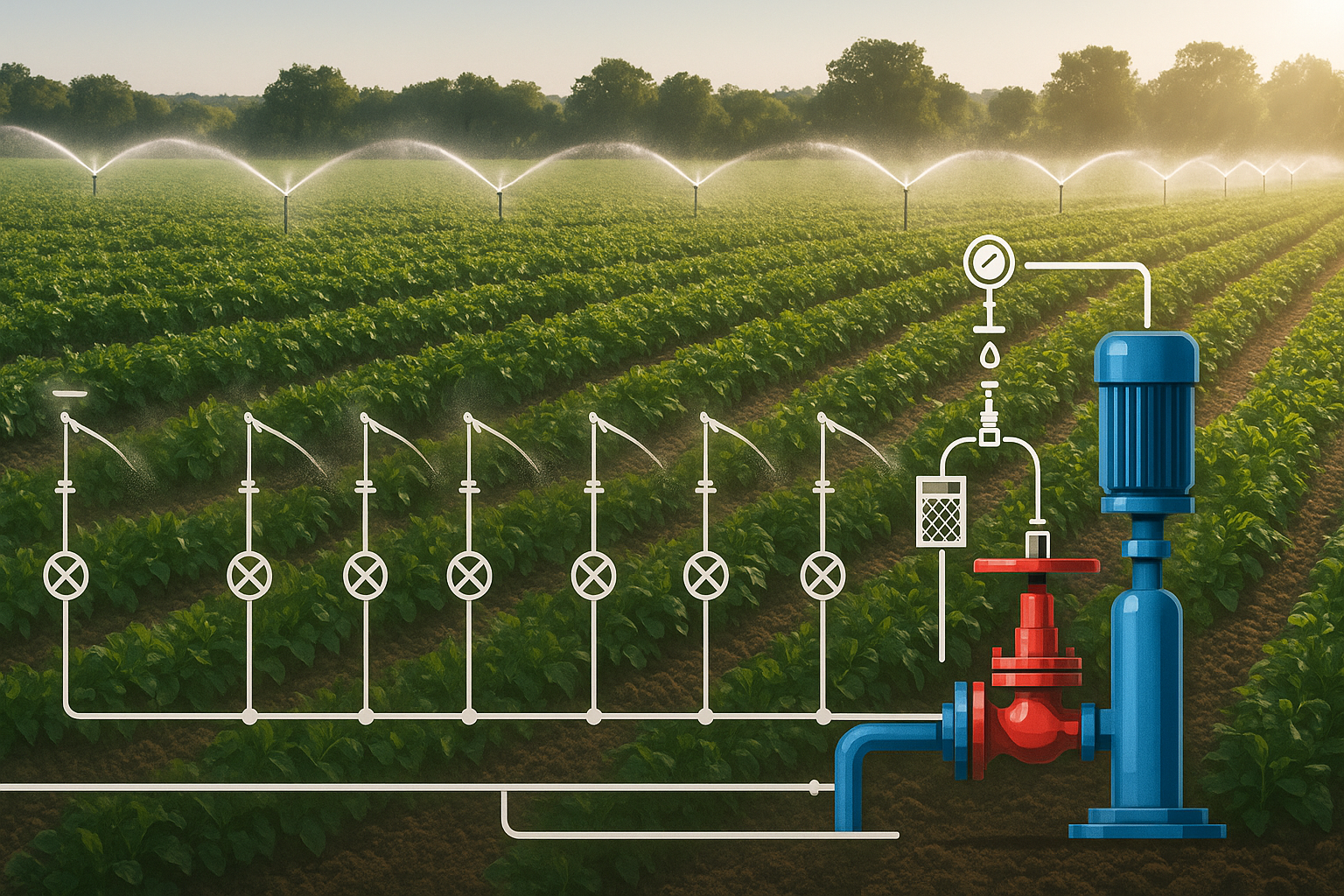
Creating an effective commercial irrigation system design isn’t just about installing pipes and sprinklers. It’s about understanding the unique personality of your property – how it breathes, how it drinks, and how it responds to New England’s sometimes temperamental climate.
Before we even think about breaking ground, we need to get acquainted with your property’s specific characteristics. Think of this as a first date with your landscape – we need to understand what makes it tick before we can build a successful relationship.
Climate considerations play a huge role in how your irrigation system will perform throughout the year. Here in the Merrimack Valley, we experience the full spectrum of New England weather – from spring’s unpredictable rainfall patterns to summer’s occasional drought conditions, fall’s changing plant needs, and winter’s freeze-thaw cycles that can wreak havoc on unprepared systems.
“Even a well-designed irrigation system requires precise scheduling based on measurements (soil moisture, ETc, or plant needs) to ensure crops receive the optimal amount of water while conserving resources,” notes irrigation experts from University of Florida research.
Your soil type is essentially your landscape’s personality. Some properties have sandy soil that drains water faster than a colander, requiring more frequent but shorter watering sessions. Others have clay-heavy soil that holds onto water like a sponge, potentially causing runoff problems if watered too quickly. In our 30+ years serving communities from Tewksbury to Chelmsford, we’ve encountered every soil variation imaginable – sometimes all on the same property!
Topographical features create the natural flow patterns across your landscape. That gentle slope near your building entrance? It could become a mini-waterfall during irrigation if not properly accounted for. The subtle depression in your courtyard? It might become an unwanted pond without proper drainage considerations. Professional designers understand that a 1-meter change in elevation creates approximately 10 kPa difference in water pressure – a critical factor in ensuring even water distribution.
Your existing vegetation and future landscape plans dictate how water should be distributed across your property. Those mature oak trees have deep roots that need infrequent but deep watering, while your seasonal flower displays might need frequent, lighter irrigation. A thoughtful commercial irrigation system design creates zones that respect these different needs, ensuring every plant gets exactly what it requires without waste.
Microclimates are the hidden influencers of irrigation needs. That south-facing wall that reflects heat onto nearby plants? It creates a pocket of higher water demand. The area constantly in shadow from your building? It likely needs less frequent watering. Even wind patterns across your property create invisible zones with different evaporation rates. Identifying these subtle variations is what separates a good irrigation system from a great one.
As one irrigation specialist wisely puts it: “Irrigation design is not only about laying out pipes – it integrates crop needs, soil properties, water source limitations, and climate conditions to achieve efficiency and profitability.
At McLeod Landscaping, we bring over three decades of local knowledge to every project. We understand how the unique conditions in Lowell, Concord, Westford, and throughout the Merrimack Valley influence irrigation performance. This deep regional expertise helps us create systems that work in harmony with your specific site conditions, not against them.
Scientific research on irrigation design for agriculture confirms what we’ve learned through experience: taking the time to thoroughly analyze your site before design begins pays dividends in system performance for years to come.

Once we’ve completed a thorough site analysis, it’s time to roll up our sleeves and tackle the technical aspects of commercial irrigation system design. These aren’t just minor details—they’re the backbone of creating a system that works beautifully while respecting our precious water resources.
Every great irrigation system starts with understanding what your water source can actually deliver. Think of it as knowing your starting point before planning a journey.
When we evaluate commercial properties, we first look at where your water comes from—municipal supply, private wells, or perhaps a pond or rainwater collection system. Each has its own personality and quirks that influence our design approach.
Next comes the fun part: measuring your water’s actual performance. It’s surprisingly simple but incredibly important. We’ll turn off all water sources, attach a pressure gauge to an outdoor faucet, and time how quickly we can fill a 5-gallon bucket. This gives us your flow rate in gallons per minute (GPM).
For instance, if your bucket fills in 18 seconds, you’re looking at about 16.67 GPM. This number becomes our north star, telling us exactly how many sprinkler heads can run at once without leaving some areas high and dry.
Water pressure doesn’t stay constant throughout your system—it drops as water travels through pipes, climbs hills, and steers valves and fittings. We use careful hydraulic calculations to ensure even the farthest sprinkler head gets enough pressure to perform properly. One rule of thumb we follow: keep water velocity below 5 feet per second in all pipes to minimize friction loss.
Of course, we can’t forget about backflow prevention. These devices aren’t just good practice—they’re often required by law to protect public water supplies from contamination. Depending on your property’s specific needs, we’ll install either Reduced Pressure Zone assemblies for high-risk areas or Pressure Vacuum Breakers where risks are lower.
A truly outstanding commercial irrigation system design looks beyond today’s needs to anticipate tomorrow’s requirements. It’s like buying a suit with room to grow.
The pipe layout forms the circulatory system of your irrigation. We carefully size mainlines to carry water from the source to zone valves, and lateral lines to distribute water to sprinkler heads. Getting the pipe diameter right is crucial—too small and pressure drops; too large and you’ve wasted money on materials you don’t need.
When placing valves, we think about both performance and practical maintenance. We typically group valves in valve boxes that we position in locations that won’t disrupt your property’s appearance but remain accessible for maintenance. For hard-to-reach areas, remote control valves can be a game-changer.
One thing we’ve learned in our 30+ years serving the Merrimack Valley: landscapes evolve. That’s why we design with growth in mind, sizing mainlines to accommodate additional zones you might want in the future, ensuring controllers have extra capacity, and strategically placing quick coupler valves for manual watering needs.
Finally, we provide comprehensive documentation of your system—detailed drawings showing all components, clear valve and zone identification, and controller programming information. This becomes your roadmap for future maintenance and modifications.
At McLeod Landscaping, we bring these technical considerations to life while keeping the specific needs of Massachusetts properties in mind. Our experience throughout Wilmington, Carlisle, and neighboring communities has taught us that attention to these details transforms an adequate system into an exceptional one that serves your property for years to come.
More info about How Does a Lawn Irrigation System Work?

The landscape of commercial irrigation system design has been completely transformed in recent years. Gone are the days of simple timers and manual adjustments – today’s systems are smart, responsive, and remarkably efficient.
Remember when irrigation systems just ran on timers, regardless of whether it had rained all night? Those days are thankfully behind us. Modern smart irrigation technology represents a game-changer for commercial properties looking to balance beautiful landscapes with responsible water management.
Weather-based controllers now serve as the brains of sophisticated irrigation systems, connecting to local weather stations or online services to make real-time adjustments. These clever devices automatically modify your watering schedule based on rainfall, temperature, and humidity levels – something we know fluctuates dramatically throughout our New England seasons. The results speak for themselves: many of our clients see water usage reductions of 20-50% compared to traditional timer-based systems.
Flow management systems add another layer of intelligence to your irrigation setup. These systems constantly monitor water movement, immediately detecting leaks or broken pipes and shutting down affected zones before significant damage or water waste occurs. One client called me last summer after receiving an automatic alert about unusual flow at 2 AM – we were able to address a broken sprinkler head before it created a small pond on their property!
“Smart irrigation systems significantly reduce water wastage, allow for more customization for different areas and plant types, and lead to long-term savings on water bills and maintenance costs due to efficient water use and early leak detection,” according to industry research, and our three decades of experience in the Merrimack Valley certainly confirms this.
The convenience factor can’t be overlooked either. Most modern systems offer mobile control capabilities, allowing property managers to adjust programs from anywhere via smartphone or computer. Imagine being able to delay irrigation before an outdoor corporate event or respond to a sudden heatwave – all from your phone. For larger commercial campuses, these systems can even integrate with overall building management systems, creating a coordinated approach to resource management.
The real magic of smart irrigation happens at ground level, where various sensors provide real-time data about actual watering needs – not just what a calendar says should happen.
Rain sensors are perhaps the simplest but most immediately effective devices in the smart irrigation toolkit. These unassuming components prevent your system from running during or after rainfall – a basic function that still manages to reduce annual water use by an average of 22.1% according to independent studies. I still remember driving past properties during rainstorms and seeing sprinklers running full blast; thankfully, this wasteful practice is becoming increasingly rare.
Soil moisture sensors take this intelligence a step further by measuring actual moisture levels in the soil itself. Rather than guessing about water needs, these sensors prevent irrigation when soil moisture is adequate for plant health. The water savings can be dramatic – research shows reductions of up to 66.2% over three years. For commercial properties with extensive landscaping, this translates to significant cost savings while maintaining or even improving landscape health.
For the most sophisticated water management, ET (evapotranspiration) sensors measure the combined effect of evaporation and plant transpiration. These advanced devices calculate precise water requirements based on actual plant water loss, providing the most accurate water application of any system. For high-profile commercial properties where landscape appearance is critical, these sensors ensure plants receive exactly what they need – no more, no less.
The combination of flow sensors and master valves creates a powerful safety net for your irrigation system. By monitoring water flow throughout the system, these components detect abnormal patterns that might indicate leaks or breaks, then automatically shut down the affected zones. One university research park we’re familiar with saved 25 million gallons of water and $120,000 on water bills across 55 acres after implementing smart irrigation technology with these protective features.
The return on investment for smart irrigation is impressive and quick. Studies show ROI of 87% for rain sensors and 200% for soil moisture sensors within just the first year of implementation. For our commercial clients throughout Andover, Billerica, Burlington and beyond, these technologies represent not just environmental responsibility, but smart business sense.
At McLeod Landscaping, we’ve witnessed how these technologies transform water management practices. From corporate campuses to municipal properties, smart irrigation delivers the perfect balance of beautiful landscapes and responsible resource use – something increasingly important to both property managers and the communities they serve.
More info about The Benefits of Installing a Smart Irrigation System in Your Home
When you’re considering a commercial irrigation system design, understanding both the upfront costs and long-term financial benefits helps you make an informed decision. Let’s take a look at what goes into the dollars and cents of these water-wise investments.
The initial investment in a commercial irrigation system can vary considerably depending on your specific property needs. One of the primary factors affecting cost is the type of system you choose.
For large, open spaces like corporate lawns or sports fields, traditional sprinkler systems are often the go-to option. According to industry data, the average cost to install a sprinkler system on a one-acre commercial lot hovers around $10,280, though prices can range from $7,000 to over $30,000 depending on complexity and features. These are average costs based on internet data and not actual costs for McLeod Landscaping.
If you’re looking at more targeted watering for landscaped beds or areas with specialty plantings, drip irrigation systems typically range between $1,800 and $2,500, though complex commercial installations can reach $7,500 or more. Again, these are average costs based on internet data and not actual costs for McLeod Landscaping.
Your property’s size dramatically influences cost, with most commercial installations budgeting roughly $1,000 per irrigation zone. Larger properties naturally require more extensive pipe networks, additional sprinkler heads or drip emitters, and more complex zoning arrangements to ensure efficient water distribution.
The water source you’ll be tapping into also affects your bottom line. Municipal connections often require permits and backflow prevention devices, while well systems might need pumps and filtration equipment. I’ve seen some properties in the Merrimack Valley opt for rainwater harvesting systems, which require collection infrastructure and storage facilities—an upfront investment that pays off through reduced water bills.
The level of technology you choose significantly impacts costs as well. Basic controllers with simple timers represent the entry-level option, while smart controllers with weather monitoring capabilities offer more efficiency at a higher price point. Fully integrated systems with multiple sensor types provide the ultimate in water conservation but come with premium pricing. Smart or WiFi irrigation systems typically cost between $300 and $3,000 depending on the number of zones and features. These are average costs based on internet data and not actual costs for McLeod Landscaping.
Site conditions can throw some budget curveballs too. Rocky soil might require specialized equipment, existing hardscape elements may need to be steerd carefully, and steep slopes often need pressure regulation devices to ensure consistent watering.
“Smart irrigation systems significantly reduce water wastage, allow for more customization for different areas and plant types, and lead to long-term savings on water bills and maintenance costs due to efficient water use and early leak detection.”
While that initial price tag might cause some sticker shock, a well-designed commercial irrigation system delivers impressive returns over time. The water savings alone can be substantial—smart controllers typically reduce water consumption by 20-50%, while drip irrigation can cut usage by up to 60% compared to traditional sprinklers.
For commercial properties throughout Chelmsford, Concord, and Lowell, these water savings translate directly to lower utility bills. During our hot New England summers or occasional drought conditions, when water rates often increase, these savings become even more significant. I’ve worked with several business parks in the area that have recovered their initial investment within just a few years through reduced water bills alone.
Beyond direct water savings, efficient irrigation leads to healthier landscapes that simply cost less to maintain. Plants that receive the right amount of water—not too much, not too little—thrive with fewer interventions. This means fewer replacement plants, reduced fertilizer needs (since nutrients aren’t being washed away), and even less frequent mowing as growth patterns become optimized.
Property value improvements represent another financial benefit that’s harder to quantify but no less real. Well-maintained, lush landscapes contribute significantly to curb appeal, creating positive first impressions for clients and visitors. For property managers, this often translates to improved tenant satisfaction and retention, potentially qualifying for LEED certification points for water efficiency as well.
The labor savings from automated systems shouldn’t be overlooked either. No more staff time spent moving hoses or manual sprinklers, no more manual seasonal adjustments, and remote management capabilities that reduce the need for site visits. One property manager I worked with in Tewksbury estimated they saved nearly 20 hours of maintenance staff time each week after installing a smart irrigation system.
Perhaps most valuable is the early problem detection these systems provide. Smart irrigation setups identify issues before they become costly disasters—immediately detecting leaks before they cause water damage, monitoring pressure to prevent system damage, and using flow sensing to quickly identify broken heads or pipes.
Independent studies have shown remarkable returns, with properties implementing smart irrigation technology achieving ROI of 87% for rain sensors and 200% for soil moisture sensors within just the first year of operation.
At McLeod Landscaping, we work closely with our commercial clients throughout the Merrimack Valley to develop commercial irrigation system designs that balance upfront investment with long-term returns. After all, the best system isn’t just the one that waters efficiently—it’s the one that makes financial sense for years to come.
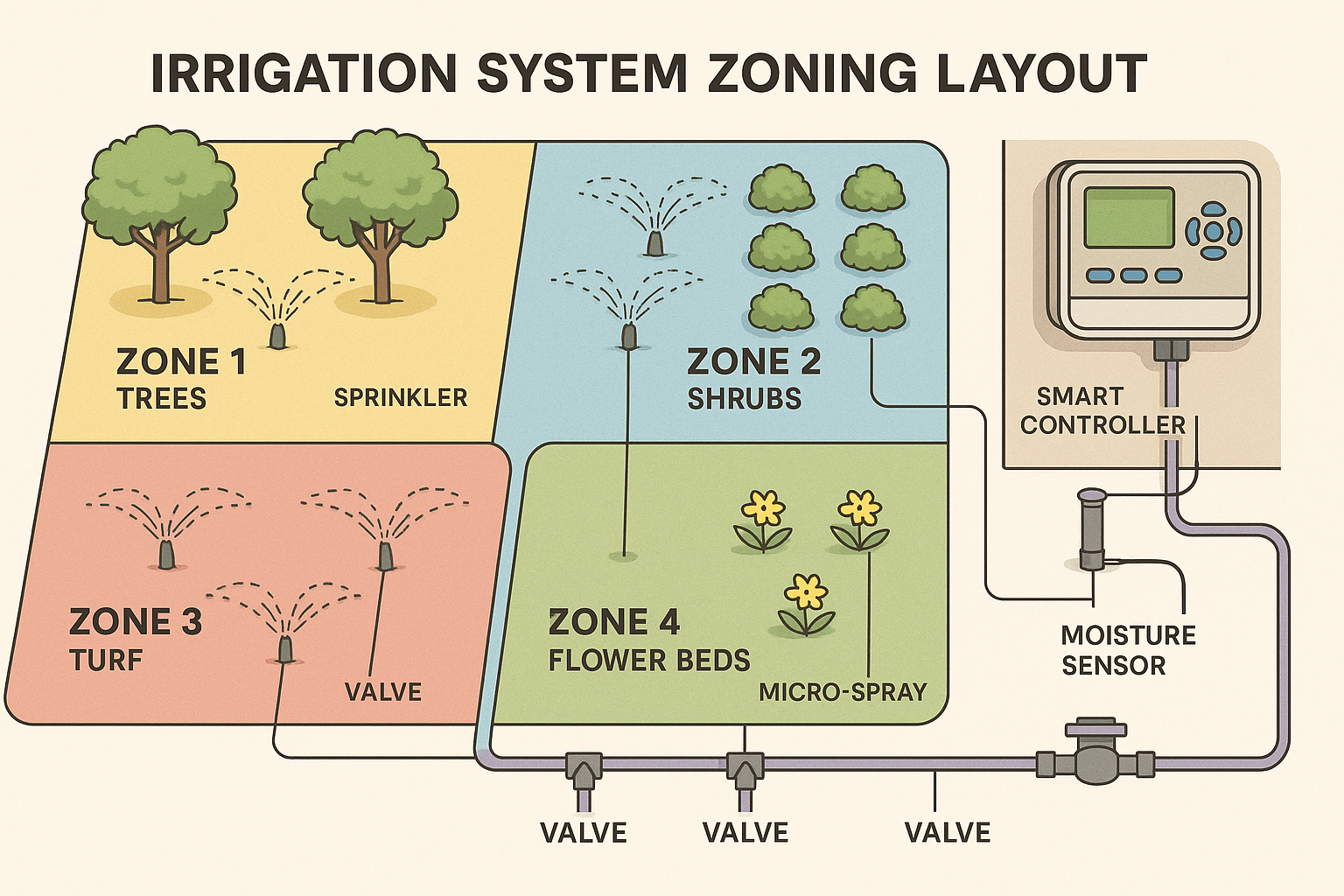
When it comes to commercial irrigation system design, thoughtful zoning might just be the unsung hero of the entire operation. Think of zoning as creating a customized water delivery plan for every corner of your property—ensuring that thirsty annuals aren’t treated the same as drought-tolerant natives.
Creating effective irrigation zones is both a technical challenge and a horticultural art form. It’s like conducting an orchestra where every instrument needs to play at just the right volume.
Water supply capacity drives many zoning decisions from the start. Your property’s available water pressure and flow rate essentially determine how many sprinklers can run simultaneously without leaving some areas high and dry. If your calculations show your property requires 26.2 GPM total but your water supply only delivers 16.67 GPM, you’ll need to divide your system into at least two separate zones that run sequentially rather than simultaneously.
The technical side of zoning follows some non-negotiable rules that experienced designers understand intuitively. Never mix different types of sprinkler heads within the same zone—spray heads and rotors deliver water at different rates, leaving some areas soggy while others remain parched. Head-to-head coverage ensures consistent watering with no dry spots between sprinklers. And elevation changes must be accounted for since water pressure naturally decreases as elevation increases (about 0.433 PSI per foot of elevation gain).
Your controller’s capacity also influences zoning strategy. Most commercial controllers handle between 12-48 zones, with smart controllers offering additional flexibility for scheduling and monitoring. When we design systems for corporate campuses in Tewksbury or Billerica, we often install controllers with room for expansion—it’s always easier to add zones later if your controller has available stations.
Valve placement might seem like a minor detail, but it significantly impacts both system performance and future maintenance. We typically group valves in accessible valve boxes, strategically placed in unobtrusive locations around the property. There’s nothing more frustrating than needing to repair a valve and finding it’s buried under a newly installed bench or planter!
The most sophisticated aspect of zoning involves understanding plant water requirements and environmental conditions. This practice, called hydrozoning, groups plants with similar thirst levels together.
High water use zones typically include lush turf areas, annual flower displays, and container plantings—elements that often create those crucial first impressions for your commercial property. These areas might need watering several times weekly during peak summer months.
Moderate water use zones generally contain established perennials, many shrubs, and ornamental grasses. These plants have deeper root systems that can access moisture further down in the soil profile, requiring less frequent irrigation.
Low water use zones feature drought-tolerant species and native plants adapted to local rainfall patterns. Once established, these areas might need supplemental water only during extended dry periods. For many of our clients throughout the Merrimack Valley, expanding these low-water zones has become a priority for both environmental and budgetary reasons.
Beyond plant selection, environmental factors create invisible microclimates across your property. Sun exposure dramatically affects water needs—a south-facing slope in full sun might require twice the water of a north-facing, shaded area with identical plants. Wind exposure accelerates evaporation, while different soil types hold varying amounts of moisture. A sandy area might drain completely in hours, while clay soil retains moisture for days.
For commercial properties, usage patterns also influence zoning decisions. High-visibility areas near entrances and gathering spaces often receive priority watering to maintain their appearance, while less-trafficked perimeter areas might tolerate occasional stress. High-traffic turf areas typically need more frequent irrigation to recover from wear.
The best zoning systems also accommodate seasonal adjustments. In spring, zones activate sequentially as different plants break dormancy. Summer brings peak water demand, while fall allows for gradual reduction as plants prepare for winter. A well-designed system makes these transitions seamless.
At McLeod Landscaping, we’ve seen the remarkable difference thoughtful zoning makes for our commercial clients in Westford, Wilmington, and throughout the Merrimack Valley. One medical office complex we worked with reduced their water consumption by 40% after implementing properly zoned irrigation with smart controls—all while improving their landscape’s appearance and reducing maintenance needs.
The beauty of well-executed zoning isn’t just in water savings—it’s in the healthier plants, reduced disease pressure, and more vibrant landscapes that result when every plant receives exactly what it needs, no more and no less.
Designing a commercial irrigation system isn’t just about getting water to your landscape—it’s about creating a system that performs efficiently for years to come. At McLeod Landscaping, we’ve learned that proper maintenance and sustainable practices are what transform a good system into a great one.
Think of your irrigation system like a car—regular tune-ups keep it running smoothly and help avoid costly breakdowns. A well-maintained system can last decades, while neglected ones often fail prematurely.
The secret to long-term efficiency starts with a seasonal approach. In our New England climate, spring startup is crucial—we activate the system, test pressure, and make initial adjustments as plants begin their growing season. During mid-season checks, we evaluate performance when water demand is highest. As temperatures drop, fall winterization becomes essential to prevent freeze damage (a single frozen pipe can cause thousands in repairs). We often recommend using the off-season for any significant repairs or upgrades when the system isn’t needed.
Regular “wet checks” are the backbone of good maintenance. These inspections involve running each zone while looking for issues like leaks, misaligned heads, or clogged emitters. It’s amazing what a simple adjustment can do—I’ve seen properties reduce water usage by 15% just by correcting sprinkler angles!
Component maintenance matters too. Over time, sprinkler heads may need raising as plants grow around them, nozzles can clog with mineral deposits, and drip irrigation lines benefit from periodic flushing. Smart system components like weather stations and soil sensors need calibration to maintain their accuracy.
Don’t underestimate the importance of controller programming. Your irrigation schedule should evolve with the seasons and changing landscape conditions. We often find controllers still running spring schedules in August—a recipe for wasted water and unhealthy plants.
“Good record-keeping is worth its weight in gold,” as one of our long-time clients puts it. Tracking water usage, documenting repairs, and maintaining updated system maps makes future maintenance more efficient and helps identify potential problems before they become serious.
Water conservation isn’t just environmentally responsible—it makes financial sense too. Modern commercial irrigation system design incorporates numerous strategies to reduce waste while maintaining beautiful landscapes.
High-efficiency nozzles and emitters can dramatically reduce water use. Technology has come a long way—today’s rotary nozzles apply water much more slowly and evenly than older models, allowing better absorption and less runoff. For sloped areas, cycle-and-soak programming works wonders by applying water in shorter bursts with rest periods in between, giving the soil time to absorb moisture before more is applied.
Many of our forward-thinking clients in the Merrimack Valley are exploring alternative water sources. Rainwater harvesting systems collect runoff from roofs and hardscapes, storing it for irrigation use. One office complex we worked with in Andover installed a 20,000-gallon underground cistern that now supplies nearly half their irrigation needs!
The most water-efficient landscapes start with thoughtful plant selection. Native plants already adapted to our local rainfall patterns simply need less supplemental water. We often recommend grouping plants with similar water requirements together—what irrigation professionals call “hydrozoning.” This prevents the common problem of overwatering drought-tolerant plants just to keep thirsty ones alive.
Soil health plays a huge role in irrigation efficiency. Healthy soil with adequate organic matter acts like a sponge, holding moisture where roots can access it. Simple practices like mulching not only reduce evaporation but also gradually improve soil structure as the mulch breaks down. I’ve seen properties reduce irrigation needs by 30% just by improving their soil quality and maintaining proper mulch depths.
Education remains one of our most powerful tools for sustainability. When property managers understand how their irrigation system works and why certain schedules are set, they become partners in water conservation. We love sharing knowledge about system operation, explaining the reasoning behind watering schedules, and celebrating water savings with our clients.
At McLeod Landscaping, we’ve helped countless businesses throughout the Merrimack Valley implement irrigation systems that balance beautiful landscapes with responsible resource use. Whether you’re managing a corporate campus in Billerica, maintaining municipal grounds in Chelmsford, or overseeing a retail center in Burlington, proper maintenance and sustainable design principles will keep your irrigation system performing at its best for years to come.
Choosing the right commercial irrigation system for your property isn’t a one-size-fits-all decision. At McLeod Landscaping, we often get asked this question, and I always emphasize that it starts with understanding your specific situation.
First, take a close look at your water source and availability. The pressure, flow rate, and quality of your water supply will fundamentally determine what your system can handle. A property with limited water pressure will need a different approach than one with abundant supply.
The size and layout of your landscape matters tremendously. Larger commercial properties typically require multiple irrigation zones, while properties with diverse landscapes might need different irrigation methods for various areas. A corporate campus with both expansive lawns and intricate garden beds would benefit from a hybrid approach.
Your plant selection plays a crucial role too. Those beautiful native perennials have vastly different watering needs than your turf areas or annual color displays. We design systems that respect these differences rather than treating all plants the same.
Don’t overlook your soil conditions. Here in the Merrimack Valley, we see everything from quick-draining sandy soils to heavy clay that holds moisture for days. These soil variations significantly impact how often and how deeply you should water.
Local climate patterns and microclimates on your property will influence your system design as well. Areas that receive afternoon shade might need half the water of those in full sun all day.
Of course, budget considerations matter – both what you spend upfront and the long-term operational costs. Sometimes investing more initially in smart technology saves substantial money over time.
If water conservation is important to your organization (as it is for many of our commercial clients), systems with weather-based controllers and high-efficiency components deliver impressive water savings.
Finally, consider your maintenance capabilities. Who will be managing this system, and what level of complexity can they handle? Even the most sophisticated system needs proper oversight.
As one irrigation expert perfectly summarized: “The best irrigation option depends on factors like soil type, plantings, climate, and exposure, not on one single method.” That’s why at McLeod Landscaping, we take the time to evaluate all these factors before recommending a commercial irrigation system design for your specific property.
Water conservation has become increasingly important for our commercial clients throughout the Merrimack Valley, both for environmental responsibility and controlling costs. The good news? Modern commercial irrigation system design offers numerous ways to reduce waste without sacrificing landscape quality.
Smart irrigation technology represents the single biggest opportunity for water savings. Weather-based controllers that automatically adjust watering schedules based on local conditions can reduce water consumption by 20-50%. I’ve seen properties in Andover and Burlington cut their irrigation water use by a third just by making this one change.
Thoughtful hydrozone planning makes a tremendous difference too. By grouping plants with similar water requirements together, you avoid the common problem of overwatering drought-tolerant plants while trying to keep thirstier varieties happy. This approach creates healthier plants while using less water.
The components you select matter significantly. High-efficiency nozzles and drip irrigation can dramatically reduce water consumption compared to traditional spray heads. For one office complex in Billerica, switching to drip irrigation in planting beds reduced their water use by nearly 40% in those zones.
Timing is everything when it comes to efficient irrigation. Watering during early morning hours (typically between 4-7 AM) minimizes evaporation and wind drift. This simple scheduling adjustment can save thousands of gallons over a season.
For sloped areas or heavy soils, cycle-and-soak programming prevents runoff by breaking longer watering times into shorter cycles. Rather than running a zone for 12 minutes straight, we might program three 4-minute cycles with soak time in between, allowing water to penetrate deeply without waste.
Proper pressure regulation ensures optimal performance. Too much pressure creates misting and evaporation; too little results in poor distribution. Finding that sweet spot maximizes efficiency.
Regular system inspections catch the small problems before they become big water wasters. A single broken sprinkler head can waste hundreds of gallons in just one watering cycle.
Finally, consider how your landscape design itself influences water use. Reducing high-water-demand turf areas and incorporating native plants adapted to local rainfall patterns creates naturally water-efficient landscapes.
As irrigation researchers have noted: “Even a well-designed irrigation system requires precise scheduling based on measurements to ensure optimal water delivery while conserving resources.” That’s why our approach combines thoughtful design with ongoing monitoring and adjustment.
A well-maintained irrigation system can last for decades, while a neglected one can deteriorate quickly. For our commercial clients throughout Tewksbury, Chelmsford, and the surrounding communities, understanding maintenance requirements helps protect their landscape investment.
Seasonal procedures form the backbone of any maintenance program. In our New England climate, proper spring startup is essential—we carefully activate the system, check for winter damage, and make necessary repairs before the growing season begins. Equally important is fall winterization, where we thoroughly blow out all water from the system to prevent freeze damage during our harsh winters.
Between these seasonal bookends, regular inspections keep everything running smoothly. For most commercial properties, we recommend monthly visual checks during the growing season, with more comprehensive system reviews quarterly. Any landscape construction or modification should trigger an immediate inspection, as even minor digging can damage irrigation lines.
Individual component maintenance prevents small issues from becoming major problems. Sprinkler heads need adjustment as plants grow or soil settles. Nozzles occasionally clog and need cleaning or replacement. Drip irrigation lines benefit from periodic flushing to prevent mineral buildup, and sensors and weather stations require regular calibration to maintain accuracy.
Your irrigation controller needs attention too. Seasonal watering schedules should be updated as weather patterns change. Run times often need adjustment based on observed landscape conditions. Smart controllers require software updates, and all controllers need backup battery checks.
System testing provides peace of mind and prevents waste. We check for leaks in pipes, valves, and fittings, verify proper pressure throughout the system, ensure valves function correctly and close completely, and test backflow prevention devices annually (which is often a legal requirement for commercial properties).
As irrigation professionals emphasize: “Regular maintenance includes system activations, winterizations, full inspections, adjustments, and necessary repairs during the growing season.” This comprehensive approach ensures your system performs efficiently year after year.
At McLeod Landscaping, we’ve developed maintenance programs specifically for commercial properties throughout Lowell, Concord, and beyond. Our experienced technicians become familiar with your specific system, spotting potential issues before they develop into problems. This proactive approach not only conserves water but also protects your landscape investment for the long term.
Creating an effective commercial irrigation system design isn’t just about laying pipes and installing sprinklers—it’s an art that blends technical knowledge with environmental stewardship. Throughout this guide, we’ve explored how thoughtful irrigation design can transform commercial properties while conserving our precious water resources.
Water is the lifeblood of your landscape, and how you manage it makes all the difference. A well-designed irrigation system delivers water precisely where and when it’s needed, eliminating the guesswork and waste that plague manual watering methods. This precision approach pays dividends in multiple ways for commercial property owners and managers.
First and foremost, you’ll see significant reduced water consumption and utility costs. Many of our clients throughout the Merrimack Valley have cut their water usage by 30-50% after implementing smart irrigation systems. Those savings go straight to your bottom line month after month, year after year.
Beyond the financial benefits, you’ll notice healthier, more vibrant landscapes that create powerful first impressions. Plants that receive optimal moisture develop stronger root systems and show greater resilience during stressful weather conditions. This leads directly to lower maintenance requirements as you’ll face fewer plant replacements, disease issues, and weed problems.
The extended lifespan of landscape plants represents another significant return on your irrigation investment. Trees, shrubs, and perennials that might have struggled or failed with inconsistent watering will thrive when given precisely what they need. This plant longevity improves your property’s improved value and curb appeal, creating an environment that attracts and retains tenants, customers, or employees.
Perhaps most importantly in today’s environmentally conscious world, a properly designed irrigation system demonstrates your commitment to improved environmental sustainability. Water conservation isn’t just good business—it’s responsible stewardship of our shared resources.
At McLeod Landscaping, we’ve spent over three decades perfecting our approach to commercial irrigation throughout Tewksbury, Westford, Wilmington, and surrounding communities. We’ve learned that every property tells its own story and presents unique challenges. The irrigation system that works brilliantly for an office park in Lowell might need significant adjustments for a retail center in Andover or a municipal property in Billerica.
As water resources become increasingly precious and regulations more stringent, efficient irrigation will only grow in importance. Smart technology continues to evolve, offering new ways to fine-tune water application and further reduce consumption. By implementing a thoughtfully designed system today, you position your property for success both now and in the future.
We invite you to experience the McLeod Landscaping difference—where technical expertise meets practical know-how, and where every irrigation system is designed with your specific needs in mind. Our comprehensive approach ensures that your commercial property receives exactly the right amount of water, in exactly the right places, at exactly the right times.
For more information about our commercial irrigation systems and how we can help your property thrive while conserving valuable resources, contact our team today. Together, we can create an irrigation solution that serves your landscape, your budget, and our shared environment for years to come.
Contact McLeod Landscaping today at (978) 640-0957 or click here to schedule a consultation for retaining wall installation. Let our experienced team design and install a functional and visually appealing retaining wall that enhances your landscape.


1881 Main St Unit 1, Tewksbury, MA 01876