
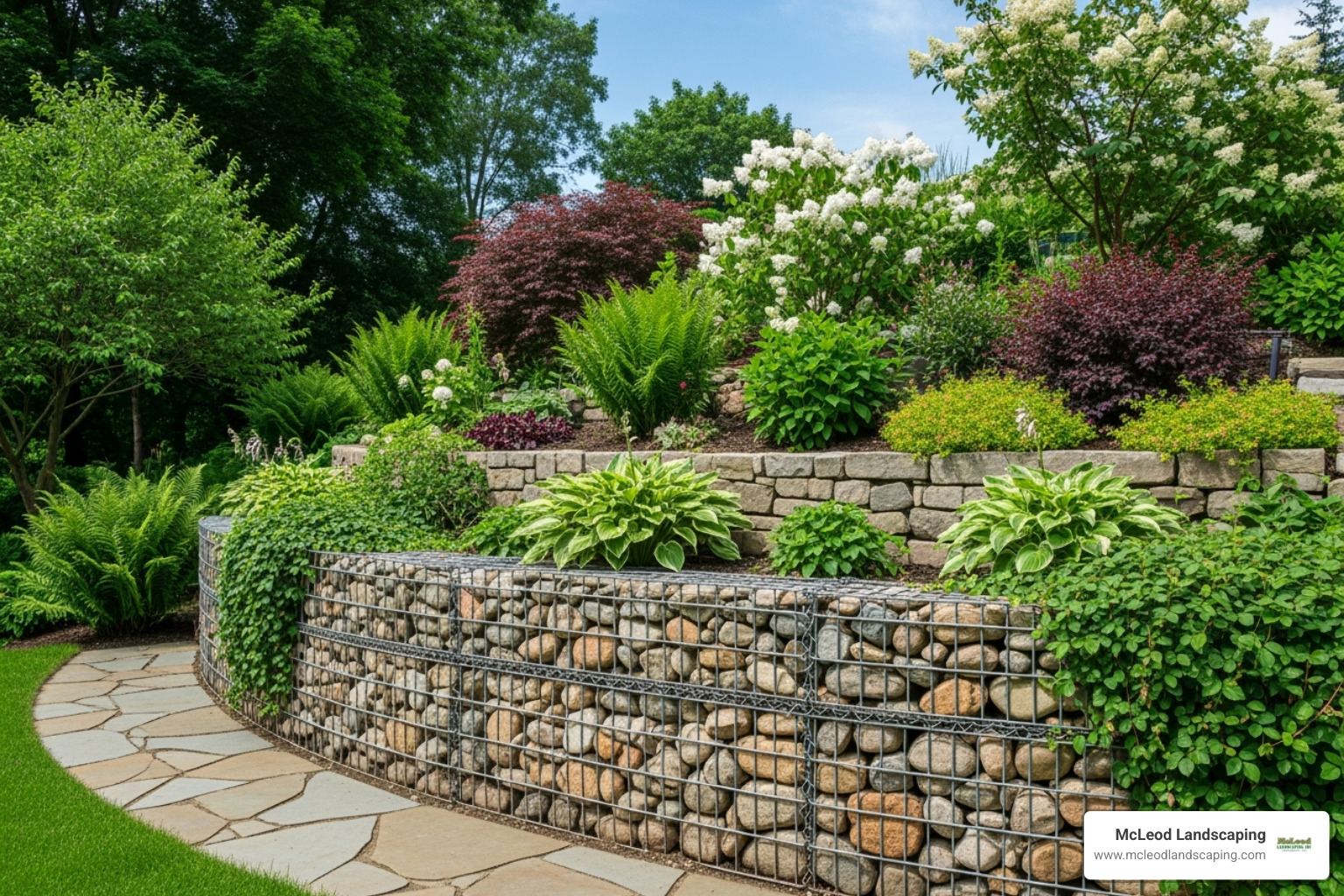
A curved gabion wall is a wire mesh basket filled with rock that follows a graceful arc instead of a straight line. These walls blend exceptional strength with natural beauty, making them ideal for retaining soil, preventing erosion, and creating striking landscape features.
Key Steps to Build a Curved Gabion Wall:
Curved gabion walls are stronger than straight walls due to the arch principle, offer superior drainage, create visual flow, are cost-effective, and can last 50-100+ years.
I’m Scott McLeod, owner of McLeod Landscaping Inc. With over 30 years of experience in the Merrimack Valley, my team and I have designed and installed many curved gabion walls, changing challenging slopes into beautiful, functional spaces. We understand the structural and aesthetic details that make these walls an excellent choice for any property.
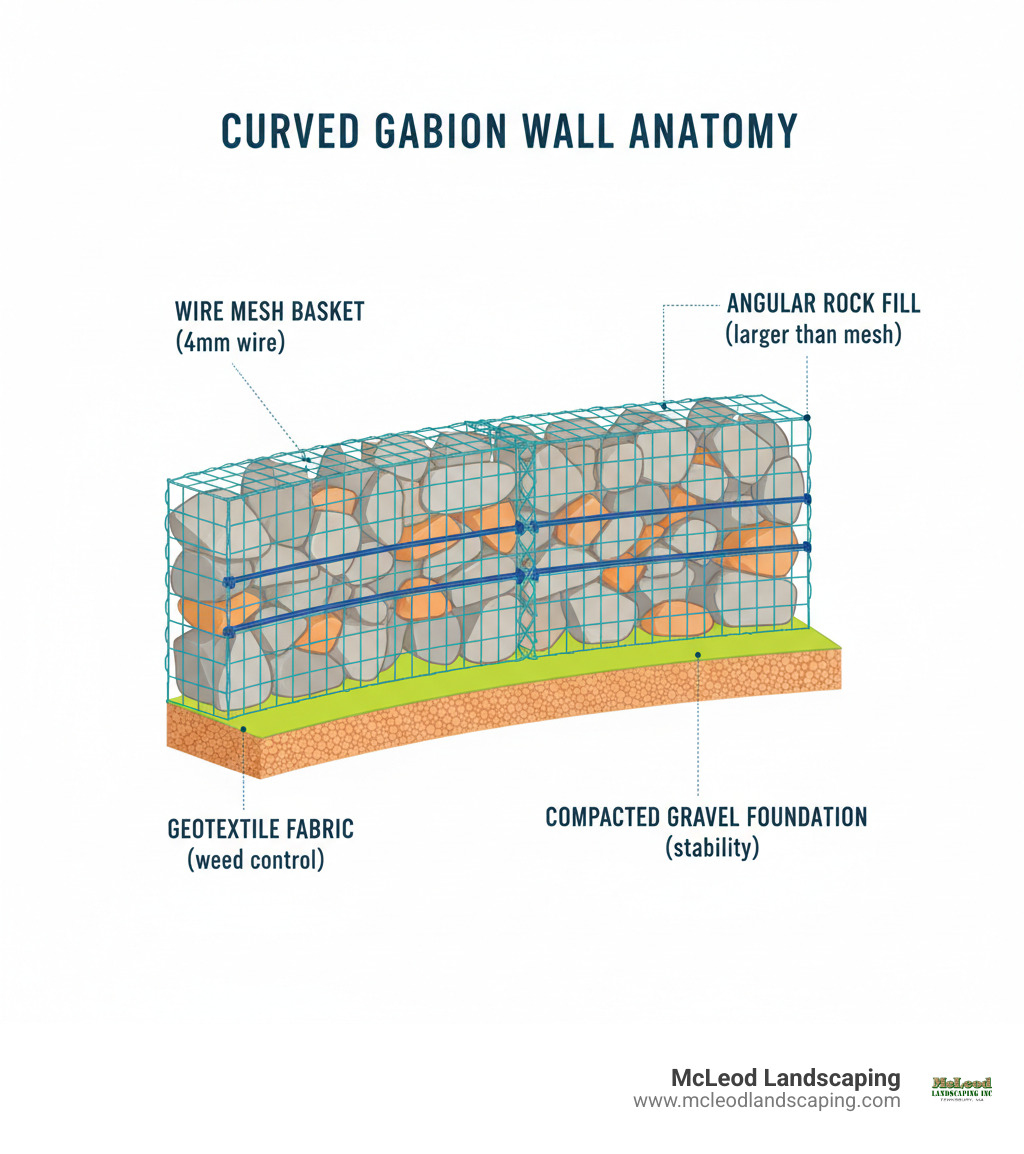
Important curved gabion wall terms:
While most retaining walls are straight and rigid, a curved gabion wall offers unique advantages. These arcing structures combine serious structural strength with natural beauty, making them ideal for soil erosion control and flood prevention. With three decades of experience installing landscape walls in the Merrimack Valley, I’ve seen how curved gabion walls become landscape centerpieces. They do more than solve drainage or slope issues; they transform properties. You can find visual inspiration for curved designs to see why they are so popular.
A curved gabion wall is often stronger than a straight one due to the arch principle, the same engineering that has kept Roman aqueducts standing for centuries. A curve distributes pressure more evenly across the structure, allowing it to handle greater lateral forces from the soil behind it.
The true genius of gabion walls, however, is their permeability. Unlike solid concrete or timber walls that trap water, gabions let water flow through the rock fill. This is a game-changer for retaining wall drainage. Without an escape route, water builds hydrostatic pressure that can cause solid walls to crack, bulge, and fail. With a curved gabion wall, water passes through freely, preventing dangerous pressure buildup. This natural drainage makes them incredibly effective for soil stabilization and slope management, especially in New England’s climate.
Straight walls can feel harsh and industrial, but a curved gabion wall introduces a natural, organic look that softens the entire landscape. Curves create visual flow and movement, guiding the eye through the space and making yards feel more expansive or intimate. An old design principle holds that curves are easier on the eyes than straight lines, and it’s absolutely true in practice.
Curved gabion walls make excellent garden focal points, such as an arcing wall defining a flower bed or a circular gabion structure serving as a planter and bench. They can direct attention, break up sight lines, or add an artistic element to your property.

The versatility shines when integrated with other hardscaping. A curved gabion wall pairs beautifully with retaining walls with steps, creating multi-level outdoor living areas. They are perfect for defining outdoor rooms, such as wrapping around a patio to create privacy without feeling closed in.
Proper planning is crucial for a successful curved gabion wall project. It ensures you have the right materials and tools, understand the costs, and build a wall that lasts. If the design phase seems daunting, our retaining wall design services can help bring your vision to life.
Gathering everything beforehand will save time and frustration. For tools, you’ll need a shovel, level, stakes, string line, measuring tape, bolt cutters, and pliers. For safety, always use heavy-duty gloves and safety glasses. A wheelbarrow and a hand tamper or plate compactor are essential for moving materials and creating a solid foundation. An air gun for C-clips can speed up assembly.
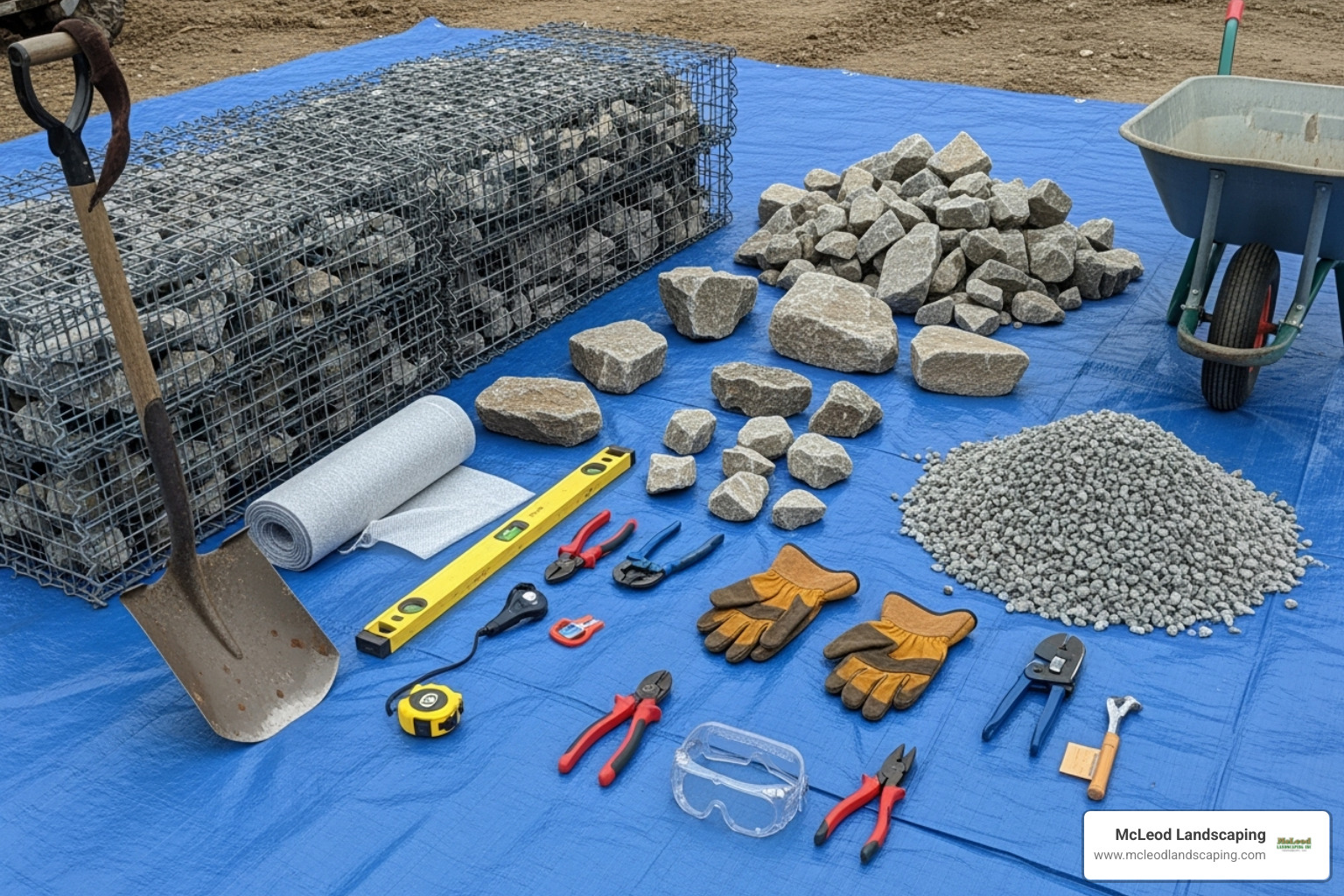
For materials, you’ll need welded gabion mesh panels (4mm wire gauge recommended), spiral binders or C-clips for connections, and internal bracing wires to prevent bulging. A geotextile fabric base will stop weeds, and compacted gravel is needed for a stable foundation. Finally, you’ll need your gabion rock fill.
Your material choices determine your wall’s longevity and appearance. For baskets, welded mesh is recommended for landscaping as it’s rigid and holds its shape well. For wire coating, standard galvanized wire offers good rust protection, but Galfan-coated wire provides superior corrosion resistance, especially in harsh climates. Always paint cut mesh ends with cold galvit to prevent rust.
For wire gauge, 4mm (5/32 inch) thickness offers the best balance of strength and workability. A standard mesh grid size is 3×3 inches (75mm x 75mm), so your rock fill must be larger than this opening.
For the fill, angular stone is better than rounded river rocks because the flat faces interlock, creating a more stable structure. For visible faces, choose an attractive landscape wall stone. To save money, you can use cheaper fill like rubble or broken concrete for the unseen interior core.
The cost of a curved gabion wall depends on its size, rock type, site accessibility, and whether it’s a DIY project or professionally installed. Gabion walls are generally more cost-effective than poured concrete, block, or timber walls.
Please note: the pricing shared here represents average costs based on internet data, not actual costs for McLeod Landscaping. Every project is unique, and factors like soil conditions and design complexity affect the final price. For an accurate quote for your project in Andover, Billerica, Burlington, Carlisle, Chelmsford, Concord, Lowell, Tewksbury, Westford, or Wilmington, MA, please contact us.
For materials and professional installation, expect a range of $25 to $200+ per square foot. A simple, low wall with basic stone will be at the lower end, while a tall, complex curve with premium stone will be at the higher end. Tighter curves require more custom work, which also affects cost. For more context, see our guide on how much a retaining wall costs. The DIY route saves on labor but requires significant physical effort and technical skill.
This is where your curved gabion wall comes together. Creating a smooth, sound curve requires precision and patience. Here is the process we follow.
A solid foundation is critical for stability. First, mark your curve using the “stake and string” method. Drive a stake at the curve’s center point, tie a string cut to your desired radius, and walk the arc, marking the ground for the inner and outer edges of the wall.
Next, excavate a trench along your marked line, digging at least 4 inches (10cm) deep or until you hit solid ground. For taller walls or poor soil, you may need to dig deeper or pour a concrete footing, especially when you build a retaining wall on a slope.
Compact the bottom of the trench until it is firm and perfectly level. Roll out geotextile fabric to prevent weeds and stop the gravel base from sinking into the soil. Finally, add 4-6 inches (10-15cm) of gravel and compact it thoroughly.
Now you’ll assemble and shape the baskets. Connect the bottom, front, back, and side panels using spiral binders or C-clips, leaving the top lid off for filling.
There are a few ways to create the curve:
As you place each basket on the foundation, connect it securely to its neighbors on all touching edges. For more guidance on different curve types, gabionbarriers.com has detailed installation techniques.
Proper filling and bracing are essential to prevent bulging. Install internal bracing wires or rods at regular intervals (about every 3 feet) at the wall’s mid-height. These ties hold the faces together and maintain the curve.
When filling, hand-place the face stones on the visible sides. Choose your most attractive rocks and arrange them tightly against the mesh. For the interior core, you can use cheaper fill like rubble or broken concrete to save money.
Fill the baskets in 12-inch layers, distributing weight evenly and adding more bracing as you go up. This gradual approach prevents bulging.

Once filled, attach the lids. You may need to bend the flat lids on-site to match the curve. Secure each lid to all surrounding panels with spiral binders or C-clips.
Building a curved gabion wall is a rewarding project. Most challenges have simple solutions, and with proper care, your wall will last for generations.
A well-built curved gabion wall is virtually maintenance-free, with a lifespan of 50 to 100+ years. Here are some best practices:
For any maintenance or repairs beyond the basics, our hardscape maintenance service and hardscape repair services can help restore your wall. However, with a solid build, you’ll likely just enjoy watching it age gracefully.
Yes, a curved gabion wall is an excellent solution for steep slopes due to its strength and drainage. However, it requires extra attention to the foundation, which may need to be deeper to reach stable ground. Terracing the slope with multiple shorter walls is often safer and more visually appealing. For any wall over 3-4 feet high on a significant slope, we strongly recommend professional consultation. Our guide on how to build a retaining wall on a slope offers more insights.
For the smoothest curved gabion wall, use custom-fabricated panels manufactured to your exact radius. For a DIY approach, two effective methods are using shorter basket lengths (e.g., 1.5 ft) to create a faceted curve, or pre-bending standard mesh panels around a large, round form like a car tire before assembly. Bending the mesh slightly past your target radius and letting it relax back helps it hold its shape.
Not always. For shorter walls (under 3-4 feet) on stable, well-drained soil, a compacted gravel foundation is usually sufficient and works well with the gabion’s natural drainage. However, a concrete footing is recommended for taller walls, walls on poor or unstable soil, or walls that will bear significant loads (like supporting a driveway). The concrete distributes weight more evenly and prevents the wall from tilting or settling unevenly over time. Site-specific soil conditions are the most important factor in this decision.
A curved gabion wall is more than just a retaining wall—it’s a statement piece that combines natural beauty with serious structural strength. We’ve covered how these walls offer exceptional durability, superior drainage, and an organic aesthetic that can soften any outdoor space. The arch principle provides strength, while the permeable rock fill prevents dangerous water pressure buildup. The graceful curves create a sense of flow and movement, changing ordinary yards into extraordinary spaces.
Building a shorter curved gabion wall on stable ground can be an achievable DIY project for those with the stamina and attention to detail. However, taller walls, complex curves, or challenging site conditions benefit greatly from professional expertise to ensure the structure is engineered to last.
At McLeod Landscaping, we have over 30 years of experience mastering hardscaping in the Merrimack Valley. We’ve seen how a well-designed curved gabion wall can completely transform properties in Andover, Billerica, Burlington, Carlisle, Chelmsford, Concord, Lowell, Tewksbury, Westford, and Wilmington, MA. Our team ensures your wall is not just beautiful, but built to last for 50 to 100 years or more.
Ready to improve your landscape with a custom-designed curved gabion wall? For professional design and installation of your retaining wall, contact our experts today! We would love to help bring your vision to life.
Contact McLeod Landscaping today at (978) 640-0957 or click here to schedule a consultation for retaining wall installation. Let our experienced team design and install a functional and visually appealing retaining wall that enhances your landscape.


1881 Main St Unit 1, Tewksbury, MA 01876