
If you’re searching for flagstone patio installers near me, here’s a quick answer to help you get started:
How to find reputable flagstone patio installers near you:
A professionally installed flagstone patio can last 25 to 50 years or more — but only when the right contractor is doing the work. Natural flagstone is one of the most beautiful, durable, and timeless patio materials available. It adds real curb appeal, increases property value, and creates an outdoor space people actually want to use.
The problem? Not every installer has the skills or experience to do it right. Poor base preparation, wrong stone thickness, or bad drainage can turn a dream patio into a costly headache within just a few seasons.
That’s where local expertise makes all the difference.
I’m Scott McLeod, owner of McLeod Landscaping Inc., and with over 30 years of hardscaping experience in the Merrimack Valley, I’ve seen what separates a flagstone patio that lasts decades from one that shifts and cracks after a harsh New England winter. In this guide, I’ll walk you through everything you need to know to find the best flagstone patio installers near me and make a smart, confident decision for your property.
Easy flagstone patio installers near me word list:
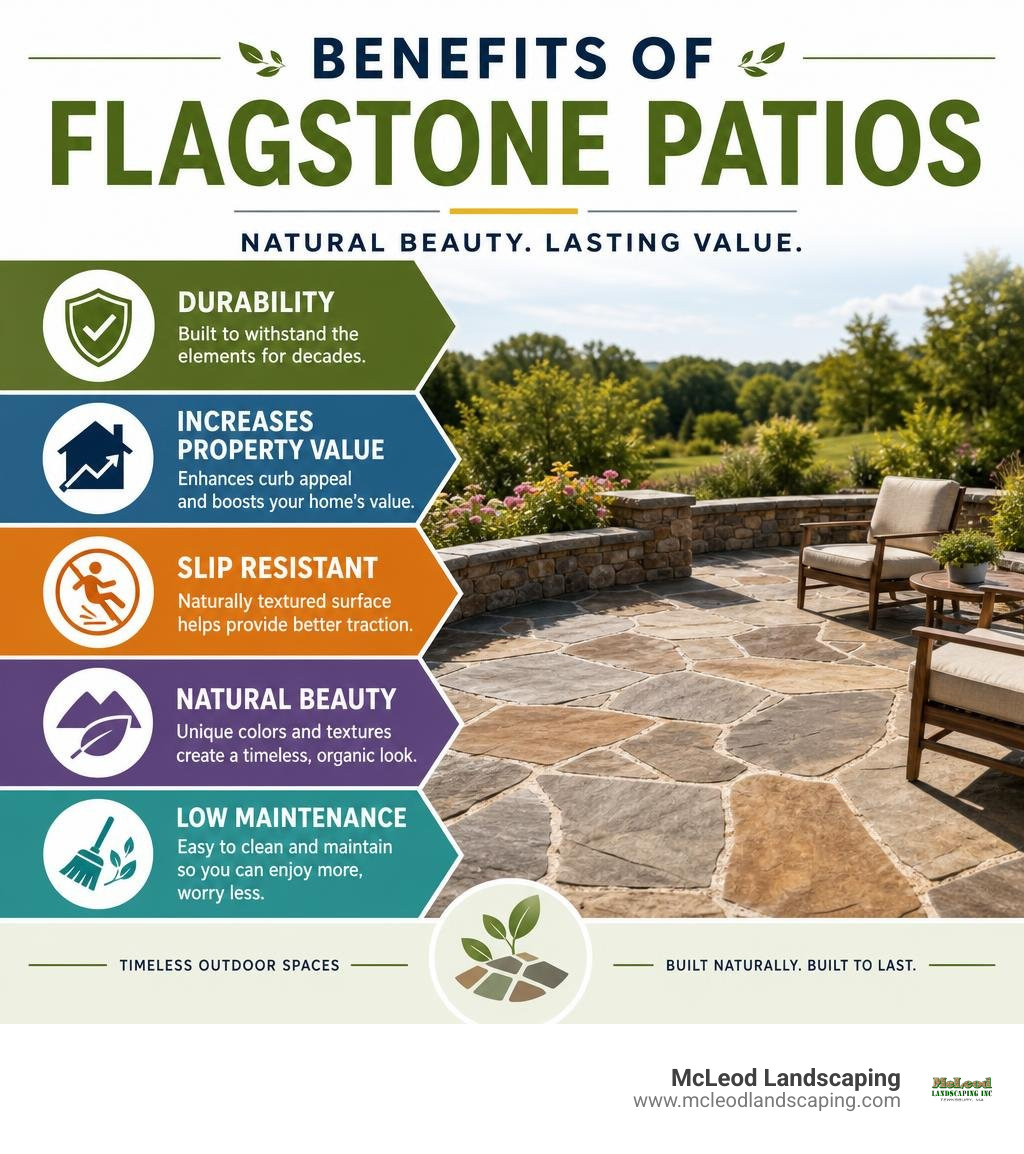
Flagstone is a broad term for flat, thin slabs of natural sedimentary rock that are quarried and split along natural planes. Unlike manufactured concrete pavers, every single piece of flagstone is completely unique. This natural stone brings an organic, high-end look to backyards that synthetic materials simply cannot replicate.
Homeowners in the Merrimack Valley love flagstone because it blends seamlessly into our historic New England landscapes. Whether you own a colonial home in Concord, MA, or a contemporary property in Andover, MA, a flagstone patio coordinates beautifully with old-growth trees, stone walls, and lush gardens.
Beyond its striking natural aesthetics, flagstone is incredibly popular for several practical reasons:
When planning your backyard transformation, selecting the right type of stone is crucial. Different stones offer unique colors, textures, and performance characteristics:
These stones can be cut into precise geometric shapes (known as “patterned” or “dimensional” flagstone) for a clean, modern look, or left in their irregular, organic shapes (known as “stand-up” or “crazy paving”) for a rustic, naturalistic aesthetic.

Finding the right contractor is the single most important step of your patio project. Because natural stone is irregular in both thickness and shape, installing it requires a high level of artistry and technical masonry skill.
When searching for flagstone patio installers near me in the Merrimack Valley, start by looking for local contractors with deep roots in the community. Local pros understand the regional soil composition—such as the heavy clay found in parts of Lowell, MA, or the rocky, sandy soil of Westford, MA—and how to prep the ground accordingly.
Always verify that any contractor you consider has the following credentials:
For a great starting point, you can research regional directories and check out the Top 10 Best Stone and gravel pros in Burlington, MA | Angi to see how local masonry specialists are rated by your neighbors. To learn more about what to look for in a professional hardscaping team, explore our guide on finding Patio Contractors Near Me.
Before signing a contract, schedule an on-site consultation and ask these essential questions:
To help you prepare for these conversations, read our expert advice on screening Patio Design Companies Near Me.
It can be tempting to view a flagstone patio as a fun weekend DIY project. However, laying natural stone is a highly demanding craft. Here is why hiring professionals is almost always the smarter, safer, and more cost-effective choice in the long run:
Discover how professional installers save your hardscape by reading about our Patio Installers and Walkway Wizards to Save Your Hardscape.
There are two primary methods for installing a flagstone patio: wet-laid (installed on a reinforced concrete slab) and dry-laid (installed on a compacted gravel and sand base). Both methods have their advantages, and the right choice depends on your aesthetic preferences, budget, and yard conditions.
In this method, a 4-inch concrete slab reinforced with wire mesh or rebar is poured first. Once cured, the flagstones are mortared directly onto the concrete base, and the joints are filled with mortar.
This method involves excavating the soil, laying down a geotextile fabric, adding 4 to 6 inches of crushed gravel (such as CR6 or stone dust), compacting it thoroughly, adding a thin sand leveling layer, and laying the flagstones on top. The joints are then filled with polymeric sand or stone dust.
Here is a quick comparison to help you decide:
| Feature | Wet-Laid (Concrete Base) | Dry-Laid (Gravel Base) |
|---|---|---|
| Primary Aesthetic | Formal, polished, uniform | Rustic, natural, organic |
| Permeability | Non-permeable (requires sloped runoff) | Highly permeable (natural drainage) |
| Weed Resistance | 100% weed-proof | High (when using polymeric sand) |
| Repairability | Difficult (requires chipping mortar) | Easy (individual stones can be lifted) |
| Freeze-Thaw Flexibility | Rigid (can crack if base shifts) | Flexible (moves naturally with soil) |
To learn more about how professionals prepare the ground for stone installations, check out our insights on Paver Patio Contractors.

Please note: The pricing details listed below are average costs based on regional internet data and are not the actual project costs for McLeod Landscaping. Every property has unique site conditions, accessibility, and design requirements that affect the final estimate.
When planning your budget, it helps to understand the typical cost ranges associated with natural stone hardscaping. According to general internet data, a professional flagstone patio installation typically ranges from $25 to $85+ per square foot.
However, because flagstone projects are highly customized, prices can vary drastically. For basic, straightforward dry-laid installations with highly accessible yards, costs may start on the lower end of that spectrum. On the other hand, complex, multi-tiered wet-laid patios featuring premium Pennsylvania bluestone, intricate custom stone cutting, built-in features, or challenging sloped terrain can range up to $180 to $270+ per square foot (representing the high end of premium masonry work, which is at least 3x the average pricing of standard installations).
Several key factors impact the final cost of your project:
For a deeper dive into hardscaping budgets, check out our detailed breakdown of Paver Patio Cost Installed.
Most residential flagstone patio projects are completed within one to two weeks. The exact timeline depends on the patio’s size, design complexity, site preparation needs, and weather conditions.
A typical project timeline follows these phases:
If you are opting for a wet-laid patio, we also have to account for the concrete base’s curing time before we can begin mortaring the stones in place. For more details on project timelines, read about our Outdoor Patio Builders Near Me.
One of the best things about flagstone is how low-maintenance it is. However, to keep it looking pristine for decades, you should perform some basic upkeep:
Learn more about long-term patio care from our team of experts at Patio Companies.
Here in Massachusetts, our patios endure extreme temperature swings—from scorching summer heat to freezing winter blizzards. This constant freezing and thawing causes the ground to expand and contract (frost heaving).
Fortunately, high-quality natural stone like Pennsylvania bluestone handles these cycles beautifully.
To protect your stone in the winter, avoid using harsh chemical de-icers or rock salt, which can penetrate the stone’s pores and cause pitting or flaking. Instead, use plain sand for traction. For more advice on designing patios built to withstand New England winters, consult our Patio Design Contractors Near Me guide.
A flagstone patio is a beautiful, long-term investment that transforms your backyard into a stunning outdoor retreat. Whether you want a cozy spot for family barbecues in Tewksbury, MA, or an expansive entertainment space in Carlisle, MA, choosing professional installation ensures your patio remains level, beautiful, and structurally sound for decades.
At McLeod Landscaping, we bring over 30 years of hardscaping experience to every project. We are proud to serve homeowners and businesses throughout the Merrimack Valley, including Andover, Billerica, Burlington, Carlisle, Chelmsford, Concord, Lowell, Tewksbury, Westford, and Wilmington, MA. Our team handles every step of the process—from custom design and excavation to precise stone cutting and final cleanup—with the highest level of craftsmanship and care.
Ready to upgrade your outdoor living space with a gorgeous natural stone patio? Schedule your professional patio installation services today and let’s build something beautiful together!
Contact McLeod Landscaping today at (978) 640-0957 or click here to schedule a consultation for retaining wall installation. Let our experienced team design and install a functional and visually appealing retaining wall that enhances your landscape.


1881 Main St Unit 1, Tewksbury, MA 01876