
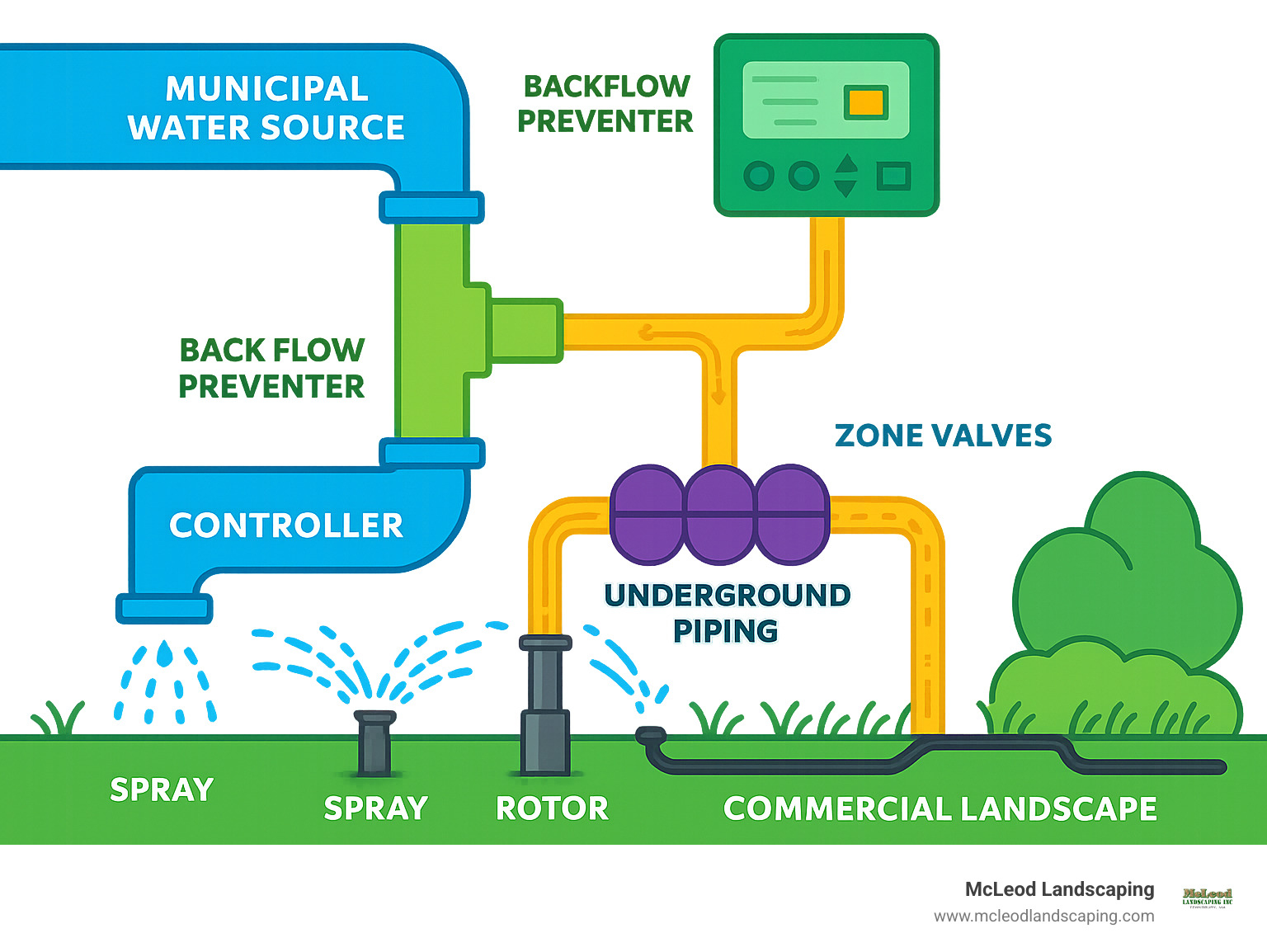
Irrigation sprinkler systems are automated watering solutions that deliver precise amounts of water to landscapes through a network of pipes, valves, and sprinkler heads controlled by programmable timers. Here’s what you need to know:
Key Components:
Main Benefits:
Most commercial systems require 40-65 PSI water pressure and are designed with multiple zones to ensure uniform coverage across different landscape areas.
For commercial property managers in the Merrimack Valley, a properly designed irrigation system isn’t just convenient – it’s essential for maintaining the professional appearance that keeps tenants and visitors satisfied while reducing long-term maintenance costs.
As Scott McLeod, owner of McLeod Landscaping with over 30 years of experience, I’ve designed and installed irrigation sprinkler systems for more than 200 commercial properties throughout the Boston area. My team specializes in creating efficient, reliable systems that keep commercial landscapes thriving year-round while minimizing water waste and maintenance headaches.
Similar topics to irrigation sprinkler systems:
Think of irrigation sprinkler systems as the circulatory system of your landscape. When every part works together, water reaches exactly where it’s needed—no more, no less.
Key Parts (Quick View)
For a deeper dive into system layout principles, see The Importance of a Well-Designed Commercial Irrigation System and How Does an Irrigation Sprinkler System Work?.
Before we choose a single sprinkler head, we measure:
If pressure or flow is low, we may recommend a booster pump or more—but only after simple tests using a gauge and a 5-gallon bucket. (DIYers can find step-by-step instructions in How to Install a Sprinkler System.)
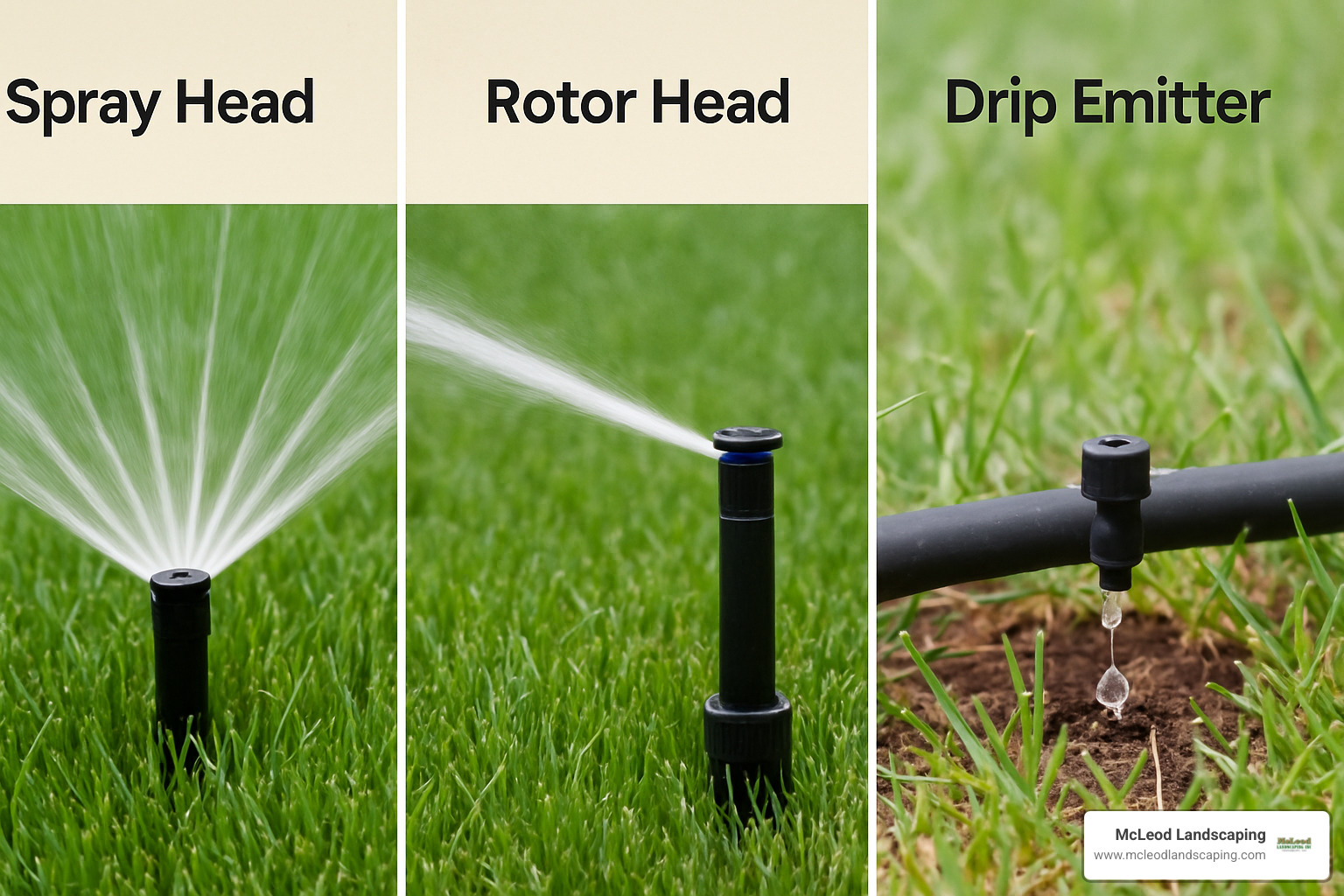
Each head type has a sweet spot:
For specification sheets and best-practice tips, visit our Commercial Irrigation Sprinkler Heads.
| Head Type | Spray Radius | Application Rate | Best Use |
|---|---|---|---|
| Fixed Spray | 8-12 ft | 1.5-2.0 in/hr | Small turf, tight spots |
| Rotary Nozzle | 25-30 ft | 0.4-0.6 in/hr | Medium turf, slopes |
| Gear Rotor | 25-35 ft | 0.3-0.5 in/hr | Large turf areas |
| Impact | 15-30 ft | 0.2-0.4 in/hr | Large open areas |
| Drip Emitter | 1-3 ft | 0.5-2.0 GPH | Beds, trees |
| Bubbler | 3-5 ft | 2-10 GPH | Tree wells |
Manual timers still exist, but most commercial properties now rely on:
Get the full rundown in The Benefits of Installing a Smart Irrigation System or browse our line-up of Commercial Irrigation Controllers.
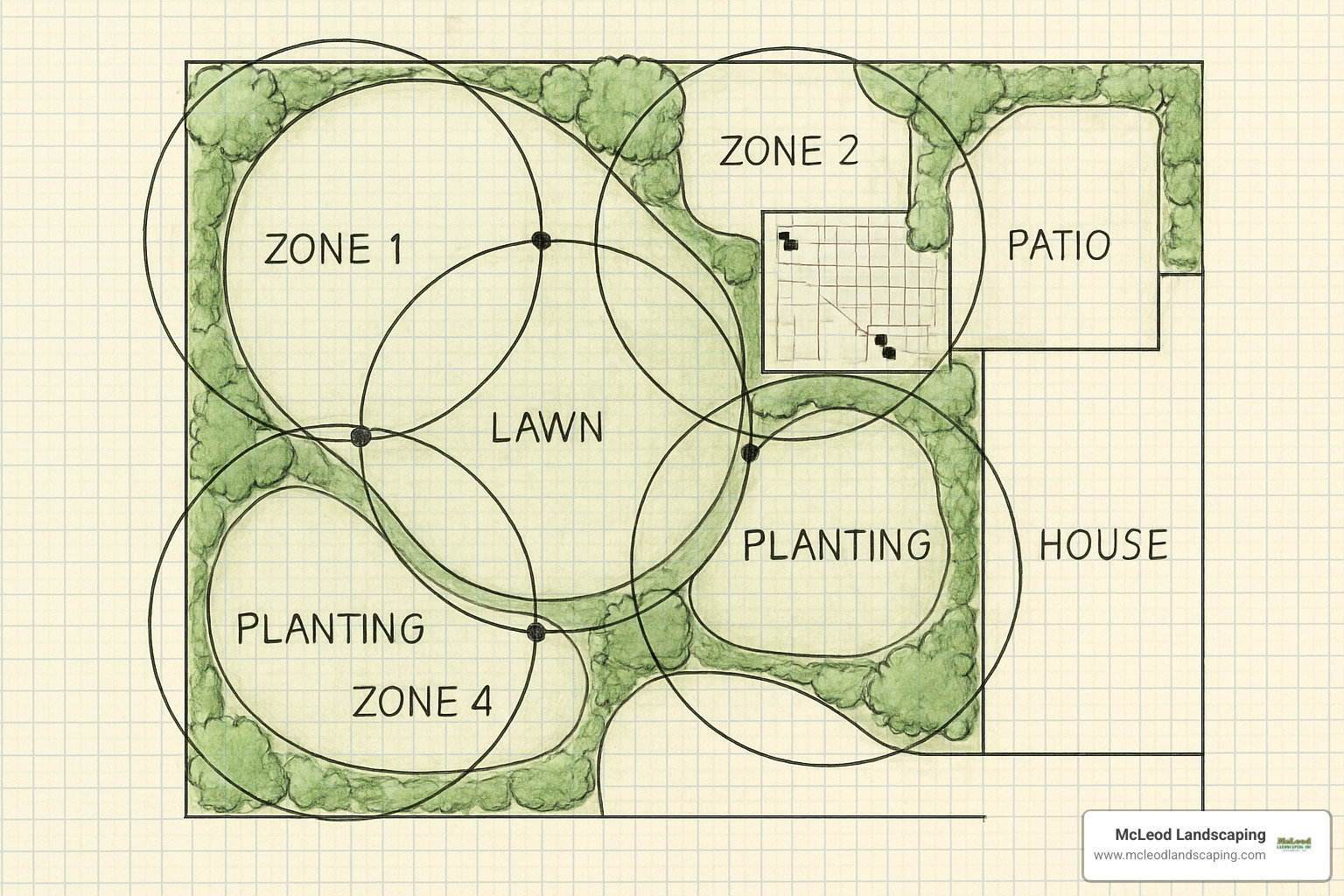
Creating a reliable system is like drafting a blueprint for a building—good plans prevent expensive fixes later. We keep three principles front-of-mind:
For more on layout fundamentals, see Commercial Irrigation System Design and Putting in a Lawn Sprinkler System.
Mapping your property (even on graph paper) highlights sun vs. shade, slopes, soil types, and obstacles. Those factors dictate zone locations and run-times. Our guide, Choosing the Right Irrigation System for Your Landscape, walks you through the basics.

DIYers can follow How to Install In-Ground Irrigation System or our simplified Lawn Sprinkler Installation checklist.
Need a visual on the full process? See How Are Irrigation Systems Installed?.
A professional tune-up a few times each season costs far less than emergency calls. During a routine walk-through we:
Full details live on our Lawn Sprinkler System Maintenance and Irrigation System Repair pages.
Learn how these steps align with EPA WaterSense best practices at epa.gov/watersense.
| Symptom | Likely Cause | Quick Fix |
|---|---|---|
| Low spray distance | Partially closed valve or dirty filter | Open valve, clean filter |
| Dry patch in lawn | Clogged or mis-aligned head | Flush/realign head |
| Zone won’t start | Broken wire or bad solenoid | Check continuity, replace solenoid |
| Pooled water | Leaking pipe or valve | Locate leak, repair section |
Step-by-step guides are available at Fix Lawn Sprinkler System or Troubleshooting Common Issues with Commercial Sprinkler Systems.
When considering irrigation sprinkler systems for your commercial property, understanding the financial picture helps you make the smartest decision for your business. The initial investment might seem significant, but the long-term benefits often make it one of the most valuable improvements you can make to your property.
The choice between DIY vs. professional installation is particularly important for commercial properties. While a DIY approach might appear to save money upfront, commercial irrigation systems involve complex hydraulic calculations, electrical work, and local code requirements that can quickly overwhelm even experienced property managers. Professional installation ensures your system operates efficiently from day one and comes with warranties that protect your investment.
Permit requirements add another layer of complexity to commercial installations. Most municipalities require permits for irrigation systems, and the application process involves detailed plans and inspections. Professional installers handle these requirements as part of their service, saving you time and ensuring compliance with local regulations.
The long-term water savings from properly designed systems are impressive. Smart controllers and efficient sprinkler heads can reduce water usage by 30% or more compared to manual watering methods. For commercial properties with large landscape areas, these savings add up to thousands of dollars annually.
The ROI from smart systems is particularly compelling. Rain sensors provide an average 87% return on investment within the first year, while soil moisture sensors achieve an remarkable 200% ROI in the same timeframe. These technologies pay for themselves quickly while maintaining healthier landscapes.
For more detailed information about system value and costs, visit How Much to Install an Irrigation System and Are Lawn Sprinkler Systems Worth It?.
Several key factors influence the investment required for commercial irrigation sprinkler systems. Understanding these variables helps you budget appropriately and make informed decisions about features that provide the best value for your specific property.
System size is the primary cost driver. Larger properties naturally require more materials – additional pipe, more zones, and greater numbers of sprinkler heads. A small office building might need a relatively simple system, while a large industrial complex or shopping center requires extensive coverage with multiple zones and sophisticated controls.
Property complexity significantly affects both design and installation costs. Properties with slopes, multiple landscape types, existing mature trees, or challenging soil conditions require more specialized equipment and installation techniques. Underground utilities, tight spaces, and accessibility issues can also increase labor requirements.
Component quality ranges from basic residential-grade materials to heavy-duty commercial components designed for continuous operation and longevity. While premium components cost more initially, they typically provide better reliability and lower maintenance costs over time. Smart controllers, high-efficiency nozzles, and commercial-grade valves represent worthwhile investments for most commercial properties.
Labor rates vary based on regional markets and contractor expertise. Experienced commercial irrigation contractors command higher rates but deliver superior results through proper design, efficient installation, and comprehensive testing. The complexity of commercial systems makes skilled installation essential for long-term performance.
Please note: The following figures are based on general industry data and do not represent a quote from McLeod Landscaping. Average costs for commercial irrigation sprinkler systems can range from $4,000 for smaller commercial lots to over $30,000 for large, complex properties, depending on specific needs and features.
For current pricing information specific to your project, visit Average Cost for Lawn Irrigation System.

When property managers ask about irrigation sprinkler systems, they’re usually choosing between two main approaches, each with distinct advantages for different landscape areas.
Sprinkler systems work beautifully for large turf areas because they mimic natural rainfall through overhead water distribution. Think of them as your landscape’s personal rain cloud – they provide uniform coverage across lawns, sports fields, and open landscape areas where consistent watering is essential.
Drip irrigation takes a completely different approach, delivering water directly to plant roots through small emitters. This method is incredibly efficient for garden beds, shrubs, and trees because it eliminates the water loss that comes from evaporation and runoff. Plus, plants love getting water right where they need it most.
Here’s the thing – you don’t have to choose just one system. Most successful commercial properties use both types strategically. We typically design sprinkler systems for turf areas and drip irrigation for planting beds, creating a comprehensive watering solution that maximizes efficiency while keeping maintenance simple.
The standard answer is that most landscapes need 1 to 2 inches of water per week, but honestly, that’s just the starting point. Your actual watering needs depend on several factors that make each property unique.
Grass type plays a huge role – cool-season grasses like fescue need different amounts than warm-season varieties. Soil conditions matter tremendously too. Sandy soils drain quickly and require more frequent watering, while clay soils hold moisture longer and need less frequent but deeper watering sessions.
The secret to healthy landscapes is watering deeply and infrequently rather than giving your property light, frequent drinks. Deep watering encourages roots to grow down into the soil, creating drought-resistant plants that can handle stress better. Shallow, frequent watering does the opposite – it creates weak root systems and increases disease problems.
This is where smart controllers really shine. Instead of guessing when to water, these systems automatically adjust based on real-time weather conditions, soil moisture levels, and what your specific plants actually need. For detailed watering guidelines specific to your situation, visit How often should I water my lawn with sprinkler system?.
I get this question a lot, and I understand the appeal of DIY installation – it seems like a great way to save money upfront. But irrigation sprinkler systems involve much more than just connecting some pipes and sprinklers.
Professional installation brings expertise in hydraulics, electrical work, and local codes that most property managers don’t have time to master. We ensure your system is designed for maximum efficiency from day one, handle all the permit applications and code compliance requirements, and provide warranty protection on both materials and labor.
More importantly, we help you avoid costly mistakes that can damage your property or create ongoing problems. I’ve seen DIY systems that flood basements, damage foundations, or waste thousands of gallons because of improper design or installation.
For commercial properties especially, professional installation becomes even more critical. You’re dealing with complex requirements, liability concerns, and the need for reliable performance that affects your property’s appearance and value. Plus, we provide ongoing maintenance and repair services, so you have a partner for the long term rather than just a one-time installation.
The initial investment in professional installation pays for itself through proper system design, reliable operation, and access to commercial-grade components that last longer and perform better than residential alternatives.
Irrigation sprinkler systems represent a smart investment for commercial properties throughout the Merrimack Valley. These automated systems provide efficient watering that maintains healthy landscapes while conserving water and reducing maintenance costs – exactly what today’s property managers need.
The key to success lies in professional design that considers your property’s unique characteristics. From soil conditions and sun exposure to plant requirements and water supply limitations, every detail matters. Expert installation ensures your system operates reliably for years while meeting all safety and code requirements.
Think of it this way: you wouldn’t trust just anyone to handle your building’s electrical or plumbing systems. Your irrigation system deserves the same level of professional attention. After all, it’s protecting one of your most visible assets – your landscape.
At McLeod Landscaping, we’ve spent over 30 years perfecting irrigation system design and installation for commercial properties in Andover, Billerica, Burlington, Carlisle, Chelmsford, Concord, Lowell, Tewksbury, Westford, and Wilmington. Our comprehensive approach includes initial design, professional installation, and ongoing maintenance to keep your landscape thriving through every season.
For commercial properties in the Merrimack Valley, a well-designed irrigation system isn’t just a nice-to-have – it’s a critical asset that protects your landscape investment while reducing long-term operating costs. Our team provides complete design, installation, and maintenance services to ensure your property always looks its best, whether you’re welcoming tenants, customers, or visitors.
Ready to explore how irrigation sprinkler systems can transform your commercial property? Learn more about our commercial irrigation systems and find how we can help you achieve the efficient, beautiful landscape your property deserves. Your future self (and your water bill) will thank you.
Contact McLeod Landscaping today at (978) 640-0957 or click here to schedule a consultation for retaining wall installation. Let our experienced team design and install a functional and visually appealing retaining wall that enhances your landscape.


1881 Main St Unit 1, Tewksbury, MA 01876