Why Granite Rock Retaining Walls Stand the Test of Time
A granite rock retaining wall is a durable structure built from natural granite to hold back soil, prevent erosion, and create functional outdoor spaces. Here’s a quick overview:
Quick Overview: Granite Rock Retaining Wall Essentials
Best For: Properties needing long-lasting, low-maintenance walls with natural beauty
Cost Range: $25-$750+ per boulder on average (based on internet data; please note these are not actual McLeod Landscaping prices and costs vary by project)
For sloped terrain, granite offers a solution that stands the test of time. Unlike timber that rots or concrete blocks that crack, granite is a strong, heavy stone that doesn’t alter soil acidity and comes in many natural hues. A properly installed granite wall can last for centuries.
A wall’s longevity hinges on three factors: proper foundation preparation, correct drainage installation, and strategic stone placement. Whether you choose natural boulders or cut blocks, understanding these fundamentals is key to a successful project.
As Scott McLeod, owner of McLeod Landscaping Inc., I’ve spent over 30 years designing and installing granite rock retaining walls in the Merrimack Valley. We help property owners transform challenging slopes into beautiful, functional landscapes. Our team understands the region’s unique soil and building requirements, ensuring every wall is engineered for beauty and longevity.
Granite is a top choice for retaining walls that stand the test of time, combining immense strength with natural beauty. It’s a preferred material for homeowners and property managers throughout the Merrimack Valley.
Primary Uses and Benefits
While any retaining wall holds back soil, a granite rock retaining wall offers benefits far beyond basic function.
Erosion Control and Soil Retention: Granite’s weight and strength make it highly effective at stabilizing slopes and preventing soil runoff, which protects your landscape, foundations, and topsoil.
Creating Terraced Gardens and Level Yards: On properties with varied topography, like those in Concord, MA, and Carlisle, MA, granite walls can transform steep inclines into usable, level areas for gardens, patios, or play spaces.
Property Landmarks and Aesthetic Improvement: With diverse natural hues and textures, granite adds a timeless touch to any landscape. It can serve as a striking landmark, a backdrop for planting beds, or a feature for outdoor living areas.
Adding Value: A well-built granite wall is an investment that improves property beauty and function, potentially increasing its value. Landscape redesigns that include retaining walls can offer an average of 105% value recovery. For more ideas, explore our backyard retaining wall ideas.
Beyond its structural prowess, granite is also an environmentally friendly choice. It’s a strong, heavy stone that does not change soil acidity, ensuring your plants thrive naturally. Its longevity also means less need for replacement materials over time, reducing environmental impact.
Types of Granite for Retaining Walls
Granite isn’t just one type of stone; it comes in various forms, each offering distinct characteristics suitable for different retaining wall designs.
Granite Boulders: These are natural, often rounded stones shaped by geological forces. In areas like Andover, MA, and Westford, MA, we find beautiful local granite boulders whose organic shapes create a rustic look. They often feature moss and lichens, adding to their natural appeal. Boulder costs can range from $25.00 to $750.00 or more, depending on rarity and size. Please note these are average costs based on internet data and not actual McLeod Landscaping prices.
Cut Granite Blocks: For a more formal, structured appearance, cut granite blocks are an excellent choice. These are quarried and then cut into uniform sizes and shapes, allowing for precise stacking and a clean, architectural finish. Their consistency makes installation more predictable and provides a sleek, modern aesthetic.
Fieldstone: While not exclusively granite, fieldstone often includes granite components and is a popular choice in the Merrimack Valley. It refers to naturally occurring stones, often found in fields, that are typically irregular in shape and size. These offer a charming, rustic appeal, ideal for blending seamlessly into natural landscapes.
Each type offers unique visual and structural qualities that we consider when designing your perfect wall. If you’re leaning towards a more natural, rugged look, our team can help you source and install a stunning boulder retaining wall that harmonizes with your landscape.
Key Selection Criteria: Boulders vs. Cut Blocks
Choosing between boulders and cut blocks involves several factors:
Aesthetics: Boulders offer a rugged, natural look, while cut blocks provide clean lines for a formal, architectural appearance.
Installation Complexity: Large boulders require heavy machinery and skilled operators for placement. The uniform nature of cut blocks can simplify installation, but both require precision.
Structural Stability: Both can be incredibly stable when installed correctly. Boulders rely on their sheer weight and interlocking placement with a slight backward lean (batter). Cut blocks can be stacked with or without mortar, and their uniform nature can facilitate reinforcement with techniques like geogrid for taller walls.
Cost Differences: Generally, large boulders can be more expensive per unit due to their weight and the specialized equipment needed for transport and placement. However, cut blocks can also be a significant investment. The cost can fluctuate widely depending on sourcing, size, and project complexity.
Design Flexibility: Cut blocks offer more control over precise dimensions and curves, making them suitable for intricate designs. Boulders, while less predictable, can create unique, flowing lines and naturalistic features.
When considering the use of large boulders, our large boulder retaining walls guide offers an in-depth look at their benefits and considerations.
Planning Your Granite Rock Retaining Wall Project
A successful granite rock retaining wall begins with meticulous planning. We consider the project’s scope, budget, local regulations, materials, and design to ensure a smooth build.
Before You Dig: Codes, Permits, and Planning
Skipping this critical step can lead to costly delays, fines, or even wall removal.
Checking Local Building Codes: Municipalities in the Merrimack Valley, like Tewksbury and Lowell, have specific regulations. Walls over 3 to 4 feet typically require a building permit and an engineer’s design, which we always verify early on. For instance, many cities provide detailed guidelines online, similar to the Retaining Wall Standards provided by the City of Cincinnati, which outline compliance requirements.
Homeowner’s Association (HOA) Rules: If you live in a community with an HOA, they might have additional restrictions on wall height, materials, or aesthetic guidelines. We’ll help you steer these to ensure compliance.
Calling 811 to Mark Utilities: Always call 811 a few days before you plan to dig. This free service ensures that underground utility lines (gas, water, electric, communication) are marked, preventing dangerous and expensive accidents.
Proper planning is the bedrock of a long-lasting wall. For a comprehensive overview of the entire process, our retaining wall installation guide is an excellent resource.
Estimating Materials and Costs
Accurate material estimation is key to staying on budget and avoiding delays.
Calculating Stone Quantity: This depends on the wall’s dimensions and the type of granite you choose. For cut blocks, we calculate the face area and factor in the block dimensions. For boulders, it’s more about tonnage. For each square foot of wall face area, you’ll need approximately 0.4 cubic feet of crushed stone for the base and 0.35 cubic feet of gravel backfill.
Ordering Extra Stone: We recommend ordering 10-20% extra stone to account for cuts, compaction, and irregular shapes, especially with natural boulders. Having extra on hand prevents project delays.
Average Granite Boulder Costs: Based on internet data, individual granite boulder costs can range from $25.00 to $750.00+ each, depending on size, weight, rarity, and transport distance. Please note these are average costs from internet data and not actual McLeod Landscaping prices. For a more detailed understanding of potential expenses, you might find our article on how much does a retaining wall cost helpful.
Essential Tools and Materials Checklist
Building a granite rock retaining wall is a labor of love (and heavy lifting!). Here’s a basic checklist of what we’ll typically need:
Granite Rock: Boulders or cut blocks, depending on your design.
Crushed Stone: For the base and drainage. We recommend a clean, compactable granular material, like 3/4-inch crushed stone.
Landscape Fabric: To separate the drainage layer from the surrounding soil, preventing clogging.
Perforated Drain Pipe: Essential for managing hydrostatic pressure behind the wall.
Shovel and Pickaxe: For excavation and shaping.
Wheelbarrow or Skid Steer: For moving heavy materials. For large granite, a skid steer or excavator is often essential.
4-foot Level and String Line: To ensure straight and level courses.
Tamper or Plate Compactor: For compacting the base and backfill materials.
Mallet or Dead Blow Hammer: For adjusting stones.
Mason’s Line: For guiding straight lines.
Safety Gear: Gloves, safety glasses, steel-toed boots are non-negotiable.
Masonry Adhesive: For securing capstones.
How to Build a Granite Rock Retaining Wall: A Step-by-Step Guide
Building a granite rock retaining wall is a substantial but rewarding project. We follow key steps to ensure a strong, beautiful, and long-lasting structure.
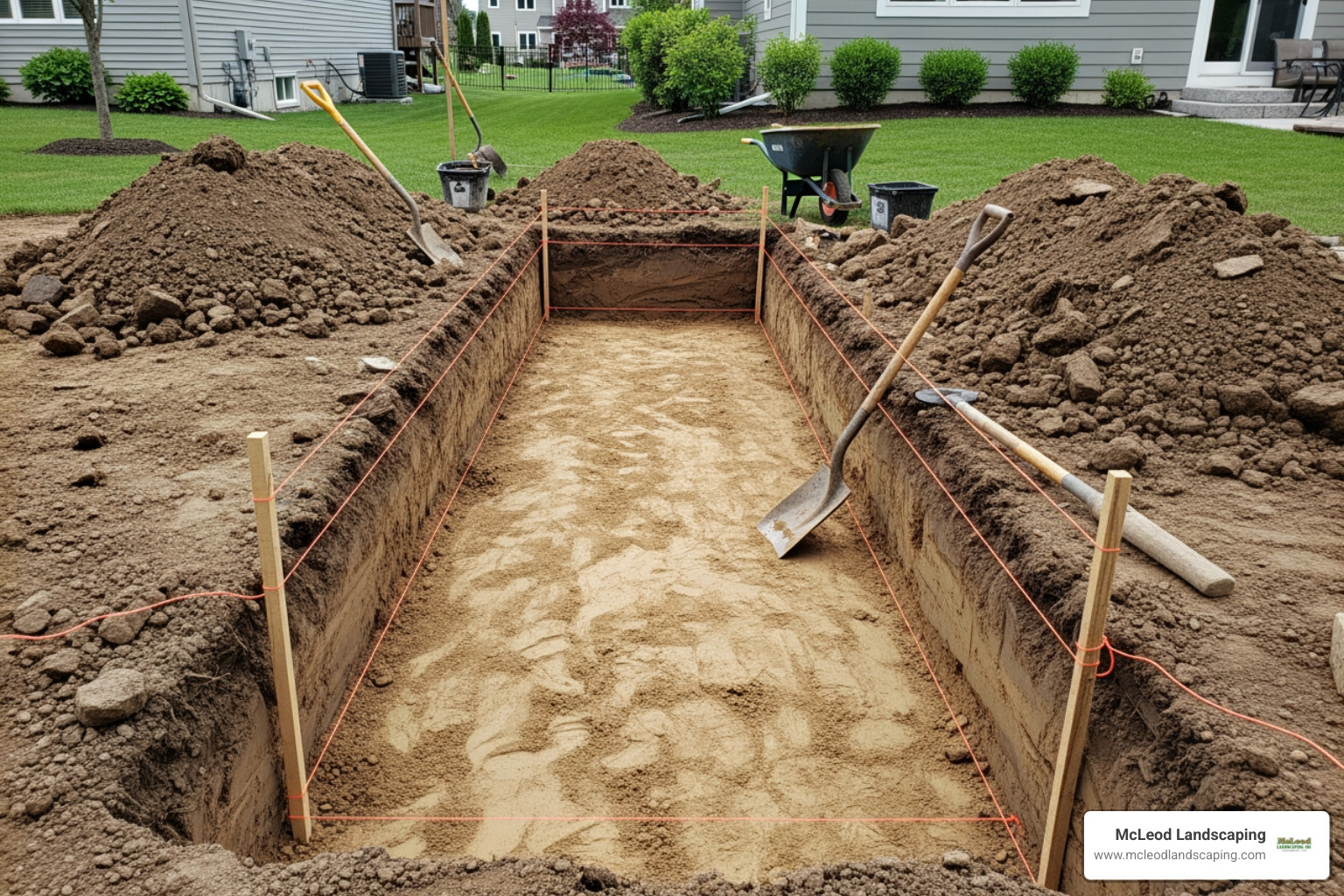
Step 1: Site Preparation and Excavation
A well-prepared site is foundational to the wall’s stability.
Clearing Vegetation: First, we remove all surface vegetation, organic materials, and debris from the wall’s path. Organic matter can decompose and cause settlement, compromising the wall’s integrity.
Marking the Wall Layout: We use stakes and a string line (or a garden hose for curves) to precisely mark the wall’s intended path. This ensures accuracy and helps visualize the final structure.
Trench Excavation: We excavate a trench deep and wide enough for the wall’s base. A general rule is one inch of depth for each foot of wall height, plus 4-6 inches for the base material. For a 3-foot wall, this means a trench at least 7-9 inches deep. The width should be at least one foot for smaller walls, and wider for larger ones. For walls under 4 ft. (1.2 m), an 18 in. (460 mm) wide by 10 in. (250 mm) deep trench with 4 in. (100 mm) of base material is acceptable. The trench bottom must be firm, undisturbed, and compacted soil.
Step 2: Installing a Solid Foundation
The foundation is the most critical part of the retaining wall, as any instability here compromises the entire structure.
Laying Landscape Fabric: We line the bottom and sides of the excavated trench with heavy-duty landscape fabric. This prevents the base material from mixing with the surrounding soil, maintaining drainage efficiency.
Adding Base Material: We then add a layer of clean, compactable granular material, typically 3-6 inches deep, such as 3/4-inch crushed stone. This layer provides a stable, free-draining base.
Compacting the Base: Using a hand tamper or plate compactor, we compact the base in 2-inch layers until it is firm and level. This crucial step prevents issues as the wall gets higher. We check for level in all directions, as a perfect base is non-negotiable for a long-lasting retaining wall installation.
Step 3: Laying the Granite Courses
Placing the Base Course: We start with the largest and heaviest granite stones for the first course, embedding them firmly into the compacted base for maximum stability.
Setting Each Course Back (Batter): For stability, each course is set back slightly into the slope. This “batter” creates a lean that resists soil pressure. A good rule is about 1 inch of batter for every vertical foot of wall height.
Offsetting Vertical Seams: For structural integrity, we always offset the vertical seams between blocks. Each stone should bridge the joint of the two stones below it, creating an interlocking pattern similar to brickwork.
Using Shims for Leveling: With natural granite boulders, we use smaller, flat stones or shims to level individual stones within a course and ensure a tight fit. We check each stone with a level as we go.
Using ‘Deadmen’ Anchors for Taller Walls: For taller granite walls (especially those over 3 feet), we may incorporate “deadmen” – long rocks that extend back into the slope, perpendicular to the wall face. These act as anchors, tying the wall into the hillside for added stability.
Step 4: Ensuring Proper Drainage and Backfilling
Proper drainage is paramount to prevent hydrostatic pressure—water buildup behind the wall that can cause bulging or failure.
Installing a Perforated Drain Pipe: At the base of the wall, directly behind the first course, we install a perforated drain pipe. We ensure it’s sloped to direct water away from the wall to a discharge point (daylighting).
Backfilling with Drainage Gravel: With each course, we backfill at least 12 inches behind the wall with clean drainage gravel (like 3/4-inch crushed stone). This permeable layer lets water flow to the drain pipe, preventing soil saturation. Hollow cores of modular blocks are also filled with gravel. Never use sand for drainage.
Compacting Backfill in 8-inch Lifts: We place the remaining backfill soil in layers no more than 8 inches thick, compacting each layer thoroughly. This prevents future settlement and ensures the soil mass behind the wall is dense and stable. This step is crucial for managing hydrostatic pressure and ensuring the long-term stability of your retaining wall drainage.
Step 5: Finishing the Wall
Placing Heavy, Flat Capstones: Once the final course is laid, we install capstones. These are typically heavier, flatter granite pieces that provide a finished look and protect the top of the wall from water penetration.
Securing Caps with Masonry Adhesive: We secure the capstones with a strong, flexible masonry adhesive to prevent shifting.
Final Grading Behind the Wall: We carefully grade the soil behind the finished wall, sloping it away from the top. This directs surface water away, further preventing it from saturating the backfill. This area is then ready for landscaping. Learn more about planting on top of retaining wall for aesthetic integration.
Advanced Considerations and Maintenance
While a well-built granite rock retaining wall is durable, some projects require specialized expertise and care.
When to Call an Engineer: Tall Walls and Reinforcement
For taller walls or those on complex sites, professional engineering is often legally required.
Walls Over 3-4 Feet: Most building codes, including those in the Merrimack Valley, require a permit and an engineer’s design for retaining walls over 3 to 4 feet high. Taller walls exert immense pressure and require precise calculations for stability.
Geogrid Reinforcement: For taller walls or those on weak soil, geogrid reinforcement is essential. These synthetic meshes are embedded in the soil behind the wall, creating a reinforced soil mass that increases strength and stability. Geogrid is used when a wall’s height exceeds what gravity alone can support. For detailed insights, you can refer to resources like Building a Reinforced Retaining Wall.
Surcharges: If there will be additional weight on the soil behind the wall—such as a driveway, patio, or pool—this is a “surcharge.” Surcharges add extra pressure that must be accounted for in the wall’s design.
Poor Soil Conditions or Steep Slopes: Weak, expansive, or saturated soils, or unusually steep slopes, can create complex engineering challenges. An engineer can design a wall that can safely withstand these conditions.
For any project falling into these categories, consulting with experienced retaining wall contractors like us, who can coordinate with structural engineers, is the smartest approach.
Potential Challenges with a Granite Rock Retaining Wall
While granite has many benefits, it’s important to acknowledge its unique challenges:
Heavy Lifting and Equipment Needs: Granite is incredibly dense and heavy, requiring specialized equipment (excavators, skid steers) and trained operators for placement. This is a primary reason professional installation is often preferred over a DIY approach.
Sourcing Consistent Material: Especially with natural granite boulders, finding a consistent supply of stones that match in color, texture, and size can be a challenge. It requires experienced sourcing and a keen eye.
Higher Initial Cost: Due to its durability, aesthetic appeal, and the specialized labor and equipment required, a granite rock retaining wall often has a higher upfront cost than other materials. However, this is offset by its longevity and minimal maintenance.
Mitigating Challenges: The best way to overcome these challenges is to partner with an experienced retaining wall contractor. We have the equipment, expertise, and supplier relationships to handle granite projects efficiently and safely.
Long-Term Maintenance for Your Granite Rock Retaining Wall
A key benefit of a granite rock retaining wall is its low maintenance. A properly installed wall can last for generations with minimal upkeep.
Routine Inspections: We recommend periodic visual inspections (once or twice a year) to check for any signs of shifting, bulging, or settlement. Early detection allows for prompt remediation.
Ensuring Drainage Remains Clear: The drainage system is vital. Ensure the discharge point of your drain pipe remains clear of debris so water can flow freely away from the wall.
Cleaning Moss or Lichen (If Desired): Over time, granite may develop a patina of moss or lichen. Many find this charming, but it can be removed with a gentle scrubbing with water and a brush if you prefer a cleaner look. Avoid harsh chemicals.
Minimal Maintenance for Properly Built Walls: A professionally designed and installed granite wall requires almost no significant maintenance, making it an ideal solution for property owners in places like Burlington, MA, or Wilmington, MA. For insights into keeping your wall in top shape, check out our retaining wall repair guide 2025.
Frequently Asked Questions about Granite Retaining Walls
How long does a granite retaining wall last?
A properly constructed granite retaining wall can last for over 100 years, often for centuries. As a durable natural stone, granite resists weathering, decay, and pressure. It is largely unaffected by the freeze-thaw cycles common in the Merrimack Valley and won’t rot like timber. The wall’s longevity hinges on a quality installation, especially a solid, well-drained foundation, allowing it to stand for generations.
Can I build a granite retaining wall myself?
A DIY installation may be possible for small, decorative walls under 3 feet that aren’t retaining significant soil. However, due to granite’s extreme weight and the need for proper engineering, walls over 3-4 feet should be built by experienced professionals. Safely moving heavy stones requires specialized equipment and trained operators. Professional expertise is essential for understanding soil mechanics and drainage to prevent dangerous and costly structural failure, ensuring safety, code compliance, and a durable result.
What is the best base for a granite retaining wall?
The best base is a trench with at least 4-6 inches of compacted, clean, granular material, like 3/4-inch crushed stone. This material is compacted in layers to form a solid, level, and free-draining foundation. This base evenly distributes the granite’s weight, prevents settlement, and allows for drainage. A landscape fabric liner is used to separate the base from the native soil. A level, stable base is the most critical factor for a wall’s long-term stability.
Conclusion: Building a Legacy with Granite
A granite rock retaining wall is an investment in your property’s enduring beauty and stability. Its superior durability, natural aesthetic, and low maintenance make it an excellent choice for properties in the Merrimack Valley. By controlling erosion, creating usable space, and enhancing property value, granite truly stands the test of time.
Building with granite requires expertise in engineering and careful execution. While a small decorative wall might be a DIY project, any structural wall needs the expertise of a professional hardscaping team to ensure a flawless, long-lasting result.
At McLeod Landscaping, we bring over 30 years of experience to every project. We design and install beautiful, durable hardscapes, including granite rock retaining walls, suited to the unique landscapes of Andover, Chelmsford, Concord, and beyond. Our local knowledge and commitment to craftsmanship ensure your wall is built to last for generations.
Contact McLeod Landscaping today at (978) 640-0957 or click here to schedule a consultation for retaining wall installation. Let our experienced team design and install a functional and visually appealing retaining wall that enhances your landscape.